AI Futures Project Moves Superhuman AI Researcher Forecast to 2027
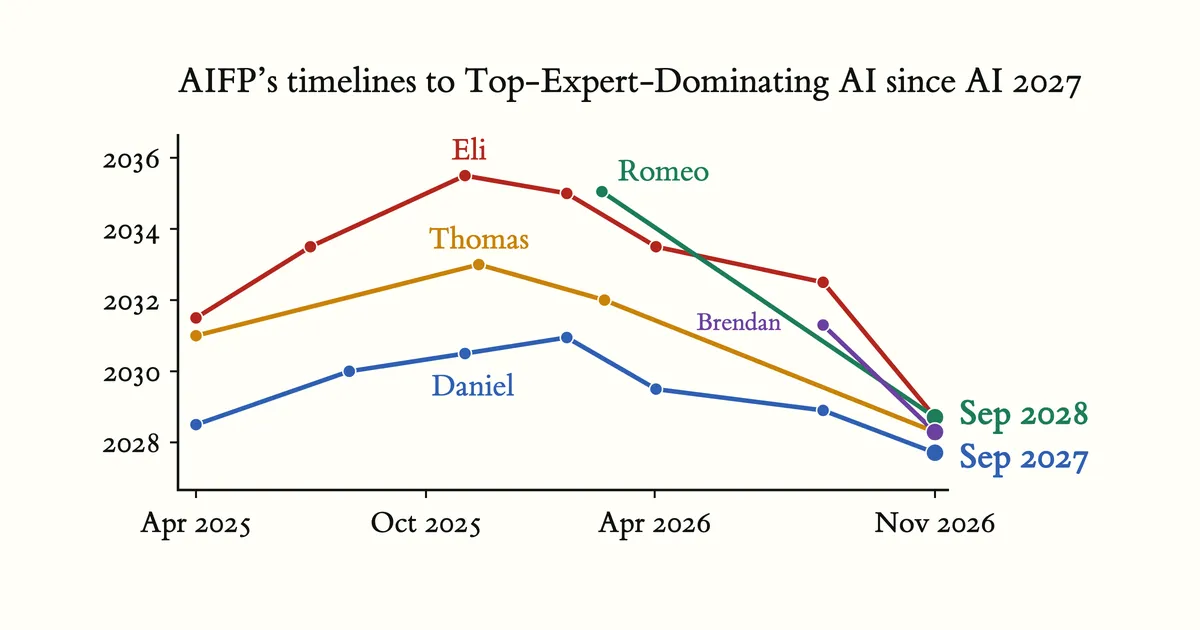
The AI Futures Project now forecasts that Superhuman AI Researcher, or SAR, will likely arrive at some point in 2027, following evidence that AI research progress may be accelerating faster than expected. The group also estimates a 35-65% chance that Top-Expert-Dominating AI will arrive before 2028.
- The AI Futures Project now expects SAR to arrive in 2027.
- METR's findings imply a 1.7x AI-attributable acceleration in progress.
- The project gives TED-AI a 35-65% chance of arriving before 2028.
- Its filtered model produces a February 2027 median SAR forecast.
- The group calls for pausing or substantially pacing frontier AI development.
METR report prompts a major timeline update
The AI Futures Project says a recent assessment by METR implies that AI is currently accelerating the pace of progress by 1.7x relative to historical levels. METR estimated that Anthropic is making AI progress about twice as fast as its historical rate, with around 80% of the current acceleration attributed to AI.
According to the AI Futures Project, that combination implies an AI-attributable acceleration of 1.7x, or between 1.67x and 1.74x depending on how the 80% estimate is interpreted. The group says this result was unexpected because its most recent timelines forecasts were made less than three months ago, and its most aggressive model had assigned less than 4% probability to progress being accelerated by at least 1.7x in November 2026.
The project cautions that the analysis is preliminary. It also says that METR's estimates rely significantly on evidence that was not made public, because Anthropic redacted a majority of the evidence METR considered most informative.
SAR and TED-AI milestones
SAR is defined by the AI Futures Project as the point at which a company would prefer to fire all its human researchers and rely entirely on automated AI researchers rather than retain a team of the world's best human researchers without AI assistance.
Previously, Daniel, described as the most bullish member of the group, assigned a 50% chance of SAR arriving before 2029. The project now says all of its forecasters expect SAR to arrive at some point in 2027, assuming no substantial deliberate slowdown.
The project also discusses Top-Expert-Dominating AI, or TED-AI. It defines TED-AI as AI that is better than top human experts at virtually all tasks and says there is a 35-65% chance that systems capable of automating all white-collar work will arrive before 2028.
Several approaches produced late-2027 to mid-2028 estimates for SAR. These included extrapolations based on research progress, self-reported labor uplift and Anthropic's reported levels of task automation. Ajeya Cotra's toy model predicted SAR in December 2027, while Tom Davidson's toy model placed SAR sometime in 2027 under a software-only singularity scenario.
The model's faster forecast
The AI Futures Project says its filtered AI Futures Model predicts a median SAR date of February 2027 when conditioned on a 1.7x AI-attributable acceleration in November 2026. The model includes the effects of automation on the pace of progress, allowing it to forecast beyond the SAR milestone.
By comparison, a simple research taste extrapolation produced July or September 2027 estimates, depending on whether parameter uncertainty was included. Other simple models predicted SAR between late 2027 and mid-2028. The project says the filtered model's faster result reflects both a higher assumed level of research capability and further automation.
The group is investigating why its earlier AI Futures Model was wrong. Possible explanations include near-advanced coding skills producing more AI research and development uplift than expected, other abilities such as data generation contributing to acceleration, and the model treating the relationship between AI research effort and progress too conservatively.
The project's warning about AI development
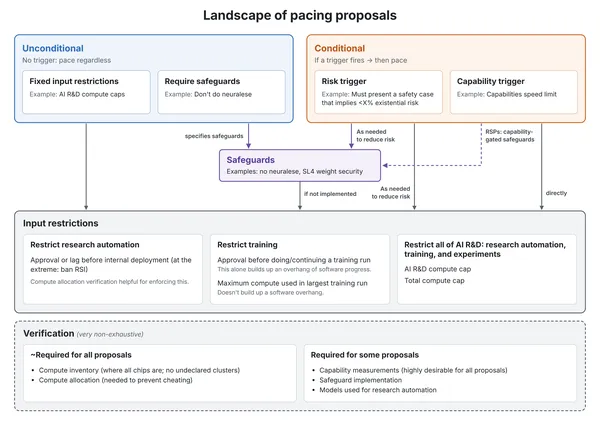
The AI Futures Project argues that a 2027 SAR would make it “incredibly urgent” to pause or substantially pace frontier AI development. It says the ideal outcome would be an industry-wide pause followed by an international agreement.
The project says companies are not on track to align a SAR and warns that using a misaligned SAR for recursive self-improvement could create an “extremely bad position.” It also says that if SAR is trained in the near future, China will probably be able to steal the training recipe and possibly the model weights.
For users and the wider AI market, the update does not announce a product release or a confirmed development schedule. It is a forecast revision based primarily on METR's assessment of Anthropic and on the AI Futures Project's own models. The project's conclusions remain conditional on AGI projects and companies not slowing down, and the authors emphasize that their analysis may contain modeling errors.
AI Futures Project: Q3.5 Timelines Update: Looks Like the Intelligence Explosion Will Happen in 2027 After All