AI Sign Language and Easy Read Tools Aim to Close Information Gaps

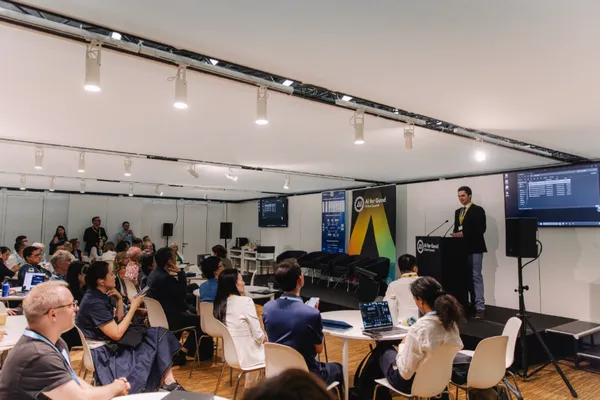
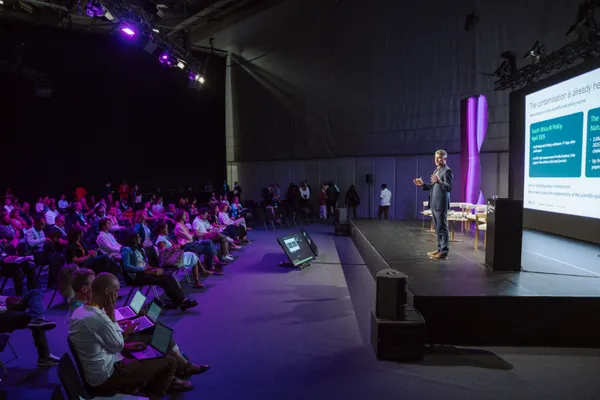
AI can help deliver information in sign language and turn complex text into Easy Read formats, but human review remains essential, said Kevin Lee, Founder and CEO of EQ4ALL, at the AI for Good Global Summit 2026. Drawing on examples from Korea and the United States, he argued that AI should be judged by whether it lets more people access and understand information, not only by productivity.
- Kevin Lee of EQ4ALL spoke at the AI for Good Global Summit 2026 on AI for sign language and Easy Read.
- AI sign language translation is not yet fully accurate, so sign language users review and revise the output.
- Limited, time-consuming training data remains a main barrier to accuracy and scalability.
- Examples from Korea include sign language on the Seoul metro, a pilot at Incheon Airport and emergency alert avatars.
- Large language models can speed up Easy Read production, with human review kept in the process.
Sign language where text falls short
Lee opened with the scale of the need. According to the World Health Organization, around 430 million people worldwide require rehabilitation for disabling hearing loss. There is no official global count of deaf people, but the World Federation of the Deaf estimates that more than 70 million belong to signing deaf communities.
For many sign language users, spoken and written languages may not be a first language, so text-heavy digital information can be hard to use. Captions do not always solve this, and in some cases information needs to be presented directly in sign language.
Lee described a workflow in which written text passes through an AI-powered sign language translation system. Because the technology is not yet fully accurate, sign language users review and revise the output before the final version is delivered.
Training data is a central obstacle. Facial expressions, body movements and other non-manual signals also carry meaning, which makes creating and annotating high-quality data demanding. According to Lee, producing sign language training data can take considerably more time than preparing datasets for written-language translation, and limited data remains one of the main barriers to accuracy and scalability.
Lee presented the technology as a partner to human expertise rather than a replacement for sign language professionals. As more material is translated, content that has already been reviewed can become training data. This can improve the engine over time, reduce the revision needed and lower the cost of producing accessible content. He also stressed that diversity in digital sign language avatars helps the technology reflect the communities using it.
Practical uses in transport, homes and emergencies
Lee pointed to several deployments. On public transport, emergency announcements are often audio-only, so deaf passengers can miss instructions such as evacuation notices. He described a system on the Seoul metro in which screens display sign language information when an emergency announcement is made. At Incheon Airport, a pilot project was designed to provide gate changes and other time-sensitive updates in sign language. Avatars have also been built into barrier-free kiosks, and in museums and galleries they can explain cultural, scientific and historical content on digital devices.
Another example was a television-based application for deaf children and their families. Lee said more than 90 percent of deaf children are born into hearing families, and that children may feel isolated at home when relatives do not share a common sign language. Television was chosen because family members can use the same screen together, with the aim of supporting shared sign language learning.
Sign language content can also be delivered through webpages, tablets, QR codes and text-message links. One example was QR codes on food packaging that give sign language information on how to store, prepare or consume a product.
On emergency alerts, which are often distributed mainly as text on mobile and television, Lee described approaches used in Korea. These include sign language avatars shown through television set-top boxes, emergency information on large public screens, and mobile links that open a sign language version of the warning. In the article's words, accessibility is not "an additional feature to introduce after information has been created", but must be built into the channels that carry essential information.
Easy Read and inclusive digital tools
The session also covered Easy Read, a format that makes written information clearer. It supports people with intellectual and developmental disabilities, people with low literacy and those reading in a language that is not their first. Specialists have traditionally rewritten content sentence by sentence, which is costly and time-consuming, so only a limited amount is available.
Lee explained that large language models can speed this up. Historical pairs of standard text and Easy Read versions can be used to train systems that convert complex material into simpler language, with human review and continuous quality improvement kept in the workflow. He also presented an "Easy Cast" format that uses AI-generated dubbing so audiences can switch between an original commentary and a simplified version.
Lee closed with tools for everyday digital life. EQ4ALL has created sign language GIFs for social media posts and messages, so sign language users do not need to record a new video each time. The company has also developed digital sign names, since many sign language users have both a written name and a sign name.
The session's takeaway, as summarized by the AI for Good article, is that building accessibility into digital services lets AI reduce communication barriers and enable more people to take part in society on more equal terms. Lee put the starting point this way: "Equal access to information is the starting point of equitable opportunity."
ITU AI for Good: Bridging communication gaps with AI-powered accessibility