AI weather training expands to help countries support farmers
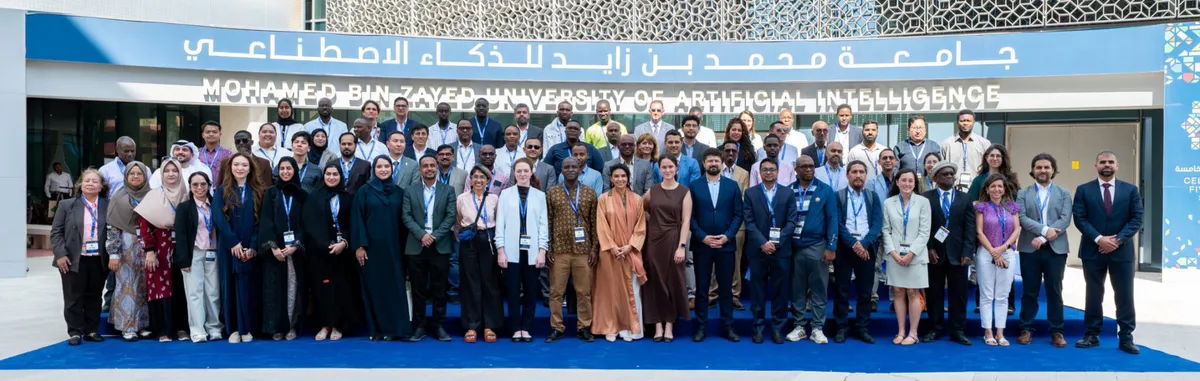
Officials from 15 countries are meeting in Abu Dhabi to learn how to evaluate and deploy AI-based weather forecasts for farmers. The program aims to help national institutions provide more accurate, timely and actionable agricultural information.
- Officials from 15 countries are taking part in the 2026 training program.
- The program builds on a 2025 pilot with Bangladesh, Chile, Ethiopia, Kenya and Nigeria.
- Participants are developing country-specific plans to integrate AI forecasts into national services.
- The initiative aims to build capacity across 30 countries by 2028.
- A consortium received $60 million from the OpenAI Foundation to reach 100 million smallholder farmers by 2030.
Training expands beyond its five-country pilot
The AI Weather Forecasting for Agriculture Training Program is holding its second-year program from November 9 to 13 at the Mohamed bin Zayed University of Artificial Intelligence and the National Center for Meteorology in Abu Dhabi, United Arab Emirates. Representatives from national meteorological and hydrological services and ministries of agriculture are taking part.
The program began with a 2025 pilot involving Bangladesh, Chile, Ethiopia, Kenya and Nigeria. This year, representatives from Bolivia, Colombia, Indonesia, Pakistan, Peru, the Philippines, Rwanda, Senegal, Sierra Leone and the United Arab Emirates have joined the original cohort.
Participants are being trained to independently evaluate AI forecasting models, decide how they perform in local conditions and integrate them into national services. They are also learning how to turn forecasts into information that farmers can use when making agricultural decisions and investments.
Two tracks connect forecasting with farm decisions
The 2026 curriculum has two complementary tracks. The Meteorological Services Track gives participants hands-on experience running AI weather models, comparing their accuracy with existing forecasting systems and assessing their performance with local observational data.
The Agricultural Services Track focuses on converting forecasts into practical agricultural advice and identifying effective ways to deliver it to farmers. Precision Development helped design this track, drawing on its work supporting governments with agricultural advisory services.
Countries are developing projects around priorities they have selected themselves. These include predicting the start of rainy seasons, anticipating extreme temperatures and improving short-term rainfall forecasts. Each country team is expected to leave with an initial roadmap covering technical requirements, institutional responsibilities and implementation steps for testing and integrating AI forecasting into national services.
A broader effort to build national forecasting capacity
The program is convened by the International Affairs Office at the Presidential Court of the United Arab Emirates and jointly organized by MBZUAI and the University of Chicago, in collaboration with the Agricultural Innovation Mechanism for Scale, known as AIM for Scale, and the National Center for Meteorology.
It forms part of a wider effort involving AIM for Scale, the University of Chicago, the University of California, Berkeley, Precision Development, Digital Green and the International Maize and Wheat Improvement Center. The consortium was recently awarded $60 million by the OpenAI Foundation to reach 100 million smallholder farmers with AI-based weather forecasts by 2030.
The program's stated ambition is to build capacity across 30 countries by 2028. According to the University of Chicago's Data Science Institute, AI could help low- to middle-income countries access forecasting at the same standard as countries with advanced economies, while enabling them to develop services suited to local conditions and reduce dependence on external forecast products.
That goal requires more than access to models. National institutions must be able to assess which approaches work in their own contexts and connect forecasting systems with agricultural services. This matters as climate variability, including the effects of the current El Niño, creates greater uncertainty around rainfall, drought and flooding in agricultural regions. For users, the intended result is locally relevant weather guidance that can support better farm planning, productivity and resilience.
UChicago Data Science Institute: AI Weather Forecasts Empower Countries to Build Advanced Forecasting Capabilities in Service of Farmers