Sam Altman and ADNOC's Al Jaber link AI growth to energy supply at ADIPEC 2026
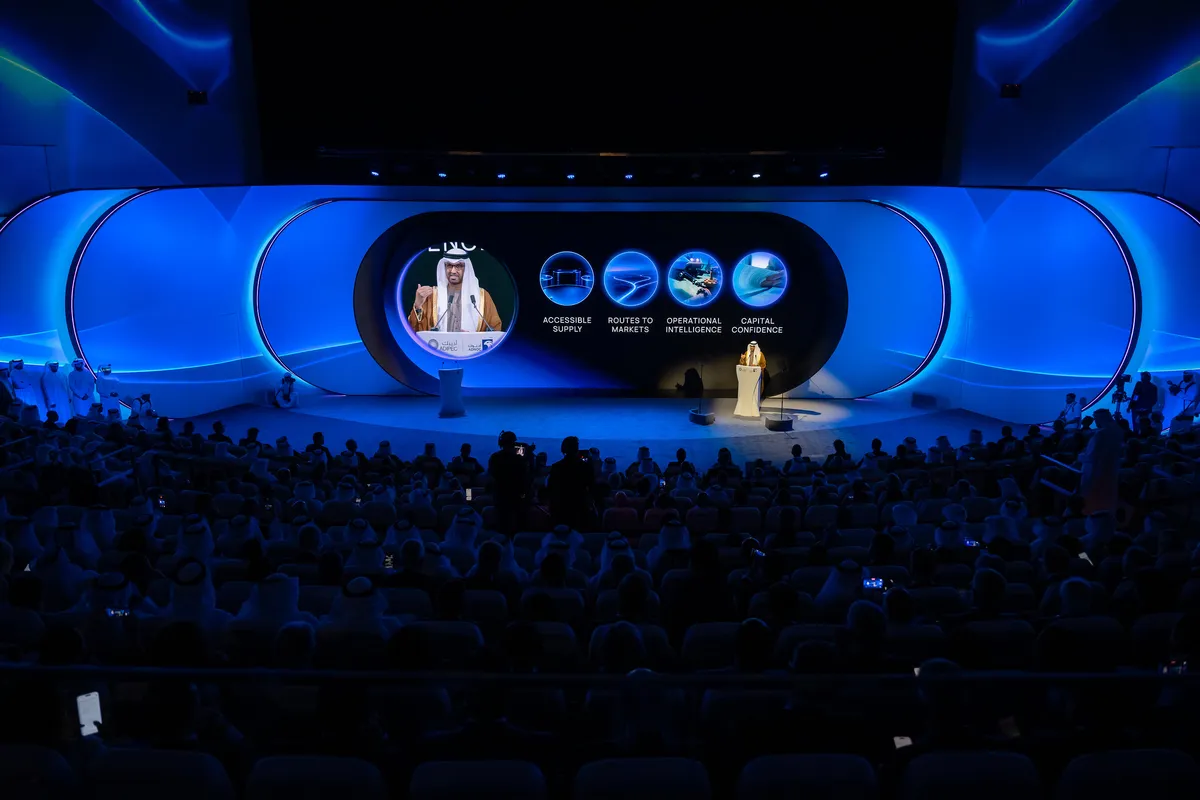
OpenAI CEO Sam Altman told the opening of ADIPEC 2026 in Abu Dhabi that AI and energy are increasingly dependent on each other, as ADNOC chief Dr Sultan Al Jaber called on the industry to rethink how it builds, protects and delivers secure energy.
- ADIPEC 2026 opened in Abu Dhabi on 2 November and runs until 5 November, with 2,260 exhibitors and an expected 239,000 participants.
- ADNOC's Dr Sultan Al Jaber outlined five steps to reduce the impact of future energy shocks, including accessible supply and operational intelligence.
- Sam Altman said AI can make energy systems more efficient but its expansion will require significantly more energy.
- Altman described the ADNOC-G42-OpenAI partnership as a model for applying AI to industrial challenges.
A record edition focused on resilience
ADIPEC 2026 opened in Abu Dhabi on 2 November and runs until 5 November. According to organiser dmg events, it is the largest edition in the event's history, with an expected 239,000 participants from more than 170 countries. The exhibition has 2,260 exhibitors across 16 halls, 30 country pavilions and four specialised zones: AI, Digitalisation, Low Carbon and Chemicals, and Maritime and Logistics. More than 1,800 speakers will appear across 13 conference programmes and over 380 sessions.
The event is held under the patronage of H.H. Sheikh Mohamed bin Zayed Al Nahyan, President of the UAE, and hosted by ADNOC. Asia participation is the strongest in its history, with China, India, Malaysia, Singapore and South Korea among the pavilions. Opening-day talks centred on supply resilience, intelligent energy systems and long-term investment as energy demand rises.
Al Jaber: five steps to reduce future shocks
Dr Al Jaber, UAE Minister of Industry and Advanced Technology and ADNOC Managing Director and Group CEO, opened the ceremony. He said the industry must fundamentally rethink its approach after a year of unprecedented disruption that exposed vulnerabilities in international supply chains. Since the disruption in the Strait of Hormuz, he said, nearly one billion barrels of crude have been drained from inventories.
He set out five steps:
- Accessible supply: expanded strategic storage, larger product stockpiles and flexible refining capacity closer to consumer markets.
- Routes to market: infrastructure built before it is needed and enabled by advanced logistics.
- Operational intelligence: a move from automated operations to intelligent energy systems that anticipate risk and optimise performance.
- Capital follows confidence: policy to create it, finance to accelerate it and insurance to keep trade moving.
- People: which he called the most important step.
Al Jaber said ADNOC's resilience was planned in advance and pointed to its "end-to-end AI-enabled operating model". He said the company's ambition is to become "the most customer-centric energy company on earth".
Altman on AI's appetite for energy
Sam Altman gave a speech and took part in an interview at the ceremony. According to the organisers' account, he argued that AI can make energy systems more efficient, reliable and innovative, but that its rapid expansion will also require significantly more energy. He said AI is increasingly used not just as a productivity tool but as a platform for scientific discovery and problem-solving, with potential to transform energy operations, materials development and system design.
Altman praised the UAE's approach to the technology. "I think the UAE has consistently been the most forward-looking country in the world for AI adoption," he said, adding that the country decided to "go all in on AI". He described the ADNOC-G42-OpenAI partnership as a model for applying advanced AI to real-world industrial challenges.
Ministers and CEOs on security of supply
In the opening ministerial panel, UAE Minister of Energy and Infrastructure Suhail Mohamed Al Mazrouei said the country needs "additional layers of protection" and spare capacity, and that AI will be needed "to design better and become more resilient". Nigeria's Minister of State for Petroleum Resources (Gas), Dr. Ekperikpe Ekpo, also took part.
The CEO panel included Meg O'Neill of bp, Richard Jackson of Oxy and Markus Krebber of RWE AG. Jackson said Oxy's strategy has been durability, focused on sustainable cash flow and production.
What it means
The opening day linked two themes: energy security after recent supply disruption, and the growing role of AI in both running and consuming energy. Organisers say the remaining days will focus on turning strategic priorities into investment decisions, partnerships and practical solutions.