Gulf AI Expansion Faces a Grid Bottleneck as Transformers Take Years
The Gulf is attracting AI data center investment faster than its power infrastructure can expand, with transformer and grid connection lead times emerging as a central constraint. Saudi Arabia and the UAE have announced major energy and technology ambitions, but the electricity needed for that growth remains difficult to deliver.
- Dubai's solar park had 3,860 MW operating and plans to exceed 8,000 MW by 2030.
- Saudi Arabia had about 12.3 GW of renewable capacity operating at the end of 2025.
- Saudi transformer lead times were reported at 3 to 4 years.
- OpenAI chief executive Sam Altman identified energy as his main challenge.
- Analysts expect Saudi operational renewable capacity of 45 to 74 GW by 2030.
Power capacity is growing, but delivery lags
Dubai's Mohammed bin Rashid Solar Park had 3,860 MW of solar capacity in operation as of June 2026, with a plan to exceed 8,000 MW by 2030. Saudi Arabia ended 2025 with about 12.3 GW of renewable capacity operating, against a national target of 130 GW.
The figures show the difference between announced capacity and power that is already connected and running. The UAE's Barakah nuclear facility reached its full 5.6 GW capacity with all units in service in 2024. Yet solar supplied about 12 percent of UAE electricity in 2024, according to the EIA Country Brief cited in the source.
ACWA Power reported a global renewable portfolio of 52.3 GW in the first half of 2026, including more than 34 GW in Saudi Arabia. The source argues that financing, land and generation equipment are available at scale, while the more difficult step is connecting projects to the grid.
AI demand is becoming an energy issue
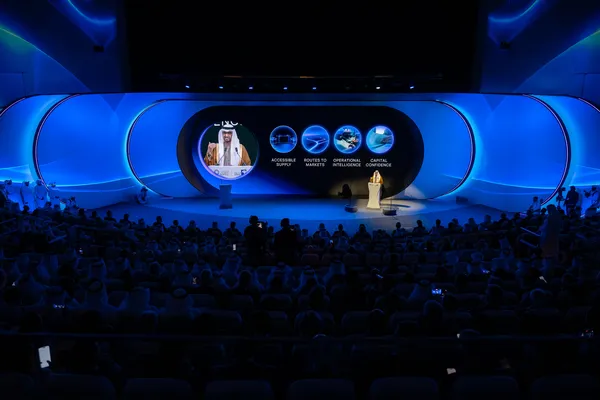
Saudi Arabia has been investing billions of dollars to position itself as the Middle East's cloud hub, according to Arab News. The region is also linking energy and computing more directly. At the ADIPEC opening in Abu Dhabi on 2 November, OpenAI chief executive Sam Altman identified his main challenge with one word: "Energy".
At the same event, ADNOC and Abu Dhabi technology group G42 announced that ADNOC would become the first energy company to deploy OpenAI Frontier for oilfield development and commercial operations. Sultan Al Jaber, the UAE's industry minister and ADNOC's group chief executive, said the global energy industry must rethink how it builds, protects and delivers secure energy.
However, the source says the public announcements do not include a megawatt figure for the data center load being pursued. Investment values can be approved before the grid capacity needed to support them has been scheduled.
Transformers could determine the pace
Vision2030.ai identified the grid as the constraint on Saudi Arabia's 130 GW renewable program and put transformer lead times at 3 to 4 years. Analysts cited by the source estimate that operational capacity could reach between 45 and 74 GW by 2030, rather than the announced 130 GW.
From 12.3 GW operating at the end of 2025 to a 130 GW target, Saudi Arabia would need to add 117.7 GW in five years, or about 23.5 GW a year. The analyst estimate implies an actual delivery rate of 6.5 to 12.3 GW annually. Even the upper end would be roughly half the pace required by the target.
The source attributes the gap to the structure of the equipment market. Solar modules come from a large global supply chain and can be obtained in months, while high-voltage transformers and other interconnection equipment come from a narrower industrial base and are ordered years in advance.
What the bottleneck means for Gulf AI plans
The source's central argument is that each additional gigawatt of AI demand may initially be supplied by gas before new solar capacity can be connected, if transformer lead times remain at current levels. That is an analysis rather than a published forecast, and the article identifies two signals that would challenge it: transformer lead times falling below a year, or Saudi operational renewable capacity doubling before the end of 2027.
For companies planning data centers, the issue is therefore less about whether the Gulf has sunlight, capital or ambitious targets. It is whether generation projects, substations and high-voltage connections can arrive on the timetable required by AI infrastructure. The region's energy and technology strategies are moving together, but the grid may set the speed.
ACN Newswire: Artificial Intelligence: Gulf Power Arithmetic: Demand Arrives in Months, Transformers Take Years