ASUS adds 64GB Ascent GX10 as cheaper entry to local agentic AI

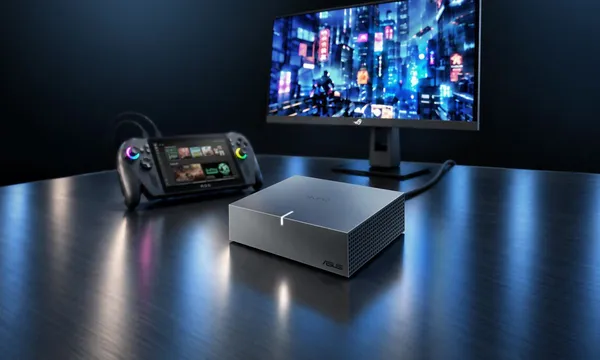
ASUS has announced a 64GB configuration of its Ascent GX10 compact AI supercomputer, sitting alongside the existing 128GB model. According to ASUS, the new version offers a more accessible entry point for developers, researchers and data scientists who want to build and run AI agents on their own hardware.
- ASUS announced a 64GB Ascent GX10 alongside the existing 128GB model, based on NVIDIA DGX Spark.
- It uses the NVIDIA GB10 Grace Blackwell Superchip, with up to 1 petaflop of FP4 AI performance using sparsity.
- The 64GB of LPDDR5x memory at 273GB/s is sized for 30-35B open-source models run on-device.
- Two units can be clustered for 128GB of pooled memory and up to 2 petaflops, which ASUS says is up to 1.7X a single 128GB system.
- Pricing and availability were not given in the announcement.
Same platform, smaller memory
The ASUS Ascent GX10 64GB is based on the NVIDIA DGX Spark platform and uses the same NVIDIA GB10 Grace Blackwell Superchip as the original model. The chip pairs a Blackwell GPU with fifth-generation Tensor Cores and FP4 support with a 20-core NVIDIA Grace Arm CPU. According to ASUS, it delivers up to 1 petaflop of AI performance (FP4, using sparsity) from a compact device that runs from a standard wall socket.
The difference lies in memory. The new model carries 64GB of LPDDR5x coherent unified memory with 273GB/s of memory bandwidth. ASUS says this is sized to run today's most capable 30-35-billion-parameter open-source models and agents entirely on-device. As an example, the company points to Qwen3.8-27B, which it says now delivers performance comparable to frontier models from just months ago, within a memory footprint that fits comfortably on the 64GB system.
The 128GB model remains in the lineup. ASUS positions it for teams working with the largest local models and the most demanding workloads.
Clustering for larger workloads
Two Ascent GX10 64GB units can be connected through the built-in NVIDIA ConnectX-7 networking. According to ASUS, a pair offers up to 128GB of unified memory, up to 2 petaflops of AI compute and up to 546GB/s of combined memory bandwidth, which it describes as up to 1.7X the performance of a single Ascent GX10 128GB system.
With clustering and support for NVIDIA's NVFP4 format, users can run compressed versions of larger models, including Qwen3.8-Flash-Next, ASUS says. Setup is handled through the NVIDIA Sync App and its Cluster Assistant, which the company says takes just minutes and requires no changes to the software environment or workflow. ASUS describes this as an upgrade path: start with one unit for prototyping and inference, then add units as models, context windows and concurrent agents grow.
Hardware, software and the case for local agents
The system shares the thermal design of the 128GB version, with 7-level fan control, ultrawide fins, five heat pipes and two 140x80mm fans. ASUS says this is meant to sustain performance over long-running agent sessions.
It ships with the NVIDIA AI software stack on NVIDIA DGX OS, including PyTorch, Jupyter and Ollama. NVIDIA OpenShell and NVIDIA NemoClaw provide policy-based agent security, and SSH-based remote management lets IT teams provision and monitor fleets of systems alongside existing infrastructure.
ASUS argues that agentic AI, where systems autonomously plan, use tools and carry out multi-step tasks, has driven a surge in token consumption. That raises cloud inference costs and questions about how confidential business data and intellectual property pass through public APIs. Running open-source models locally, the company says, lets teams keep token generation and data in-house.
What it means for builders
The 64GB model targets what ASUS calls the larger early-majority audience of developers, researchers and AI-curious teams ready to experiment hands-on, rather than only professional teams already running frontier-scale models locally. ASUS describes it as a more flexible, lower cost of entry to the DGX Spark platform. The announcement does not state pricing or availability.
ASUS also places the Ascent GX10 within a wider local-AI portfolio. ProArt laptops and mini PCs powered by NVIDIA RTX Spark act as personal AI workspaces, while the ASUS ExpertCenter Pro ET900, powered by NVIDIA DGX Station, addresses larger professional and enterprise workloads.