Baseten adds NVIDIA's Nemotron 3.5 Super VL, an open multimodal model
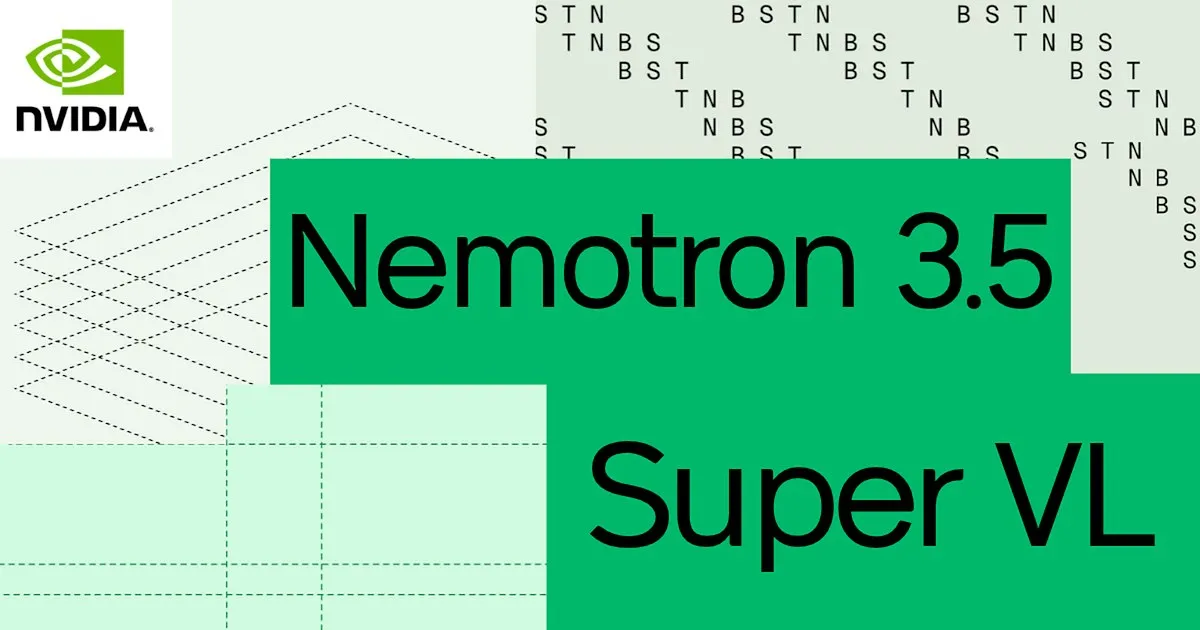
Baseten has made NVIDIA's Nemotron 3.5 Super VL available for inference and customization. The open multimodal model combines visual understanding, reasoning and tool use for applications that work with documents, images, interfaces and video.
- NVIDIA's open multimodal Nemotron 3.5 Super VL is now available on Baseten for inference (Dedicated and Model APIs).
- The model is a 120B-parameter Mixture-of-Experts design that activates 12B parameters per token.
- According to NVIDIA's reported evaluations, it earns a GDPval Elo of 1190 versus 493 for Nemotron 3 Super.
- Baseten Loops supports supervised fine-tuning and reinforcement learning on the model from day one.
- Super VL joins Nemotron 3 Super and Nemotron 3 Ultra on Loops.
What the model offers
According to Baseten, demand is growing for agents that work with visual information in documents, and multimodal input is becoming a standard feature across model size classes. Nemotron 3.5 Super VL is NVIDIA's latest open model release in that direction, and it is available on Baseten from the date of the announcement, October 15, 2026.
Baseten describes three main capabilities:
- Native visual understanding: reading documents, images, application screens and video, including information that gets lost when only text is extracted.
- Reasoning and tool use: using visual context to decide what to do next and to generate tool calls that an application can execute.
- Customization and control: adapting the open model to a team's own data and workflows with the Baseten Loops SDK.
Baseten says this makes the model well suited for customer service, document intelligence, enterprise productivity and web research use cases.
Architecture and benchmark results
Nemotron 3.5 Super VL builds on the Nemotron 3 Super architecture. It is a 120B-parameter Mixture-of-Experts model that activates 12B parameters per token. Its hybrid Mamba-Transformer architecture supports long-context processing, while multi-token prediction (MTP) helps accelerate generation. NVFP4 KV cache quantization is designed to reduce memory requirements for long-context inference.
A vision encoder lets the model handle visual inputs alongside text. In practice, Baseten says, an agent can inspect a document layout, interpret a screenshot or analyze a video clip, and then use the result to reason about its next step. On Baseten, developers can evaluate the model with NVFP4 weights on NVIDIA Blackwell GPUs.
Baseten also points to NVIDIA's reported evaluations to argue that adding vision has not weakened text reasoning. On three text-oriented benchmarks covering professional tasks, scientific coding and graduate-level science questions, Nemotron 3.5 Super VL scores higher than Nemotron 3 Super. On GDPval, it earns an Elo rating of 1190, compared with 493 for Nemotron 3 Super. It also scores higher on SciCode and GPQA-diamond.
Training with Baseten Loops
Customization is available the same day. Loops is Baseten's managed product for supervised fine-tuning and reinforcement learning. A training loop is a Python script that calls the Loops SDK, and Baseten says it provisions and operates the sharding, distributed training, parallelisms and GPU clusters behind it, so teams do not need to set up training infrastructure.
Super VL joins Nemotron 3 Super and Nemotron 3 Ultra on Loops, and teams already training those models can switch base models without changing tools. When a run finishes, the trained checkpoint can be deployed and served on the same platform.
What it means for developers
Developers can start evaluating the model for inference on Baseten, through both Dedicated deployments and Model APIs. Baseten suggests testing it on a team's own images, documents or application screenshots, and measuring how well it understands those inputs, how reliably it produces the outputs an application needs, and whether its latency fits the workflow.
From there, teams can connect the model to their application's tools and use Baseten Loops to post-train it on their own data, tools and policies. For teams building document or interface-reading agents, the release offers an open multimodal option that can be tested and customized on one platform.
Baseten: Announcing NVIDIA Nemotron 3.5 Super VL on Baseten