CMU and Siemens Build PRISM to Tell When Humanoid Robots Can Stop Safely
Researchers at Carnegie Mellon University and Siemens have developed PRISM, a method that assesses the "safe stoppability" of humanoid robots and alerts human operators when a robot may be unable to halt safely. The work will be presented at IROS 2026 in Pittsburgh.
- CMU and Siemens developed PRISM, a method for assessing the safe stoppability of humanoid robots.
- Cutting power to a humanoid makes it collapse, so the standard E-stop does not suit these robots.
- Researchers used simulation to define a safety envelope of actions and environments where a safe stop is possible.
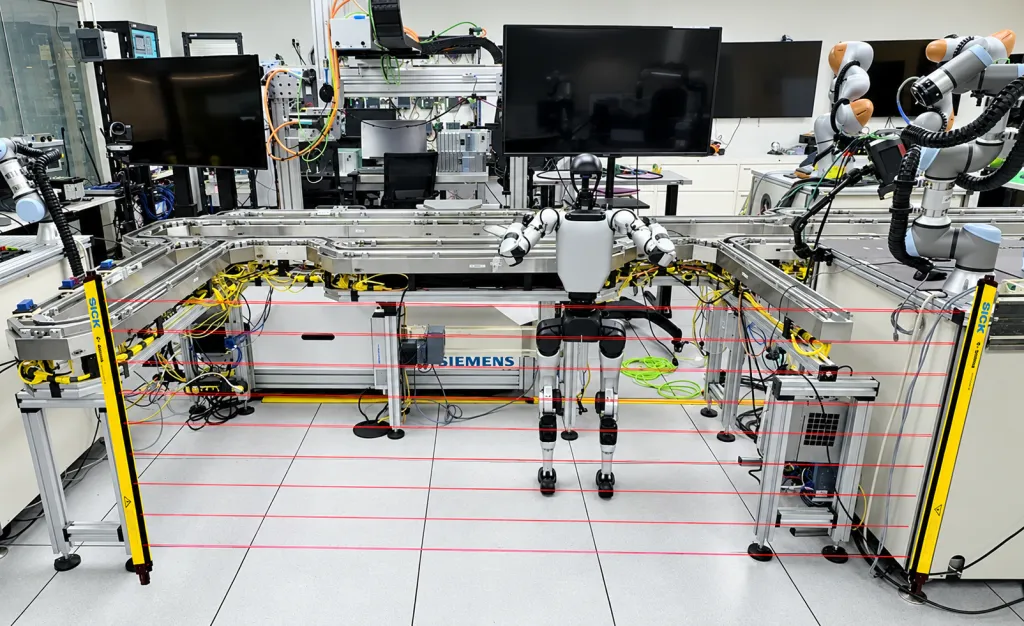
- Siemens demonstrated PRISM on a commercially available robot a bit more than four feet tall.
- The work will be presented at IROS 2026 in Pittsburgh.
Why the red button does not work for humanoids
Emergency stop mechanisms, often a big red button mounted on a robot, have long been the de facto standard for robot safety, according to Changliu Liu, an associate professor in CMU's Robotics Institute. For an industrial robot mounted in place, pressing the E-stop cuts power and halts all motion.
A humanoid is different. It needs power to balance and control its joints, so cutting power makes it collapse, potentially harming itself or anyone it falls on. Roboticists have therefore tried to stop humanoids by first directing them into a neutral position. In the CMU study, that meant the robot standing with its arms hanging down on either side. From there, further steps such as attaching a support harness can let operators power the robot down safely.
"But it's not always safe to execute this fallback to the neutral position," Liu said. The robot might be surrounded by people or obstacles, standing on a slippery or uneven surface, or holding an object. In those cases, returning to neutral could itself be risky.
Defining a safety envelope with simulation
Liu and her students in the Intelligent Control Lab worked with colleagues at Siemens to define the operating conditions in which a humanoid can be stopped safely. Outside this safety envelope of actions and environments, the robot might not be able to stop safely.
The team used simulations to explore which environments and activities might impede a stop. According to the researchers, simulation let them study rare but critical states safely, without damaging a robot. The result is the Proactive Refinement of Importance-sampled Stoppability Monitor, or PRISM.
Yifan Sun, the robotics Ph.D. student who led the project, gave an example: "when the robot approaches a conveyor belt with a human worker nearby, its current state may become dangerous, and an operator may want to stop the robot or move it to a less risky place."
Tests on a commercial robot
Siemens demonstrated PRISM using a commercially available robot that stands a bit more than four feet tall. In the tests, the researchers found that PRISM enabled proactive safety monitoring and could support certification of fail-safe behaviors, a particular interest of Siemens.
The research team also included Yiyuan Pan, a master's student in robotics, and Shangtao Li, a master's student in mechanical engineering. Caiwu Ding, Tao Cui and Lingyun Wang of Siemens' Foundational Technologies Division took part as well. Siemens and the National Science Foundation supported the study.
What it could mean for humanoid safety
PRISM is currently designed as a monitor for a human controller. Sun said, however, that the robot itself could use it to recognize high-risk situations and to avoid or minimize time spent outside the safety envelope. According to Sun, this awareness could help identify additional risky situations and lead to safer operation.
The researchers frame the work against a broader trend: humanoids are increasingly operating near people and other robots, and improved safety measures are essential as they become more common in workplaces, public spaces and even homes. The study will be presented at IROS 2026, the International Conference on Intelligent Robots and Systems, held Sept. 27 to Oct. 1 in Pittsburgh.
CMU School of Computer Science: Knowing Their Limits