CMU's Wiggle and Go Teaches Robots to Handle Ropes With One Quick Shake
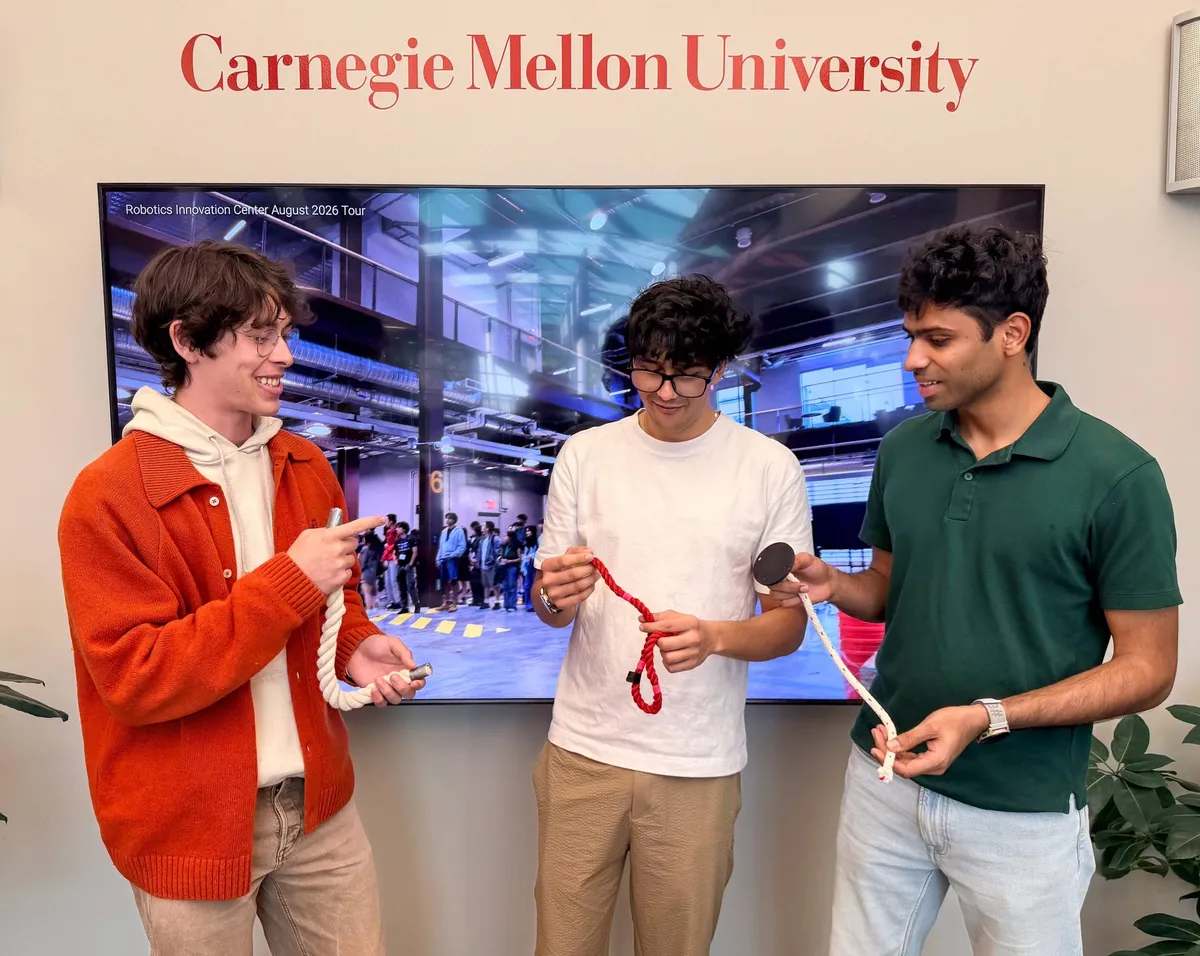
Researchers at Carnegie Mellon University have developed Wiggle and Go, a system in which a robot briefly wiggles a rope or cable, watches how it responds and estimates its physical properties. According to the team, the robot can then plan its movements more reliably without practicing the task first.
- CMU researchers built Wiggle and Go, a system that lets robots wiggle a rope or cable to estimate its physical properties.
- An overhead camera and computer vision algorithms track the wave, and a model estimates properties used for planning.
- The model was trained entirely in simulation, and the initial wiggle helps adapt its predictions to the real world.
- The work was partially funded by the National Science Foundation and accepted to the 2026 Conference on Robotic Learning in Austin, Texas.
Why ropes and cables are hard for robots
The work comes from CMU's Kenneth C. Griffin School of Computer Science. The team aims to improve how robots operate in manufacturing, construction, search and rescue, environmental monitoring and healthcare.
Jeffrey Ichnowski, an assistant professor in CMU's Robotics Institute, explained the core difficulty. "Rigid objects effectively have six degrees of freedom," he said. "With ropes or cables, you effectively have infinite degrees of freedom." He added that a rope or cable can bend, twist and stretch along its entire length, which makes its shape and movement much harder to predict.
Physical properties add another layer of difficulty. Two ropes or cables can respond differently to the same movement, depending on their length, weight and stiffness. A robot cannot determine those properties simply by looking at the object, yet it needs to understand how the object will behave in order to move it.
How Wiggle and Go works
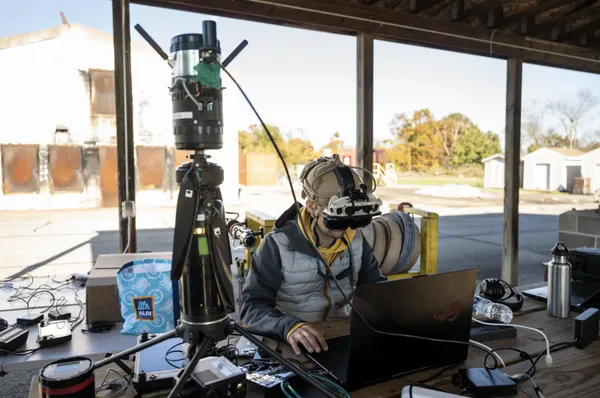
In Wiggle and Go, the robot gives the rope or cable a quick wiggle while an overhead camera records how the resulting wave travels through it. Computer vision algorithms track the movement, and a model uses that information to estimate physical properties that help explain the object's behavior. The robot then uses those estimates to plan how to move the rope toward a goal or into a desired position.
Rather than repeatedly attempting a task and adjusting after each failure, the robot plans its action from what it learns in the initial wiggle. The researchers say this could be especially valuable when a second attempt is not an option. They pointed to a robot throwing a rescue rope to someone in danger in the water, where a failed attempt could have serious consequences.
Making the system work on a physical robot was the team's biggest challenge. The model was trained entirely in computer simulation, where behaviors can be developed and tested without repeatedly using physical hardware. Arthur Jakobsson, a master's student in the Robotics Institute, noted the gap this creates: "Simulated objects do not always behave exactly like their real-world counterparts." The team therefore uses the rope's movement during the initial wiggle to estimate its properties and improve the system's predictions, which lets the robot plan more accurately in the real world.
A project born in a classroom
The project grew out of collaboration across the Robotics Institute's graduate programs. Jakobsson, who studies in the Master of Science in Robotics program, met co-authors Abhinav Mahajan and Karthik Pullalarevu, students in the Master of Science in Computer Vision program, in a class. Jakobsson brought experience working with robots, while Mahajan and Pullalarevu contributed expertise in computer vision, including tracking and interpreting movement in images.
"Sometimes, a simple exchange of ideas can lead to something bigger than what you could accomplish on your own," Mahajan said.
What it means
According to CMU, more reliable robots could improve rope and cable handling in fields such as manufacturing, construction, healthcare, and search and rescue. The approach points toward robots that can handle deformable objects without a round of trial and error first.
Wiggle and Go was partially funded by the National Science Foundation. It was accepted to the 2026 Conference on Robotic Learning in Austin, Texas, where Jakobsson will present the team's research. The team also maintains a project website with more details.
CMU School of Computer Science: A Little Wiggle Helps Robots Learn the Ropes