Team Chiron Takes Autonomous Disaster Triage Robots to DARPA Finals
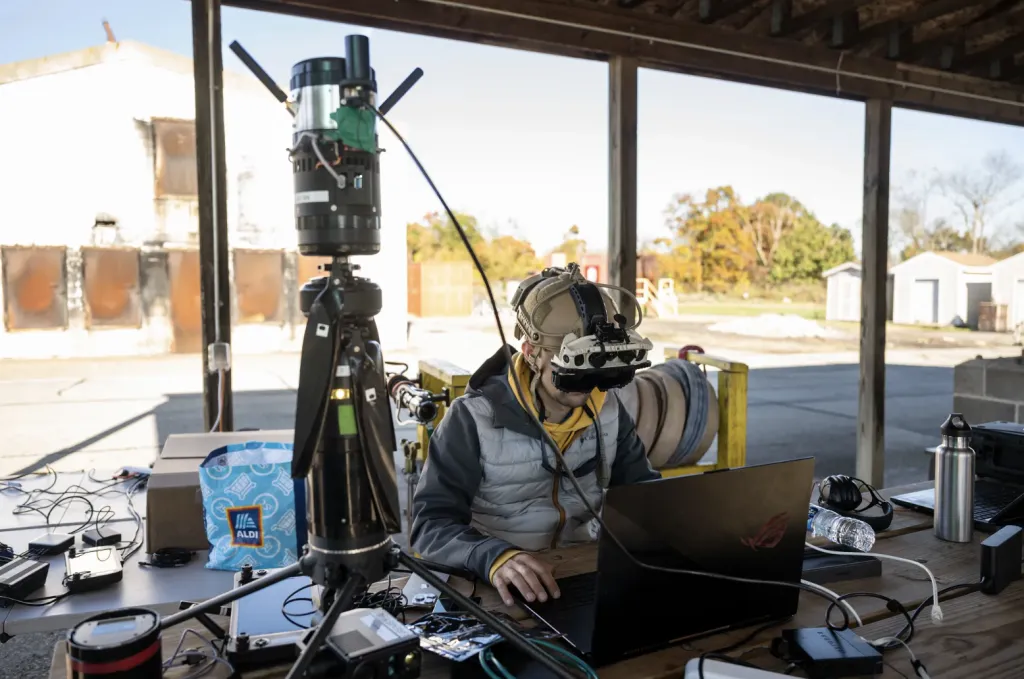
Carnegie Mellon University’s Team Chiron is competing in the finals of DARPA’s Triage Challenge with autonomous drones, ground robots and AI designed to help emergency responders assess injured people during disasters. The systems are being tested in darkness, smoke, fire, varied terrain and rubble.
- Team Chiron is competing in DARPA’s Triage Challenge finals.
- The system combines aerial drones, ground robots, sensors and AI.
- The robots assess casualties remotely, including heart rate and breathing rate.
- The finals run from Nov. 5 through Nov. 13 at Disaster City in Texas.
- The technology is designed to support, not replace, emergency responders.
Aerial and ground robots work together
Team Chiron is a collaboration among CMU’s Kenneth C. Griffin School of Computer Science, the University of Pittsburgh and Lockheed Martin. Its system uses drones to survey a disaster scene from above, identify patients with cameras and send initial reports to ground robots.
The ground robots can then deploy to gather additional information. Sensors measure physiological indicators such as heart and breathing rates, while cameras and other sensors help identify people, assess their conditions and locate them in chaotic environments. The information is relayed to emergency responders to support triage decisions.
Kimberly Elenberg, a principal project scientist in CMU’s Robotics Institute, said the system is intended to help medics determine who requires care first. “Finding the injured and reading their vital signs from a distance is only the start,” Elenberg said. The goal, she added, is to turn what the robots see into a picture of who needs care first.
Finals test systems in difficult conditions
The Defense Advanced Research Projects Agency’s Triage Challenge is a three-year competition focused on robotics, AI and sensing for emergency response. The finals began on Nov. 5 and run through Nov. 13 at Disaster City, a disaster response training facility near College Station, Texas.
Team Chiron advanced through two earlier events. In September 2024, its aerial and ground robots navigated simulated disaster scenes and assessed actors and mannequins representing injured people. The robots had to evaluate casualties from a distance, without touching them, and transmit their findings to a central command station.
In September 2025, the team tested autonomous systems at night. At CMU’s Robotics Innovation Center in Hazelwood Green, quadruped robots searched for simulated casualties in a grassy field, assessed heart rate, breathing rate and alertness, and relayed information to a remote operator. The event also challenged the robots to handle uneven terrain, low light and intermittent communications.
Lockheed Martin members are helping demonstrate the system during the finals and are contributing expertise in operating the high-altitude drones used to survey disaster scenes.
Technology intended to support responders
Team Chiron’s technology is intended to support emergency medical personnel, rather than replace them. By surveying a scene and collecting preliminary information without physical contact, autonomous systems could help responders focus on people who need attention most, particularly in dangerous or difficult-to-access areas.
Sebastian Scherer, an associate research professor in CMU’s Robotics Institute, said disaster scenes rarely provide a complete picture because people may be hidden, lighting may be poor or sensors may produce unclear readings. The team is working to combine those pieces of information for responders on the ground.
The project also includes a medical collaboration with Lenny Weiss, an associate professor of emergency medicine at the University of Pittsburgh. The partnership connects the engineering work with the practical demands of assessing and treating patients during emergencies.
The finals give Team Chiron an opportunity to demonstrate how autonomous navigation, sensing and AI can operate together in a practical emergency response setting. Its broader aim is to help responders assess casualties more quickly, make better-informed decisions and direct limited medical resources to those who need them most.
CMU School of Computer Science: Team Chiron Competes in DARPA Triage Challenge Finals