Confluent Introduces the Streamhouse Architecture for AI Decisions
Confluent has introduced the Streamhouse, a data architecture designed to keep business state and context current across distributed systems as AI agents make increasingly autonomous decisions. The company says the approach is intended to give applications, agents and analytics reusable information instead of requiring each system to rebuild its own understanding.
- Confluent introduced the Streamhouse data architecture concept.
- It is designed to maintain current business state and context across distributed systems.
- The architecture has three requirements: Always Current, Decentralized and Mission Critical.
- Streamhouse is intended to support applications, AI agents and analytics.
- The approach complements operational systems, warehouses and lakehouses.
Why Confluent says current data matters
Confluent frames Streamhouse against a shift in how businesses use software. Generative AI began by helping people draft and summarize, the company says, but has moved toward writing code, carrying out complex tasks and making decisions with less human involvement. People may still set the direction and limits, while decisions can happen at machine speed.
That speed creates a problem when enterprise data architecture mainly describes the past. An outdated answer from a report or dashboard can be corrected by a person. When an AI agent acts on an inaccurate or outdated understanding, however, the result can be the wrong action. Confluent argues that businesses therefore need to maintain their state as it changes, with enough context and reliability for software to act on it.
The three requirements of a Streamhouse
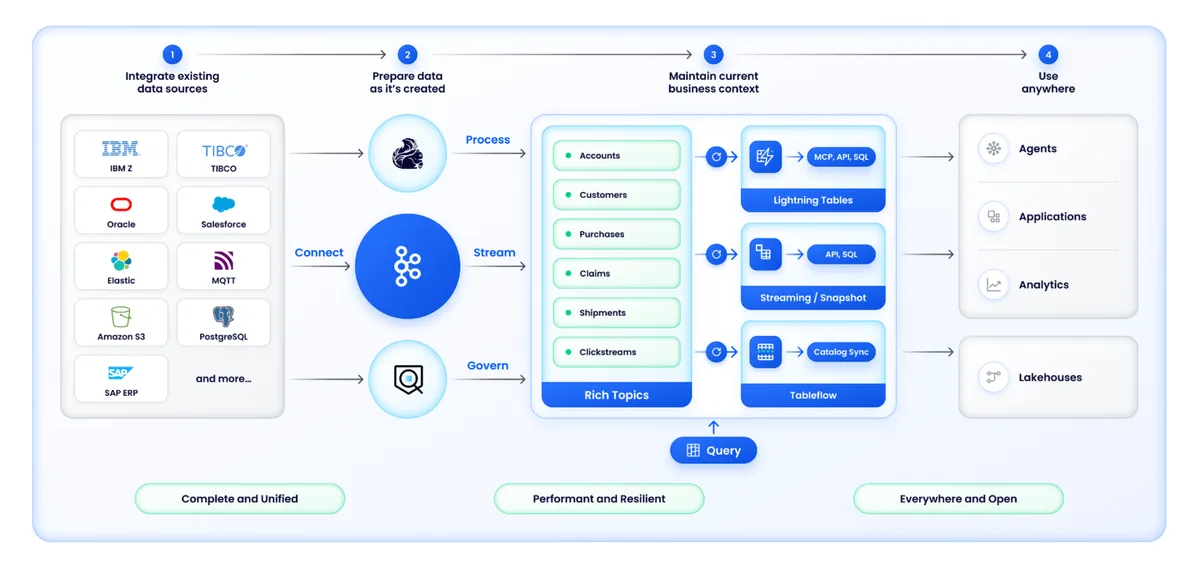
Confluent defines a Streamhouse as a data architecture that “continuously captures, processes, governs and serves current business state and context across distributed systems,” making that information available to applications, AI agents and analytics.
The architecture has three requirements. Always Current means building from history and then maintaining state as changes happen, while preserving the ability to replay, correct and recompute results. Decentralized means operational and analytical systems keep their own responsibilities while sharing state and its meaning without first consolidating onto one physical platform. Mission Critical means information used for production decisions must meet appropriate requirements for correctness, availability, security, recovery and traceability.
The proposed model combines familiar technologies. Connectors capture operational changes and historical data, an event backbone makes those changes available for processing and replay, and stateful processing maintains useful representations of business state. Semantic models connect definitions and relationships, governance and lineage provide controls, and serving systems expose the results through streams, queries, APIs and operational or analytical tables.
A shared understanding across existing systems
Streamhouse does not prescribe a single technology stack. Confluent lists Kafka Connect and managed data replication services for capturing changes, Apache Kafka and Apache Pulsar for transporting them, Apache Flink and database materialized views for transformation, and PostgreSQL or open Apache Iceberg tables for serving maintained state. The company says these choices involve tradeoffs involving latency, consistency, replay, cost and operational complexity.
The architecture is intended to complement existing systems rather than replace them. Operational applications and databases remain responsible for authorizing and committing transactions. Warehouses and lakehouses continue to support historical analysis, exploration and model training.
For users of those systems, the proposed benefit is a reusable business state and context that can be consumed as streams, current-state queries or tables. Confluent says this can reduce the need for downstream applications, analytical pipelines and AI agents to independently rebuild the same definitions and computations. It does not promise a perfectly synchronized global version of “now,” but aims to reduce conflicting interpretations by sharing maintained state and context across a distributed business.