Constructor launches Commerce AEO to tie AI answer traffic to revenue
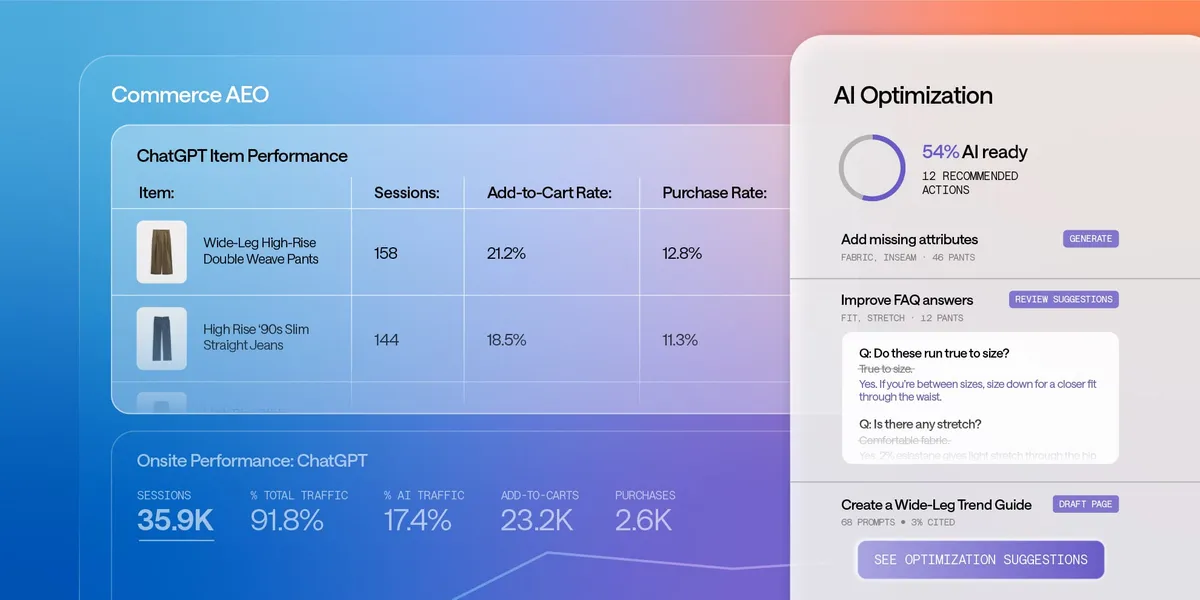
Constructor has released Commerce AEO in beta, an answer engine optimization tool that measures AI-referred traffic by add-to-carts, purchases and revenue rather than by citations alone. According to the company, generalist AEO tools focus on visibility and traffic, not on which traffic actually leads to sales.
- Constructor has launched Commerce AEO, now in beta, to measure AI answer engine traffic by add-to-carts, purchases and revenue.
- The company says generalist AEO tools define win rate by citations, not by purchases.
- The tool offers AI traffic attribution, share-of-voice tracking, a technical audit and content recommendations.
- A "Draft" button lets Constructor generate product descriptions, attributes or whole pages for users to edit or publish.
- Constructor plans to expand to more retailers over the coming months.
Why Constructor says generalist AEO falls short
Retailers and brands have started using answer engine optimization (AEO) to appear more often in AI answers. Constructor argues that visibility is important, but that success in ecommerce should ultimately be measured by add-to-carts, purchases and revenue.
The company says current AEO products are not built specifically for commerce. In its view, they define "win rate" by how often products are cited in AI answers, not by instances where a shopper buys. Constructor gives an example: a nonstick skillet may be a retailer's best seller overall, but when shoppers ask answer engines for skillets with "even cooking" or "heat retention", a cast iron skillet may convert far better. Most AEO tools, according to Constructor, would not show that difference.
The second gap the company names is guidance. Retailers want specific recommendations for improving results, and in some cases the ability for the system to act on their behalf. Teams with content staff want a concrete list of changes, while those with limited resources sometimes want help creating the content.
What Commerce AEO does
Commerce AEO is built on Constructor's full funnel visibility and AI optimization using shopper behavioral data such as clicks, add-to-carts, purchases and revenue. Constructor describes three core functions.
- Tie AI traffic to revenue: The tool follows AI-referred sessions through to purchase. Its AI traffic overview connects sources such as ChatGPT, Muse, Perplexity, Copilot and Gemini to the ecommerce metrics a team already tracks, showing which source drove traffic, which categories gained and whether that turned into revenue.
- Track AI visibility: It tracks share-of-voice across AI surfaces, including which topics a retailer appears for, which competitors appear alongside it and how this changes over time.
- Increase catalog discoverability: This combines a technical audit with content recommendations.
The technical audit works like a technical SEO audit for AI. It checks whether content is structured so AI crawlers can reach and understand it, and flags gaps that could cause an answer engine to miss or misstate a catalog.
Recommendations and drafted content
On the content side, Commerce AEO recommends fixing or adding product attributes, filling in missing information on product detail pages (PDPs) and product listing pages (PLPs), and creating new product pages and sections. Constructor offers two examples. If shoppers often ask to compare products, the tool might suggest a comparison feature or page. If shoppers often ask about skincare routines, it could recommend an article titled "The 10-Step Layering Guide to a Skincare Routine" with relevant products at each step.
The tool can also write the content. With the click of a "Draft" button, Constructor can produce PDP descriptions, missing product attributes or an entire new page. Users decide whether to use the draft as inspiration, edit it or publish it as is. According to the company, all content is structured to improve performance across answer engines, and it describes a library of thousands of AI-generated buying guides drafted from shopper data.
Constructor points to two reasons its approach works. The first is personalization: it says Commerce AEO fine-tunes product pages into AI-ready variants using shoppers' real behavior and ecommerce data. The second is scale: across tens of thousands of products, it creates AI-ready pages for every item in the catalog, building on the conversion data the company already ingests and the catalog attributes it already enriches at scale.
Availability and what it means for retailers
Commerce AEO is now available in beta. Constructor says it will expand to more retailers over the coming months, and interested companies can get in touch through the company's blog post.
The company says the goal is to help retailers increase visibility with the people most likely to buy, measure results and keep improving performance across external AI answer engines and agents, including ChatGPT, Muse, Claude, Instinct, Perplexity, Gemini and others. For retailers, the pitch is a shift in how AI traffic is judged: from whether a brand is mentioned to whether those visits produce revenue. Constructor frames this as what an agentic commerce strategy will require as use of answer engines and personal AI agents keeps growing. The claims about performance come from Constructor itself, and the source gives no pricing or results data.
Constructor: Are Your Ecommerce Products Converting from AI Traffic?