Databricks moves CustomerLake Campaign Agents to Beta, opens Profile Agents preview
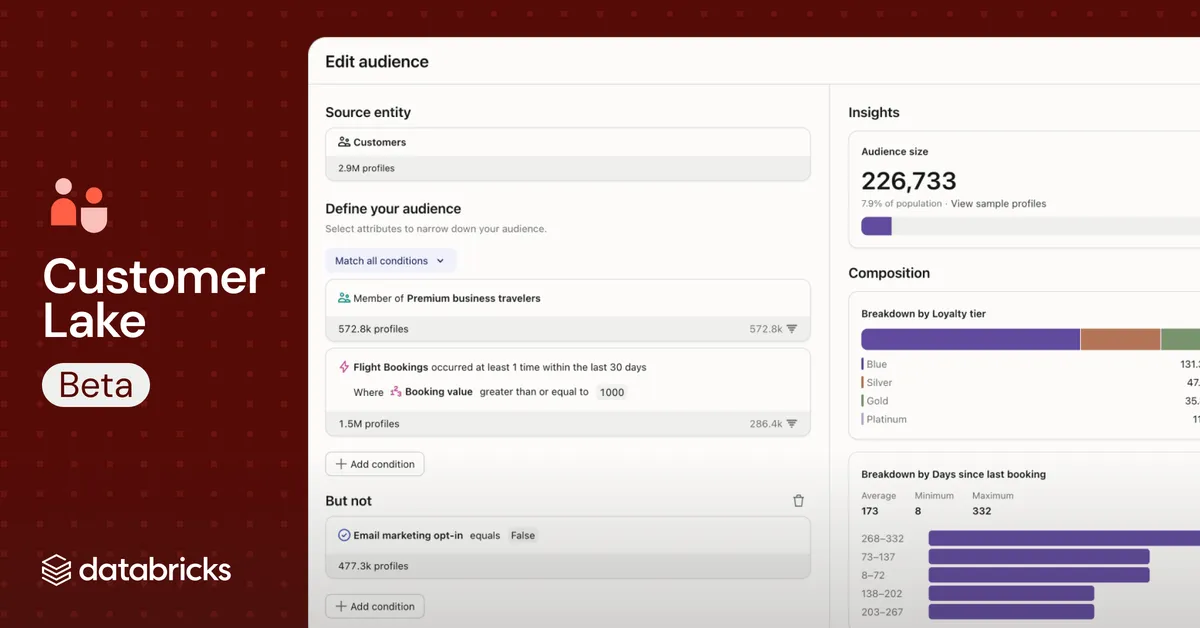
Databricks has moved Campaign Agents, part of its CustomerLake Agentic CDP, into Beta, and Profile Agents has entered Private Preview. According to Databricks, the step opens participation to more customers who meet the technical requirements.
- Databricks has moved CustomerLake Campaign Agents to Beta and Profile Agents to Private Preview.
- CustomerLake is an Agentic CDP embedded in the Databricks Data + AI platform, with audience building in natural language via Genie.
- HP reports audience-ready data in 2 hours versus 2 to 3 months, and a potential 40% cut in CDP total cost of ownership.
- Philadelphia Union reports a 90% cut in audience turnaround time, and Wine.com runs 100 active audiences across 6.5 million profiles.
- Databricks' own Summit campaign for 30,000 attendees showed a 10 point conversion lift against a control group.
What Databricks is releasing
CustomerLake is a customer data platform embedded in the Databricks Data + AI platform. Databricks introduced it at Data + AI Summit, arguing that marketers should run their CDP inside the governed data and AI environment where complete customer context already lives, instead of copying that data into another system.
Campaign Agents is now in Beta. Profile Agents, which is meant to build and use Customer360 profiles, is in Private Preview. Databricks describes the two as the next stage of product maturity for the Agentic CDP. The company says CustomerLake is powered by Genie, which lets marketers build audiences in natural language using customer data already in Databricks.
Databricks organizes the product around three principles: Embedded, Democratized and Autonomous. It also cites a figure that 74% of consumers use AI to discover, compare, or purchase products, and argues that marketers need agents of their own to respond to changing intent in real time.
Customer results reported by Databricks
The company published a series of customer accounts. These are the customers' own statements as presented by Databricks.
- HP: Kumar Ram, Global Head of Marketing Technology and AI Enablement, says HP had data and attributes ready for audience building within 2 hours, versus 2 to 3 months with a traditional CDP. He also cites the potential to reduce CDP total cost of ownership by 40%.
- Getnet by Santander: Chief Data and AI Officer Ainhoa Alonso says CustomerLake gives the company its first unified Customer 360, combining transactions, interactions, behavior and predictive models such as churn propensity score. After the Mexico rollout, Getnet plans to expand across Latin America and Europe.
- Zé Delivery (AB InBev): The CRM team builds audiences in CustomerLake and syncs them directly to Braze without engineering support, according to Bruno Smarsaro Bazelato, Director of Data and Analytics.
- Wine.com: The company launched production email campaigns 23 days after kickoff and has scaled to 100 active audiences syncing daily to Braze, across 6.5 million profiles.
- Philadelphia Union: Kyle Mathiot, SVP Technology & Analytics, says replacing the previous CDP with CustomerLake cut audience turnaround time by 90%. The team now runs hundreds of audience syncs each month to Salesforce Marketing Cloud.
Databricks tests it on its own Summit campaign
Databricks also used CustomerLake in its own marketing. For Data + AI Summit, it personalized session recommendations for 30,000 in-person attendees. Campaign Agents evaluated each person's engagement history and wrote an email reflecting the recipient's interests and behavior.
According to Databricks, the campaign produced a 10 point conversion lift against a control group, a 10% click-through rate and a 60% open rate, outperforming every previous Summit email campaign.
Delivery partner Stitch adds that CustomerLake enabled an enterprise media brand to deliver marketer self-service segmentation in days versus months with a traditional CDP, building on its existing Databricks data foundation.
What it means for marketing teams
Databricks frames these results as building blocks for what it calls Infinity Campaigns: continuous, agent-driven engagement loops that analyze customer signals, determine relevant actions and adapt as customer context changes. In that model, people set strategy, goals and guardrails, while agents help scale execution.
For enterprises that already keep customer data in Databricks, the pitch is that marketers can work directly with existing schemas, governance and data models rather than rebuilding them in a separate CDP. Access to Campaign Agents is limited to customers who meet the technical requirements, and Profile Agents remains in Private Preview. The cost and speed figures come from customers and Databricks, and some, such as the 40% cost reduction, are described as potential savings rather than confirmed outcomes.