HP Cuts CDP Setup to 2 Hours With Databricks CustomerLake
HP says it became audience-ready in two hours with Databricks CustomerLake, a process that could have taken 2 to 3 months with a traditional customer data platform (CDP). According to Databricks, HP also estimates that consolidating CDP capabilities on CustomerLake could cut total cost of ownership by up to 40%.
- HP says it became audience-ready in two hours with Databricks CustomerLake, versus a possible 2 to 3 months with a traditional CDP.
- HP estimates up to 40% lower CDP total cost of ownership compared with its former composable CDP approach.
- HP expanded its marketing data with 90% net-new signals and grew intent-data ingestion from 75 to approximately 20,000 topics.
- A comparable governed data-sharing request now takes 48 hours instead of three months, according to HP's Luis Alonso.
- HP plans to bring identity resolution into its Databricks environment for governed measurement and activation.
Early results from HP's CustomerLake rollout
At Data + AI Summit 2026, Luis Alonso, Global Head of Data Strategy & Engineering for MarTech & AI Enablement at HP, described how the company is building an AI-ready go-to-market data foundation on Databricks. Databricks published the details in a blog post.
The post highlights three results from HP's early work:
- Up to 40% lower CDP total cost of ownership: HP estimates this compared with its former composable CDP approach.
- 90% net-new marketing signals: HP expanded the data available across media, brand, intent and technographic sources.
- Audience-ready in two hours: in the first session with CustomerLake, HP configured data models, published attributes and was ready to build audiences.
Alonso said of the experience: "We had our data models in place, we had attributes published, and we were ready to build audiences", work that might previously have taken two or three months.
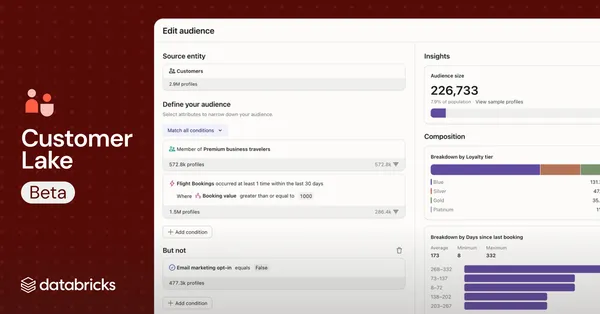
According to the post, CustomerLake is native to Databricks and Unity Catalog. HP's team could therefore work directly with its existing schemas, tables, definitions and governance instead of recreating that context in a separate platform.
Why HP is rethinking the traditional CDP
HP does not see a CDP as a single product or a narrow set of activation features. It defines it as a collection of capabilities: first- and third-party data strategy, account profiling and clustering, identity and buying-group intelligence, audience segmentation and activation, closed-loop measurement, and always-on automation and self-service.
As HP consolidated more governed data and business logic on Databricks, keeping a separate CDP increasingly meant duplicating pipelines, data and operational overhead, according to the post. Composable architectures reduced some data movement, but the activation layer still lacked the business definitions, context and governance already present in the data platform. Without that context, the post argues, an AI agent may reach data but still lack the definitions, relationships, metrics and governance needed to use it correctly.
HP's wider data transformation merged hundreds of data lakes and repositories into a small number of Databricks lakehouses. The company applies central standards with federated execution, so domain experts keep ownership and stewardship while sharing governed data products. Alonso described a 2024 request to share data with a sales partner that took three months, roughly 15 email exchanges and three escalations, without a reliable outcome. Today a comparable request can produce a governed Delta Sharing asset within 48 hours.
Genie, semantic layers and identity
HP is using AI/BI Genie and agent-based capabilities to make the data foundation usable by business teams, across three layers: decision-making and planning for executives, insight generation and activation for marketers and analysts, and building and scaling for engineers.
The company is building semantic layers so Genie understands what its data means. One example is a media metric view covering 26 dimensions and 10 measures, which centralizes definitions for media-spend and performance KPIs. HP has also expanded intent-data ingestion from 75 topics to approximately 20,000 topics, and Genie Code helps plan how to cluster those signals for richer account profiles.
HP also plans to bring identity resolution back into its Databricks environment rather than leaving it with an external identity provider. According to the post, this would create a governed base for measurement, audience activation and model improvement. Alonso noted that reaching even 10% of HP's consumer customer base through this consent-preserving approach could create a substantial new opportunity for the commercial business.
The post adds that HP has hundreds of millions of consumer customers but a much smaller known population of business contacts. CustomerLake lets it work across B2C and B2B data models in one environment through a shared identity layer, and HP can bring in data from other platforms using Lakehouse Federation.
What it means for other enterprises
Databricks frames HP's evaluation around three areas: outcomes, productivity and total cost of ownership. It offers four takeaways for other companies modernizing their marketing stack: define the CDP around business needs, build a governed Marketing Lakehouse, choose CDP capabilities closest to your data and AI, and measure outcomes, productivity and TCO together.
The figures are HP's own estimates and early experience as reported by Databricks, and the 40% cost reduction is described as "up to". Still, the case points to a direction Databricks is promoting: running marketing activation on the same governed foundation as the rest of a company's data, so that marketers and AI agents work from shared definitions rather than copies spread across disconnected systems.
Databricks: How HP Is Building an AI-Ready CDP with Databricks CustomerLake