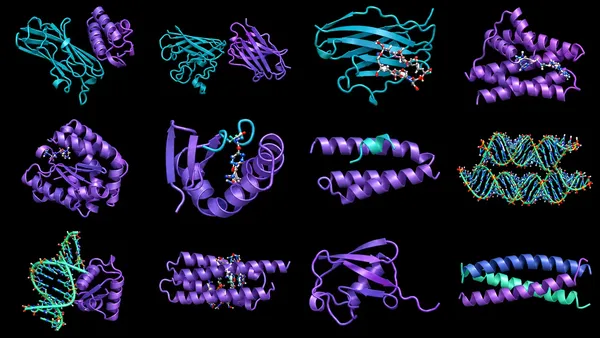
Databricks adds NVIDIA's RFD4-Proteina protein design model to Genesis Workbench
Databricks is bringing RFD4-Proteina, an NVIDIA BioNeMo open model co-developed with the University of Washington Institute for Protein Design, into its Genesis Workbench blueprint. According to Databricks, the model runs on its AI Runtime, which offers serverless NVIDIA GPU compute, so life sciences teams can work next to their own research data.
- Databricks is integrating NVIDIA's RFD4-Proteina, co-developed with the University of Washington Institute for Protein Design, into Genesis Workbench.
- RFD4-Proteina adds optional reward-guided search to joint sequence and structure generation, steering designs toward properties like thermostability or binding affinity.
- Genesis Workbench includes Antibody Design and Vaccine Design workflows using the model.
- Workloads run on Databricks AI Runtime with serverless NVIDIA H100 GPUs, with Unity Catalog and MLflow handling governance and tracking.
- Genie Code, NVIDIA BioNeMo Agent Toolkit skills and Claude-based agent skills support building and adapting workflows.
What RFD4-Proteina does and how it is integrated
RFD4-Proteina is meant to help scientists turn ideas for useful proteins into designs they can test. According to Databricks, it builds on Proteina-Complexa, NVIDIA's generative model for designing protein binders, which co-generates amino-acid sequences and all-atom structures in a single pass. RFD4-Proteina extends that joint generation approach with optional reward-guided search. Researchers can use it to steer candidates toward properties such as thermostability or binding affinity.
Genesis Workbench is described as an open, modular life sciences blueprint. It shows how to connect biological models with input preparation, candidate evaluation and downstream analysis on Databricks. Two built-in workflows use RFD4-Proteina: Antibody Design and Vaccine Design. Developers can reuse single components or adapt the implementation to their own scientific methods. Databricks calls the integration planned and says it offers day-zero model support.
Anthony Costa, Director of Digital Biology at NVIDIA, said that the hard part of protein design is choosing the few candidates worth making in the lab. Running the model next to a team's own experimental data, he said, helps scientists make that choice based on what their experiments have already shown.
Agent skills and AI-assisted development
Databricks Genie Code helps developers build, debug and adapt data and ML workflows using natural language. NVIDIA BioNeMo Agent Toolkit skills add instructions, scripts and references for biological models and scientific tools. These cover structure prediction, protein design, molecular docking and genomics analysis. According to Databricks, they can help a coding agent prepare inputs, invoke supported tools, inspect outputs and assemble multi-step workflows. Genesis Workbench also provides skills for Claude-based coding agents, which can help developers understand the blueprint and scaffold integrations for new models such as RFD4-Proteina.
The post gives an example prompt for Genie Code: designing a nanobody (VHH) against PD-L1 with a fixed humanized framework, running 8 iterations of 8 samples with ProteinMPNN on the CDRs and Boltz co-folding for binding. The reward is weighted toward binding, fold confidence, developability and low anti-drug-antibody risk. Databricks stresses that researchers keep control by reviewing code, selecting tools and interpreting results. It adds that dependency checks, testing and scientific review remain part of the process.
Serverless GPUs and governance
Databricks AI Runtime (AIR) is generally available and provides serverless NVIDIA GPU compute for supported workloads. Developers connect a notebook to Serverless GPU compute, select an NVIDIA H100 accelerator and a supported environment, and run their workload. Teams still need to validate model-specific libraries and dependencies. For supported biological foundation models, teams can also adapt BioNeMo Recipes, reference implementations built on frameworks such as PyTorch and Hugging Face, to train or fine-tune on proprietary data.
Governance runs through Unity Catalog and MLflow. Teams can store model weights in Unity Catalog volumes as governed MLflow models, and register fine-tuned models there to link versions with configurations and artifacts. Lakeflow orchestration and MLflow experiment tracking connect execution to repeatable workflows. Databricks says access controls and network configuration should reflect where the model, scoring tools and coding agents execute.
The example lifecycle runs from storing weights and generating candidates on AIR to tracking results in MLflow. Compatible models can then be deployed to GPU Model Serving endpoints, or run as batch jobs. For supported custom-model endpoints, scale-to-zero can reduce provisioned capacity during inactivity. Databricks warns that cold starts add latency and GPU capacity is not guaranteed when an endpoint scales back up. It recommends disabling scale-to-zero for workloads that need consistent availability or response times.
What it means for life sciences teams
The pitch is that teams can run advanced protein design models on their own governed data without moving sensitive intellectual property out of their environment. Mike Sanky, VP of Healthcare and Life Sciences at Databricks, said: "You own the science." Databricks argues this reduces the need to assemble and maintain a separate research stack.
Genesis Workbench also shows how genomics, single-cell data and protein-design or small-molecule workflows can sit in one shared environment. For developers, the blueprint is a starting point rather than a finished product. It is meant to speed up the first implementation, while validation and scientific judgment stay with the research team.
Databricks: Deploy RFD4-Proteina on Databricks