NVIDIA and UW's RFD4-Proteina designs protein sequences and structures together
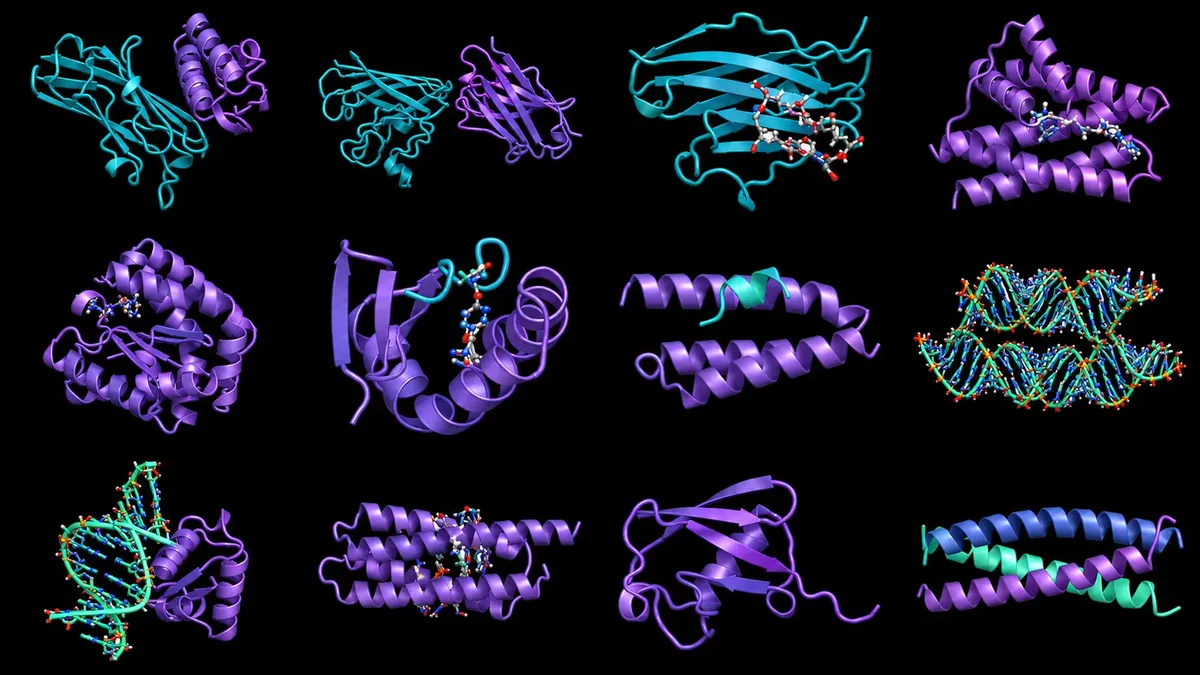
NVIDIA has published a tutorial for RFD4-Proteina, a BioNeMo open model that co-designs protein sequences and all-atom structures and uses reward-guided inference-time search to focus compute on promising candidates. According to NVIDIA, it generates 3.8x faster and uses 84% less peak memory than RFD3 at 200 residues.
- RFD4-Proteina is an NVIDIA BioNeMo open model co-developed with the University of Washington's Institute for Protein Design.
- It co-designs protein sequences and all-atom structures, removing the separate inverse-folding step.
- According to NVIDIA, it is 3.8x faster and uses 84% less peak memory than RFD3 at 200 residues.
- Sampling drops from about 400 steps in Proteina-Complexa to 60.
- Available as an open model on GitHub and as a NIM microservice with an HTTP interface.
A search problem with too many answers
NVIDIA frames protein design as a search problem. An eight-residue sequence already allows more than 25 billion amino acid combinations, and at 100 residues the number of possibilities exceeds the number of atoms in the observable universe. Because exhaustive search is impossible, success depends on knowing where to look.
RFD4-Proteina was co-developed with the Institute for Protein Design at the University of Washington's School of Medicine. It navigates this space using patterns learned from nature. The tutorial targets computational biologists, ML engineers and drug discovery researchers, and walks through designing protein binder candidates against PD-L1, an oncology target.
Building on Proteina-Complexa's partially latent approach, the model combines explicit backbone coordinates with latent representation, learned sequence and atomistic variables. Its autoencoder decoder produces the sequence and the all-atom structure together. This removes the separate inverse-folding handoff to a model such as ProteinMPNN.
Search at inference time and the speed gains
The central feature is reward-guided search. During inference-time search, the model denoises generation trajectories to obtain structures, scores them, retains and branches promising partial states, and continues until the generation criteria are met. Rewards can measure geometry, interactions or independent prediction confidence. NVIDIA says this extra search optimizes designs against a specified objective and yields higher-scoring designs.
NVIDIA attributes the efficiency gains over RFD3 to several choices:
- A residue-level latent representation instead of an atom-level one, which avoids memory blow-up.
- Engineering of the diffusion process that cuts sampling from about 400 steps in Proteina-Complexa to 60.
- CUDA-accelerated oracles for the search, including OF3 and physics methods such as tmol.
The model and kernels were co-designed with the cuEquivariance and BioNeMo Inference Runtime teams for speed and scalability. In the reported generation benchmark at 200 residues, the company states the model delivers 3.8x faster generation and 84% less peak reserved memory than RFD3.
The PD-L1 workflow and access options
Users can reach RFD4-Proteina in two ways. The open model, available on GitHub, is meant for training, inference, method development and direct control over sampling code. The NIM microservice is meant for rapid inference deployment with an HTTP interface. The NIM can be self-hosted on x86_64 or arm64 Linux with Docker, an NVIDIA driver, the NVIDIA Container Toolkit and an NGC API key. An API endpoint on build.nvidia.com needs no local GPU or model installation, though NVIDIA does not recommend it for production runs.
The workflow starts by defining what may change, what must stay fixed, and the computational and experimental success criteria. AtomWorks, the molecular data layer, prepares fixed atoms, designable residues, hotspots and molecular context. Both the open model and the NIM accept annotated CIFs, or a condition specification plus its source structure.
In the example, the repository's cropped PD-L1 structure from PDB 5O45 is the target. Its sequence and backbone coordinates are fixed, its side chains may repack, and generation is directed toward hotspot atoms on Tyr56, Met115 and Tyr123. The new binder has 100 to 150 residues with free sequence and coordinates.
Agent-driven design campaigns
NVIDIA describes the reference workflow as an iterative cycle linking molecular design, computational evaluation and experimental testing. An agent can coordinate the tools and track results, while scientists define objectives and use experimental evidence to guide the next round. The rfd4-proteina-campaign and rfd4-proteina-package skills in the BioNeMo Agent Toolkit handle generation, search, evaluation and results archiving.
For research teams, the pitch is lower memory use and faster sampling, plus a single model that outputs sequence and structure without a separate inverse-folding step. The open release also gives groups direct access to the sampling code.
NVIDIA Developer: Design Proteins with RFD4-Proteina Using Reward-Guided Inference-Time Search