Google study: AI reads blind sweep ultrasound as well as expert sonographers
Google Research reports that an AI model can estimate gestational age from "blind sweep" ultrasound scans taken by operators without sonography training, with accuracy non-inferior to expert sonographers. The prospective multi-center study, published in JAMA Network Open, tested the system in Chicago and Nairobi.
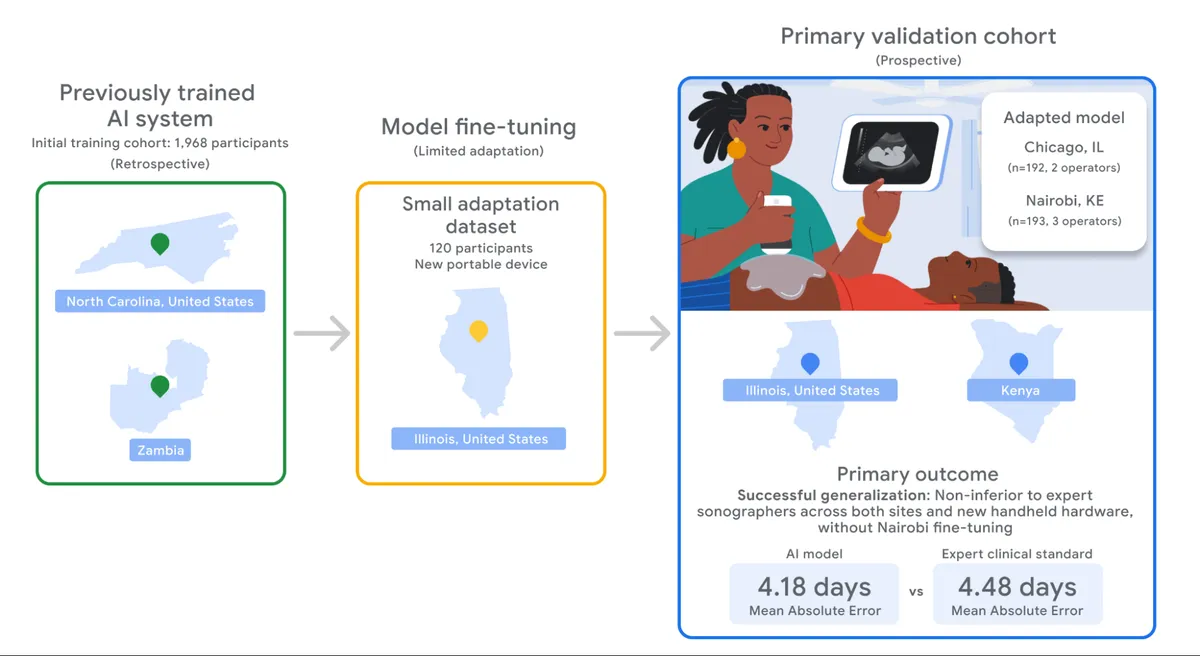
- Google's AI estimated gestational age from blind sweep ultrasound with a mean absolute error of 4.18 days, versus 4.48 days for expert sonographers.
- The prospective study ran in Chicago (n=192) and Nairobi (n=193) and was published in JAMA Network Open.
- The model was fine-tuned on only 120 Chicago participants, about 6% of the original training set, and used no Nairobi data for tuning.
- Operators were novices using a low-cost Clarius C3 handheld probe.
- Google frames the system as research, with potential to widen prenatal ultrasound access.
Why blind sweep ultrasound matters
According to the World Health Organization, as cited by Google, more than 250,000 preventable deaths occur worldwide each year due to pregnancy-related complications. Google says prenatal ultrasound can improve outcomes and reduce fetal and maternal mortality, yet two-thirds of people globally lack access to diagnostic medical imaging such as ultrasound.
The research team, led by Angelica Willis of Google Research and Nichole Young-Lin of Google for Health, focused on machine learning that interprets blind sweep ultrasounds. In this method, frontline healthcare workers glide a low-cost, portable probe across the abdomen in a standardized pattern. No specialized sonography training is needed. Google notes that traditional sonographer training is expensive and requires a multi-year commitment, while many regions face critical shortages of experts.
The paper, titled "Generalization of AI-Based Gestational Age Assessment Using Blind Sweep Ultrasonography", examines gestational age, meaning how far along a pregnancy is. Young-Lin, an OB-GYN physician, is quoted in the post: "All of our screening, a lot of our treatments, a lot of our indications for delivery are all based on this master timeline that you get from the gestational age."
How the study was designed
Earlier research validated the model on unseen patients from the same retrospective cohort it learned from. The new study is prospective: the system ran live on mobile devices in real clinics, with only novice operators, unfamiliar ultrasound equipment and minimal fine-tuning, according to Google.
The model was originally trained on data from 1,968 participants in North Carolina and Zambia, collected with Sonosite, GE and Butterfly Networks probes. It was paired with the Clarius C3, a commercial handheld transabdominal probe. The team then fine-tuned it on a small pilot dataset of 120 participants from Chicago, approximately 6% of the original training set. This adapted the model to the new probe hardware and extended the prediction range beyond 36 weeks.
- Northwestern Medicine: an urban, high-resource academic medical center in Chicago, with 192 participants in the prospective test.
- Jacaranda Health: an urban community clinic network in Nairobi, Kenya, with 193 participants.
No Nairobi data was used for fine-tuning, so the Kenyan site served as a strictly independent external test. The sites differed in when women first seek prenatal care, how many routine ultrasounds they receive and how gestational age is usually dated. The study also included multiple gestation pregnancies.
Results compared with expert sonographers
The primary cohort covered 385 participants between 16 and 36 weeks of pregnancy. The expert standard relies on a sonographer locating specific fetal cross-sections to take precise biometry measurements, which Google describes as hard to scale, highly operator-dependent and dependent on years of training.
Across both cohorts, the AI model reached a mean absolute error (MAE) of 4.18 days, against 4.48 days for expert sonographers, demonstrating non-inferiority. In Chicago the adapted model had an MAE of 4.10 days. In Nairobi, with no local optimization, it was 4.27 days.
Exploratory metrics also pointed to resilience in complex cases. For fetal weight above the 90th percentile, the model outperformed traditional biometry formulas, according to Google.
Lessons from live deployment and what comes next
Deploying the system in everyday workflows produced practical lessons. The team observed that swappable batteries work better than plug-in docking stations for keeping devices charged between consecutive patients. Google also stresses that building trust with clinicians and patients will be required, and suggests safeguards in the app, such as model confidence estimates that reject poor-quality sweeps and convey uncertainty to the clinician.
Google says the findings indicate AI can analyze standardized blind sweep images from operators without specialized training, with accuracy comparable to expert operators using more expensive cart-based machines. The company describes the work as research with potential to expand prenatal coverage in under-resourced areas through minimally trained community health workers. It is presented as a research system, and the post does not announce a product or availability.
Google Research: Empowering frontline maternal care with AI-assisted ultrasound