Google Research details how open AI models are taking TB screening to the front lines
Google Research says its AI work on tuberculosis has moved from research benchmarks to deployed tools and open foundation models such as MedGemma. The team shared the update at IDWeek 2026 in Washington, D.C., pointing to field use in several African countries and a national program in Indonesia.
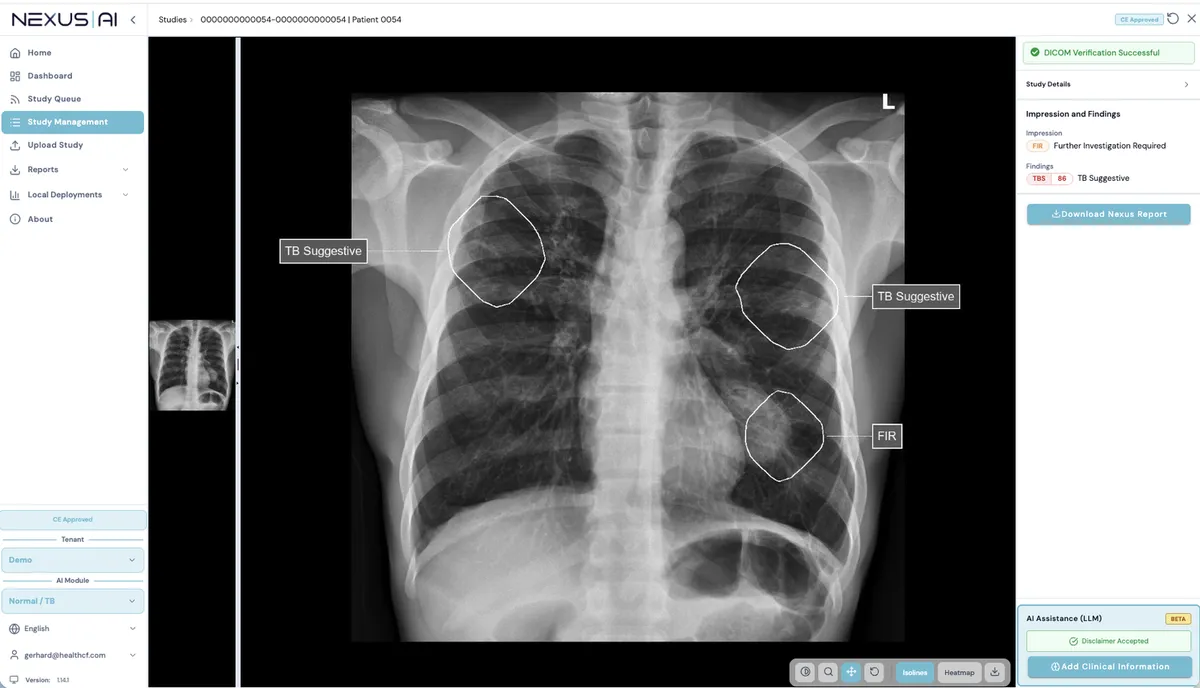
- Google Research says its TB chest X-ray AI is now a certified tool from partner Nexus AI, with EU MDR Class IIb and ISO 13485 certification.
- Nexus AI's tool operates in approximately 40 facilities, with over 25,000 chest radiographs evaluated and results in under 45 seconds.
- At the Mponeng Gold Mine, offline AI and portable X-ray kits screen miners four kilometers underground.
- MedGemma (4B and 27B) has seen more than 10 million downloads, and Indonesia is fine-tuning it with MedSigLIP for a goal of screening 50 million citizens annually.
- HeAR, trained on over 300 million audio segments, targets TB screening from cough sounds on smartphones.
From benchmark to certified tool
Tuberculosis claims an estimated 1.23 million lives each year, according to Google Research. The company says a key bottleneck is radiology: in remote rural areas and other high-burden settings, radiologists are scarce and imaging infrastructure can be days away, so many active cases go undetected.
Google's chest X-ray work began with a 2019 benchmark published in Radiology, which showed deep learning algorithms could detect active pulmonary TB at levels matching experienced radiologists. In August 2021, the Stop TB Partnership evaluated computer-aided detection software in The Lancet Digital Health and ranked Google's model among the top-performing TB screening algorithms globally. WHO also recommended CAD for TB screening and triage that year. In September 2024, NEJM AI published a prospective, multi-site validation that, according to Google, showed AI-assisted screening maintains high sensitivity across diverse patient populations.
To close what it calls the translation gap, Google partnered with Nexus AI, a Pretoria-based medical technology company. Nexus AI turned the algorithms into a clinical diagnostic tool and achieved EU MDR Class IIb certification and ISO 13485 compliance. It has also signed an agreement with FIND to pursue WHO Pre-qualification, alongside an ongoing pathway toward U.S. FDA clearance.
Deployments from clinics to a deep gold mine
The Nexus AI device screens chest X-rays for lung diseases like TB in as little as 45 seconds, according to Google. The tool operates in approximately 40 healthcare facilities across South Africa, Sierra Leone and Côte d'Ivoire, with expansions underway in the Democratic Republic of the Congo, Zambia and Cameroon. Over 90 clinicians have evaluated more than 25,000 chest radiographs, and turnaround times have fallen from weeks to under 45 seconds. Clinicians still make the final decisions. Nexus AI has delivered more than 3,000 free screenings to under-resourced public clinics, toward a goal of 10,000 sponsored screenings annually.
At the Mponeng Gold Mine in South Africa, one of the deepest mines in the world, Nexus AI worked with the Stop TB Partnership, Harmony Gold Mine and the South African Department of Health. Ultra-portable digital X-ray kits and offline AI were deployed four kilometers underground. Miners are screened on-site within seconds, and those flagged with presumptive TB can be referred immediately for confirmatory molecular testing, so screening, triage and confirmation can happen in a single visit.
Open models: MedSigLIP, MedGemma and Indonesia
Google says a single-partner solution cannot address the global TB burden, so it moved toward open foundations through Health AI Developer Foundations (HAI-DEF). It open-sourced its chest X-ray embeddings and MedSigLIP, a lightweight vision-language model that aligns medical images with clinical language. Developers can classify or search images with plain-language labels, or fine-tune the model on a small set of local examples, which lets teams build specialized models on modest regional datasets without massive compute.
Google also released MedGemma, a family of open-weight multimodal models in 4B and 27B parameter configurations. According to Google, it combines radiographic findings with clinical history, answers clinician queries in natural language and runs locally on-device without internet access. The company says MedGemma has seen more than 10 million downloads since launch.
Indonesia's Ministry of Health, which faces the world's second-highest TB burden, aims to screen 50 million citizens annually. Google says manual review is infeasible and proprietary cloud software raises data residency problems. The Ministry is instead fine-tuning MedGemma and MedSigLIP on domestic chest radiographs. Because the models run on local infrastructure, patient data stays within national borders.
Cough-based screening with HeAR
For places that imaging equipment cannot reach, Google Research also developed Health Acoustic Representations (HeAR). It was trained on over 300 million audio segments and enables non-invasive acoustic screening from cough sounds recorded on a standard smartphone microphone. According to Google, HeAR is being used in collaborative research across sub-Saharan Africa, including with CIDRZ in Zambia.
What it means
The update shows a route from published research to regulated products and open tools that health systems can adapt themselves. For high-burden regions, the claimed gains are faster triage and screening that runs offline. For governments, open-weight models offer a way to build national programs while keeping patient data in-country. Most figures, including turnaround times and download counts, come from Google and its partner Nexus AI.
Google Research: Bringing foundational models to the front lines of TB screening