Google Research expands Earth AI Geospatial Reasoning agent access
Google Research has published a technical report on its Geospatial Reasoning agent, an experimental system that combines Gemini with Earth AI models and spatial tools. The company is also widening early access through Ask Google Earth and an Agent-to-Agent (A2A) service.
- Google Research published a technical report on its experimental Geospatial Reasoning agent, which links Gemini to Earth AI models and planet-scale data.
- Experimental access is expanding via a deep research update for Ask Google Earth and an agent-to-agent API.
- Two new benchmarks, GeoExpertQueries and GeoKTools, are released in development splits for researchers.
- Google says Earth AI skills and upfront planning drive the gains over standalone LLMs, except on UnivEARTH, where a standalone LLM scores 93.6%.
- Partners including WHO Regional Office for Africa, GiveDirectly and WPP tested the agent on real workflows.
What the agent does
According to Google Research, general-purpose LLMs and standard coding tools struggle with real-world spatial problems. Planetary datasets are massive and come in specialized map and satellite formats that need careful multi-step planning to combine accurately.
The Geospatial Reasoning agent connects Gemini to Earth AI's foundation models, including WeatherNext, Flood Forecasting, the Population Dynamics Foundation Model (PDFM), AlphaEarth Foundations and Remote Sensing Foundations. It also draws on Google Maps Platform (place information, routing, air quality, rooftop solar potential), Google Earth Engine, Data Commons and Google Dataset Search.
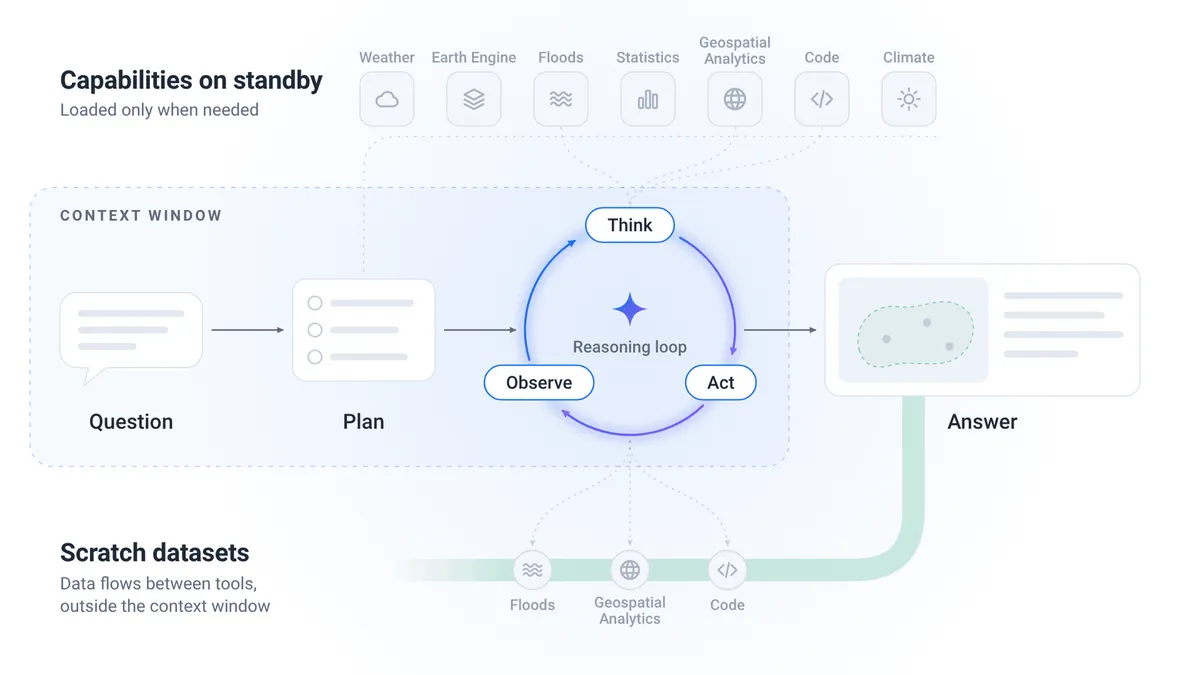
Earth AI capabilities are packaged as modular skills that the agent calls only when a question needs them. Before running complex operations, the agent builds a step-by-step plan, picks fallback datasets when local coverage is sparse, and processes large map layers in a dedicated workspace. Google says this keeps massive spatial data out of the agent's context while preserving accuracy and tracking data attribution. Each response shows the plan and the data sources used, so experts can check assumptions or substitute datasets.
Users can also bring their own data through the Geospatial Reasoning agent API, as CSV spreadsheets, GeoJSON custom map boundaries or cloud tables, and join it with Earth AI's global models and catalogs.
Planetary prediction and partner testing
The agent also powers the recently announced Planetary Prediction Engine. Given a user's local outcome data, such as regional disease rates, crop yields or grid outages, it selects relevant population and environmental signals. It fuses Population Dynamics Insights and Custom Satellite Embeddings, Google Maps Platform products built on PDFM and AlphaEarth Foundations respectively, and trains validated machine learning models for spatial prediction, super-resolution downscaling and forecasting.
Google points to its recent public health research, in which combining these population and satellite signals improved predictions of health outcomes by 12% over demographic baselines and enabled mapping at 8X finer spatial resolution.
Over the past few months, a small group of social impact and commercial partners tested the agent on their own workflows. They include the World Health Organization (WHO) Regional Office for Africa, People in Need, GiveDirectly, the Milken Institute and WPP. Use cases named by Google include disease outbreak investigations, disaster preparedness and clean energy screening.
Benchmarks and results
The technical report compares four configurations across Gemini 3.8 Flash and Gemini 3.1 Pro: a standalone LLM; the LLM with basic web search and maps grounding; the LLM with Earth AI tools but no upfront planning; and the full agent, which starts every query with a planning stage.
The evaluation uses four benchmarks. CBGB and UnivEARTH are externally developed and test geospatial code generation and question answering. Google built two new ones:
- GeoExpertQueries: complex, real-world queries with expert-authored golden workflows in areas such as crisis resilience, site selection and public health.
- GeoKTools: templated queries with verifiable answers, each requiring correct use of 1 to 4 distinct geospatial tools.
Google is releasing the development splits of both new benchmarks in full so researchers can test their own agents.
The company draws two conclusions. First, domain-specific skills are essential: an agent with only basic tools struggles on quantitative spatial tasks, and adding Earth AI skills brings a significant jump on GeoExpertQueries, GeoKTools and CBGB. The exception is UnivEARTH, where even a standalone LLM scores 93.6%, which Google says is likely because the source NASA articles and answers are on the public web. Second, upfront planning matters for open-ended work. Skills alone suffice for narrower tasks like CBGB and GeoKTools, but GeoExpertQueries requires planning to keep the agent on track and stop it from making unreliable assumptions or taking shortcuts such as using web search instead of spatial tools.
The report also discusses limitations. GeoExpertQueries scores come from an autorater that compares the agent's performance to expert workflows.
How to get access
Google is offering early access to an experimental deep research update for Ask Google Earth, and to an agent-to-agent API for developers building custom workflows, including integration recipes for connecting to Gemini. Both remain experimental, and Google links an interest form for those who want to take part.
For researchers, the two released benchmarks offer a shared way to compare geospatial agents. For organizations working on health, disaster and energy questions, the access programs open a route to try the agent on their own data.
Google Research: Putting Earth AI to work: Geospatial agents for our planet's biggest challenges