Google Research unveils 10 highlights at Research@ 2026, from Earth AI to MedGemma
Google Research used its Research@ event in Mountain View to present 10 highlights, including expanded early access to Google Earth AI and public access to its Deep Review document verification system. Yossi Matias, Vice President at Google and GM of Google Research, said the work is meant to put capabilities once out of reach in the hands of people worldwide.
- Google expanded early access to Earth AI with three new experimental ways to use it, backed by over 70 geospatial tools.
- Google.org is providing $10 million for crisis resilience and public health, including $2 million to The Milken Institute.
- Deep Review, used on over 16,000 research publications, is now open to the general public.
- TimesFM and TabFM are coming to Gemini for business and are already available to Cloud BigQuery users.
- MedGemma has been downloaded more than 10 million times by more than 65,000 innovators.
Earth AI widens early access
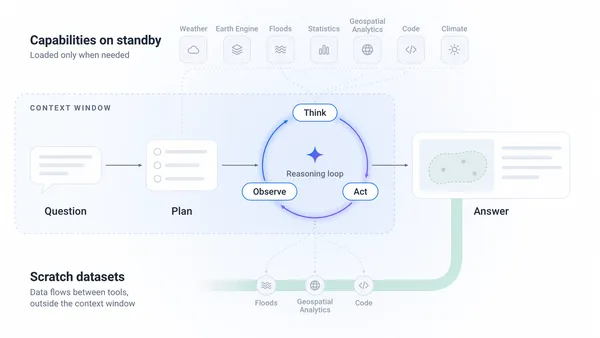
Google is expanding early access to Google Earth AI and inviting partners to try three new experimental ways of using it. The first is a deeper geospatial analysis feature in Google Earth. The second is a planetary prediction engine that generates risk assessments and forecasts different scenarios. The third is an experimental agent-to-agent API that lets developers plug Geospatial Reasoning agent skills into custom workflows, with programmatic access to satellite imagery parsing, routing and demographic embeddings.
Google also announced the integration of Google Dataset Search, for querying more than 100 million public datasets, and of TimesFM for planetary nowcasting and forecasting. According to Google, the capabilities run on over 70 geospatial tools, including the Remote Sensing Foundation Model (RSFM) and the Population Dynamics Foundation Model (PDFM), and are validated by benchmarks in the Earth AI Technical Report.
Google.org is providing $10 million in funding to organizations working on crisis resilience and public health. That includes $2 million to The Milken Institute to address infrastructure bottlenecks for affordable housing, clean energy, broadband, safe water systems and other essential infrastructure.
Tools for scientists and authors
Google described a multi-agent orchestrator that lets scientists reproduce earlier methods and analyses and apply them in new settings. In one example, researchers applied a new methodology for inverse design problems in fluid mechanics to urinary catheters. In simulation, the designs they found were better at preventing bacterial infections. The tool sits alongside Empirical Research Assistance, which generates and tests thousands of code variations in parallel, and Co-Scientist, built with Google DeepMind, which Google says helped Stanford University researchers uncover repurposed medicines for liver fibrosis.
Deep Review is an agentic system that checks complex documents for logical consistency and grounds facts. Google says many of its researchers and external authors have used an early version to review over 16,000 research publications submitted to top-tier computer science conferences. Access is now being expanded to the general public, so people can verify documents ranging from legal agreements to financial reports.
Chips, business forecasting and health AI
On hardware, Google said Synaptics will reveal next week a co-designed, low-power Edge AI chip built using Google's open source IP. It targets smart glasses and watches, connected cameras, streamers, and industrial vision and voice systems. Earlier this year the first Coralboard from Synaptics launched using Google's Coral NPU accelerator core.
TimesFM and TabFM are foundation models for time-series and tabular data. Google says both deliver accurate predictions with zero training, rank at the top of leading public benchmarks and are available to all Cloud BigQuery users. An integration into Gemini for business is coming, intended to let analysts forecast things like product sales or hospital bed capacity from tables with millions of rows, while sensitive data stays within an organization's perimeter.
MedGemma, published last week in Nature Medicine, has been downloaded more than 10 million times by more than 65,000 unique innovators, according to Google. Developers have adapted it for faster triage in overcrowded clinics and for screening for eye disease and cervical cancer. New research adds tool use, so the model can draw on health records, and explores mammography, ultrasound and electrocardiograms. Google also pointed to its AMIE research on conversational AI for clinicians and patients, with papers in Nature, Nature Medicine and a new study in The Lancet.
What it means
The announcements shift several research systems toward wider use. Deep Review is open to the public, Earth AI is reaching more partners and developers, and TimesFM and TabFM are heading into Gemini for business. For health developers, MedGemma remains an open foundation that Google plans to extend with new modalities. Most Earth AI features remain experimental and in early access, so broad availability is not yet established.
Google Research: Research@ 2026: 10 ways we're amplifying human ingenuity