Google's PDFM location embeddings tested in five global public health case studies
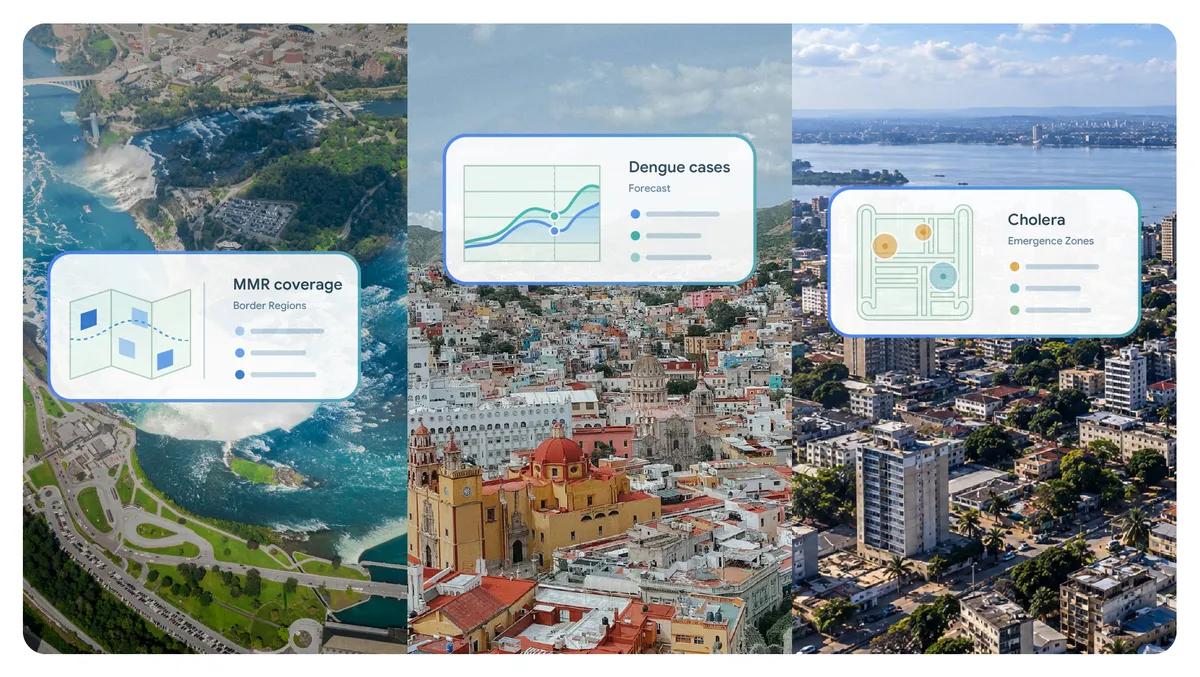
Google Research says location embeddings from its Population Dynamics Foundation Model (PDFM), part of Google Earth AI, matched or improved on conventional inputs across five partner-led public health case studies. The studies covered vaccination, cardiovascular disease, dengue, postpartum depression and cholera.
- Google Research tested its Population Dynamics Foundation Model (PDFM) in five partner-led public health case studies.
- PDFM embeddings combine privacy-preserving search trends, mobility, built environment and environmental data, refreshed monthly.
- In US-Canada border counties, MMR vaccination explained variance rose 36% (0.159 to 0.216).
- For cardiovascular mortality nowcasting, PDFM matched census-based models, with errors of 18.7 vs 19.1 deaths per county.
- PDFM is available in 17 countries, while the American Community Survey covers only the US.
What PDFM is and why Google is testing it in health
According to Google Research, conventional epidemiological surveillance is often held back by multi-year reporting lags, data siloed by geopolitical boundaries, and data sparsity. Traditional modeling also tends to need task-specific data collection and custom data engineering pipelines, which are hard to deploy during rapid outbreaks or in resource-constrained settings.
Google proposes using planetary geospatial foundation models as a remedy. PDFM is part of Google Earth AI, a suite of geospatial models connecting satellite imagery, weather, anonymous search trends, human mobility and other population dynamics. It uses self-supervised learning to compress privacy-preserving signals into compact embeddings that act as "fingerprints" for locations, refreshed monthly. The inputs include aggregated search trends, built environment and mobility data (such as the density and busyness of pharmacies, clinics and parks), and environmental determinants such as weather and air quality.
The idea is that researchers can plug these embeddings into the statistical and machine learning models they already use, instead of building new pipelines. Google says that, without task-specific fine-tuning, the off-the-shelf embeddings matched or improved on conventional inputs across a wide variety of disease domains, geographic settings and epidemiological tasks.
Five case studies, five partner institutions
Google's research partners ran independent evaluations. According to the company, the results were:
- MMR vaccination: Mount Sinai Health System and Boston Children's Hospital studied 146 US counties near the Canadian border. Adding Canadian Forward Sortation Area embeddings gave a 36% relative gain in explained variance (0.159 to 0.216, statistically significant).
- Cardiovascular disease: NYU Grossman School of Medicine tested mortality nowcasting across 3,091 contiguous US counties. Mean absolute error was 18.7 deaths per county for PDFM versus 19.1 for census-based models, and RMSE was 46.00 versus 57.69. The differences were not statistically significant.
- Dengue: The University of Oxford and Tecnológico de Monterrey worked on short-horizon forecasting across about 2,450 Mexican municipalities. Integration with TimesFM gave a statistically significant 1-month forecast gain, and accuracy improved in up to 72% of active transmission municipalities.
- Postpartum depression: The University of Washington's Institute on Human Development and Disability used CDC PRAMS data on 332,970 respondents. Risk prediction AUC rose by 0.0020 on a 0.62 baseline in seen states and by 0.0038 in unseen states. Google says the embeddings recover about 15% of the predictive signal of income and insurance records.
- Cholera: WHO AFRO examined outbreak onset prediction in 403 health zones of the Democratic Republic of the Congo over 89 weeks. Gains included +9.7% in area under the precision-recall curve at 4 weeks and +18.1% Precision@5 at 8 weeks, with +19.3% Precision@5 in endemic health zones.
Cross-border vaccination and faster chronic disease data
In the vaccination study, domestic-only models often struggle to predict local uptake near the border. By adding Canadian embeddings, the researchers raised the share of variation in MMR coverage explained by the models from 16% to 22%. They also refined coverage estimates by at least 3 percentage points for 4.7 million border residents, revealing local patterns that domestic-only models may miss.
For cardiovascular disease, which Google says claims over 916,000 lives annually in the US, the timing of data is the issue. Official county-level mortality data from the National Vital Statistics System typically lags by 1 to 2 years, and American Community Survey covariates reflect conditions up to 2 to 3 years in the past. In the NYU study, models using PDFM predicted 2023 county-level deaths about as accurately as models using ACS data, while cutting large county outlier errors by 20% (57.7 to 46.0).
Google also points to practical advantages. ACS covariates pool five years of survey data and are released up to a year after collection, while the PDFM embeddings in the study were built from a single month of data. PDFM is available in 17 countries, whereas ACS covers only the US.
What it means for public health work
Google presents the results as support for a new paradigm in which pre-trained representations of place become routine inputs to health models. Its stated argument is that health departments could guide prevention resources using current conditions rather than waiting on multi-year survey cycles. Several gains are modest, and in the cardiovascular case PDFM was comparable to census data rather than better, so the strongest claim is substitution where census data are outdated or unavailable.
Google Research: Unlocking Earth AI’s planetary geospatial foundation models for global public health