IgniteTech deploys AI that fixes, tests and ships enterprise software changes
IgniteTech says it is bringing AI-managed software development to enterprise products, allowing an automated system to investigate customer bug reports, create fixes, test them, deploy updates and report back when the work is complete. The company says the process operates within human-defined security and product guardrails.
- IgniteTech says AI can take a bug report from investigation through deployment.
- Automated tests and production checks precede customer notifications.
- People retain control of permissions, payments, data deletion and outside communications.
- Khoros plans to apply the approach to Aurora AI and Iris® AI.
- Anvil published four new versions and seventeen requested changes during four days.
From a customer report to a deployed fix
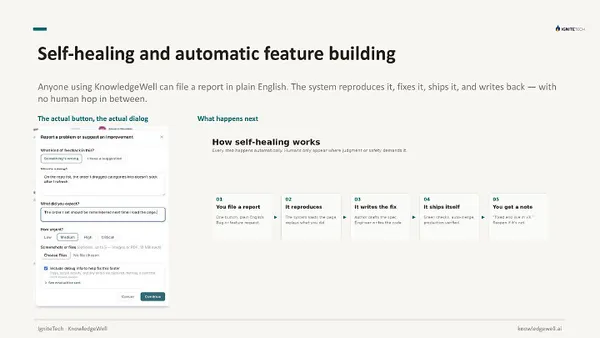
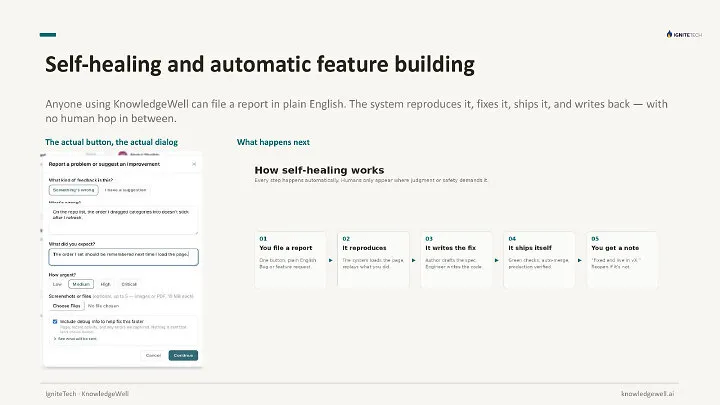
Under IgniteTech’s approach, a user reports a problem in their own words from inside a product. The AI then reproduces the issue, identifies its cause, writes a correction, sends it through automated checks and communicates with the customer once the change is live.
The company says the same process applies to feature requests. Before a fix is proposed, the system questions the person who submitted the report until it understands the issue, then reproduces the problem itself. A change is released only after automated testing. Once it is in production, the system repeats the customer’s original steps to confirm that the software works before sending a completion notice.
IgniteTech presented completion notices for three reports, each naming the version in which the change went live. Two reports began as feature requests and one as a defect report, according to the company.
A fixed pipeline with human-controlled boundaries
The company’s system uses a fixed pipeline of AI roles to plan, specify, review, build and ship changes. IgniteTech says the same gates are applied to every project, creating a repeatable process rather than leaving each software change to an ad hoc AI workflow.
People retain control over sign-in, permissions, secrets, payments, destructive data changes and communications sent outside the company. Each product also has a clear master plan that defines its purpose and direction. Requests are checked against that plan before construction begins. Relevant requests can become features for every customer, while requests that do not fit are sent for a decision.
IgniteTech says this approach keeps each product shared across customers instead of creating individually customised versions that would need to be maintained separately.
Khoros will apply the system to its AI platforms
Khoros is the first IgniteTech business named to apply the approach to customer-facing products. The company plans to use it in its Aurora AI and Iris® AI platforms, allowing customers in communities and social media to report problems or request features and see those changes integrated into the shared product.
Two internal IgniteTech systems already use the process daily: KnowledgeWell, an internal knowledge base, and Anvil, an account-management system for one of the company’s largest product programs. IgniteTech says CEO Eric Vaughan wrote both systems in less than two months to demonstrate the approach in real production software.
During four days when Vaughan was serving as a juror in Texas and had his phone turned off, Anvil continued correcting and improving itself, publishing four new versions and seventeen changes requested by five colleagues, according to IgniteTech.
IgniteTech says the approach is still developing
IgniteTech says its AI does make mistakes and does not always develop a feature exactly as the requester intended. The company says it improves continuously, week after week.
Vaughan is due to present the system at the Financial Times Future of AI Summit in London on November 5, 2026. IgniteTech says it has spent nearly four years building the guardrails and harness behind the process, drawing on more than 30 years of experience in business-critical enterprise software.
For users, the company’s claim is that software support could move away from quarterly roadmaps and accumulating backlogs toward a workflow that handles reports and requests continuously. The announcement describes that as an early-stage approach, with human oversight remaining in areas involving access, money, data deletion and external communications.