Liquid AI introduces LiquidCodec for faster, high-fidelity audio
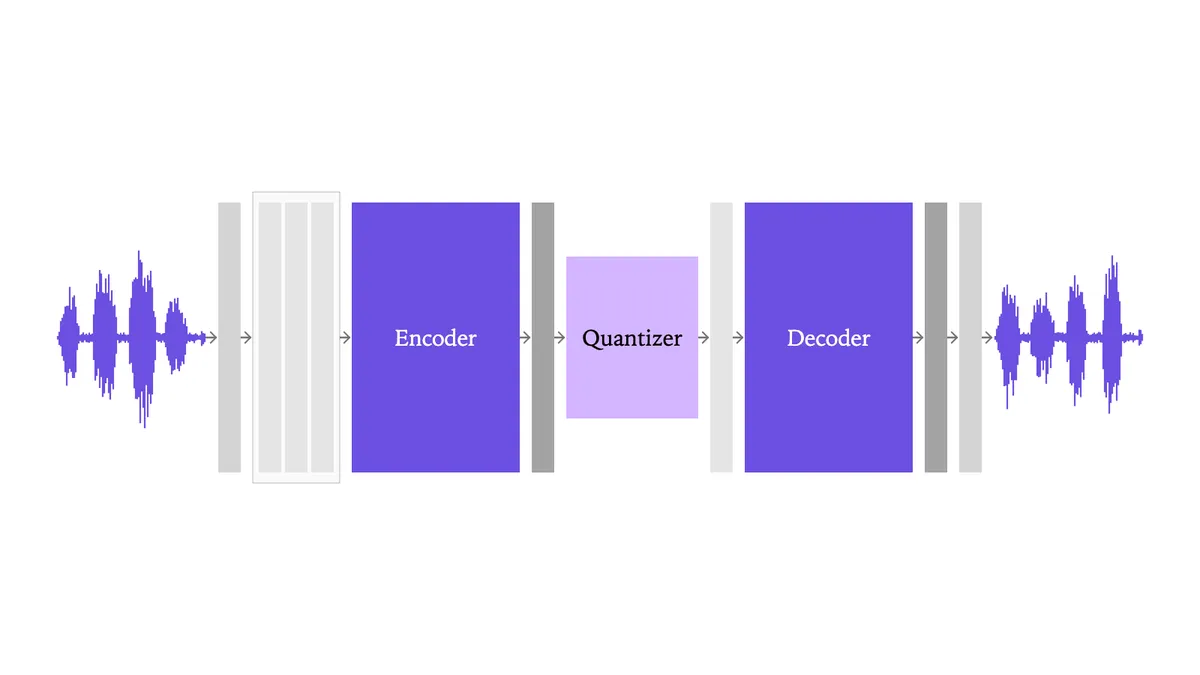
Liquid AI has detailed LiquidCodec, an in-house streaming audio codec built for the company’s LFM3-Audio-2B and LFM3-Omni-2B models. The roughly 74M-parameter system is designed to make audio tokens easier to predict while speeding up conversion back into speech.
- LiquidCodec is designed for Liquid AI’s LFM3-Audio-2B and LFM3-Omni-2B models.
- The codec has roughly 74M parameters and targets fast on-device audio processing.
- It uses grouped finite scalar quantization for more parallel audio-token prediction.
- Training covered 264,000 hours across 107 languages in its first stage.
- A second stage used 55,000 hours of cleaner full-band speech.
A codec built for on-device audio
LiquidCodec converts speech into discrete tokens that language models can predict, then converts those tokens back into audio. Liquid AI says the codec matches similarly sized models in reconstructed audio quality and speech compression, while outperforming them in speech generation and token-to-waveform decoding speed.
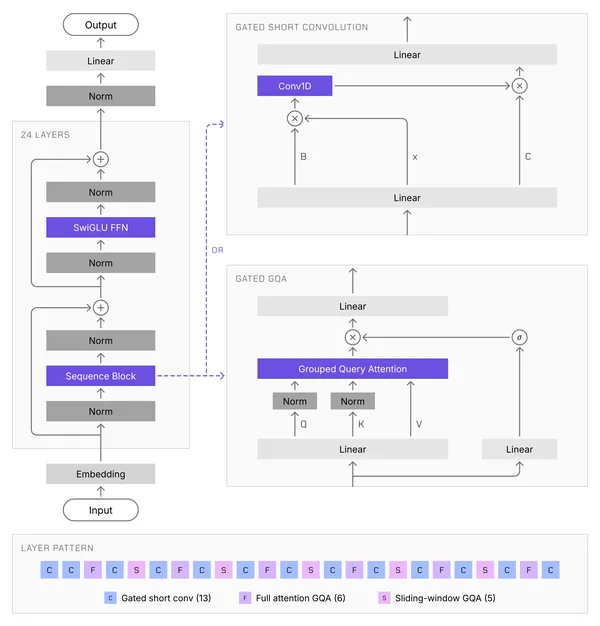
The codec combines traditional spectral processing with a symmetric encoder and decoder. Liquid AI built it on the LFM3 architecture and optimized it for on-device use, with a focus on low-latency, real-time audio streaming. The system models 24 kHz waveforms and keeps a frame rate of 12.5 Hz, producing one frame every 80 ms.
Why Liquid AI replaced its earlier approach
Liquid AI previously used the Mimi codec in LFM2-Audio-1.5B. Mimi offered a 1.1 kbps bitrate and a parameter count of about 96M. For LFM2.5-Audio-1.5B, Liquid AI replaced only the detokenizer and achieved 8× faster detokenization, while retaining Mimi’s tokenizer.
For its newest audio models, the company wanted more control over both audio-token quality and the ease with which language models predict those tokens. Mimi uses residual vector quantization, or RVQ, in which codebooks are used sequentially. LiquidCodec instead uses grouped finite scalar quantization, or GFSQ. According to Liquid AI, this approach reduces sequential dependencies between codebooks and allows parallel prediction.
LiquidCodec also uses a fully causal encoder and a symmetric tokenizer and detokenizer. Liquid AI says its design avoids costly operations used in similar codecs, including progressive upsampling with learned transposed convolutions during decoding.
Multilingual training and speech quality
Liquid AI trained LiquidCodec in two stages. The first used 264,000 hours of data across 107 languages, combining web speech, audiobooks, crowd-sourced recordings, and smaller parliamentary and meeting collections. The company used waveform and spectral losses and omitted adversarial losses during this phase to develop robust audio representations.
Liquid AI says this initial training could leave “metallic” artifacts. In the second stage, it fine-tuned the codec on 55,000 hours of cleaner, full-band speech from multiple languages. The sources were natively sampled at 24 kHz or above, and the company used adversarial critics covering waveform patterns, spectral detail, and speech features. It also used decoder-only quantization-aware training to improve robustness for edge inference.
Liquid AI says reconstruction quality is only one measure of a codec. Its tokens must also be easy for a speech model to learn during text-to-speech training. To compare codecs, the company fixed the training data, architecture, and compute budget, using 101,000 hours across six languages and a backbone initialized from pretrained LFM3-1.7B.