Meta's Muse Spark Open Weights Now Available on Modal Auto Endpoints
Meta has released weights for Muse Spark Open, a model built for agentic coding and long-horizon tasks, and it is now available on Modal Auto Endpoints. Modal says the model runs as a Shared Endpoint with per-token billing.
- Meta released weights for Muse Spark Open, now available on Modal Auto Endpoints.
- The model targets agentic coding and long-horizon tasks, with native multimodal understanding and a 1M-token context window.
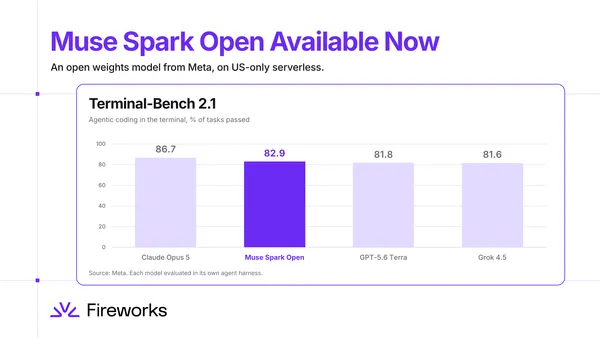
- Meta reports 76.4 on Terminal-Bench 2.1 (Terminus 2 agent) and 60 on DeepSWE 1.1 (Meta's preferred harness, xhigh reasoning effort).
- On Modal it runs as a Shared Endpoint with per-token billing.
What Muse Spark Open is built for
According to Modal, Muse Spark Open is designed for agentic coding and long-horizon tasks. The model offers native multimodal understanding and a 1M-token context window, which allows it to work with large amounts of input in a single session.
Modal lists a range of supported capabilities:
- Writing and debugging code
- Multi-step planning
- Sequential tool use
- Failure recovery across extended workflows
These abilities are aimed at agent-style workloads, where a model has to carry out a chain of actions, use tools in order and recover when a step goes wrong, rather than answer a single prompt.
Benchmark results reported by Meta
Modal cites results from Meta's own evaluations. According to the post, Muse Spark Open scores 76.4 on Terminal-Bench 2.1 using the Terminus 2 agent. It also scores 60 on DeepSWE 1.1 using Meta's preferred harness, with xhigh reasoning effort.
These are figures reported by Meta, and the scores depend on the specific agent, harness and reasoning setting used. Modal points readers to the released model card for the full benchmark results and evaluation settings. Anyone comparing the model with others should check those settings, since results on agentic benchmarks can vary with the setup.
How to run it on Modal
Muse Spark Open is offered on Modal Auto Endpoints. Modal states that it runs as a Shared Endpoint with per-token billing. That means usage is charged by the number of tokens processed, not by reserved hardware, according to the billing model named in the announcement. The source does not give prices or any usage limits.
What it means for developers
With the weights released and a hosted option live on Modal, developers who want to try a model aimed at coding agents can do so through a shared endpoint with per-token billing. The combination of a 1M-token context window and the listed focus on tool use and failure recovery points to long, multi-step coding tasks as the intended use. The source does not provide further details on pricing, rate limits or licensing, so those would need to be checked in Meta's model card and on Modal.
Modal: Muse Spark Open is now available on Modal