Meta releases Muse Spark Open, an 816B open-weight model for coding agents
Meta has released the weights for Muse Spark Open, an 816B-parameter open-weight omnimodal mixture-of-experts model co-trained with Muse Code for coding agent workflows. Inference provider Baseten, which published the details, says the model is available from day 0 on its Model APIs and Dedicated Inference.
- Meta released the weights for Muse Spark Open, an 816B-parameter omnimodal MoE model with 42.7B active parameters and a 1M token context window.
- The model was co-trained with Muse Code for coding agent workflows and accepts text, image, video and audio input.
- A hybrid global/local attention design cuts KV-cache memory by roughly 3.7x at 128K context, according to Baseten.
- Baseten serves an NVFP4 checkpoint of about 540 GB that fits on a single 4×GB300 node.
- It is available now on Baseten Model APIs and Dedicated Inference through an OpenAI-compatible endpoint.
What Muse Spark Open offers
According to Baseten, Muse Spark Open has 816B total parameters with 42.7B active during inference and a 1M token context window. It accepts text, image, video and audio as input and produces text output. Baseten describes it as the most capable US open-weights model to date.
The model was co-trained with Muse Code and is designed specifically for coding agent workflows. It can also be used with third-party coding agents such as OpenCode, Pi and Deep Agents Code.
The omnimodal input opens up workflows that text-only models cannot handle, Baseten says, for agents that support image, video or audio input:
- Screenshot-driven UI debugging: the agent compares a screenshot of a rendered page with a design mockup or bug report image and fixes the layout code.
- Video reproduction to test case: a developer records a bug on screen, and the agent extracts the steps and writes a reproduction script or end-to-end test.
- Voice-driven pair programming: the developer talks and types at the same time, with audio taken as direct input rather than transcribed first.
Benchmarks and where it stands
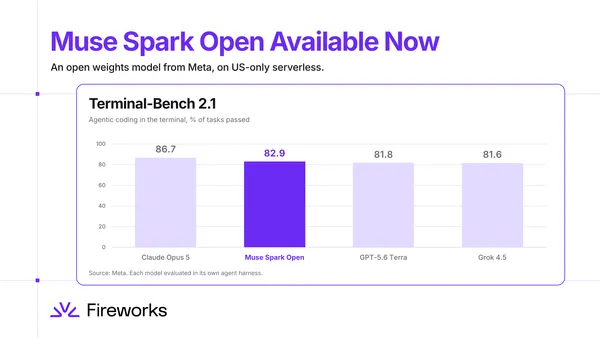
Based on benchmark scores reported by Meta, Muse Spark Open is competitive with models from other frontier labs on agentic coding and knowledge work. On the agentic coding benchmarks, each model was tested with its own lab's coding agent: Muse Spark with Muse Code, Claude Opus 5 with Claude Code, and GPT-5.6 Terra with Codex. The scores therefore reflect each model in the tooling it was built for, not a shared harness.
The comparison set includes each lab's flagship model but excludes the top-tier models above them, namely Claude Fable 5.1 and GPT-6 Astra.
Baseten's own assessment is more cautious. In routine agent loops, such as running commands, reading output and fixing what breaks, Muse Spark Open should feel close to the flagship closed models. On large, multi-file changes across many steps, users should expect it to need more guidance or retries than Claude Opus 5 or GPT-5.6 Terra, while it holds up well against Grok 4.5 and Gemini 3.6 Flash. When an agent has to write up its work, it beats every model in the chart except Opus 5.
Architecture built for long agent sessions
Coding agents read context, reason, generate and re-read results in a tight loop, and may run background subagents in parallel. That demands high throughput and efficient memory use over long contexts. Muse Spark Open addresses this with two design choices.
The first is a compressed mixture-of-experts block. A shared pooler compresses the input vector before it reaches the experts, and a shared unpooler projects their combined output back to the original dimension. The router, which selects experts for each token, still reads the full-width vector. According to Baseten, this halves each expert's parameters, shrinks total model size by roughly 800B parameters compared with an uncompressed design, frees GPU memory for larger KV caches and concurrent sequences, and reduces inter-GPU traffic in the MoE layer.
The second is a hybrid attention schedule. Of the model's 62 layers, 46 are local attention layers with a 2048-token sliding window using rotary position embeddings, and 16 are global attention layers that see the full sequence with no positional encoding. Local layers only keep the most recent 2048 tokens in their KV cache, while the full context is preserved in the global layers. Baseten says this cuts KV-cache memory by roughly 3.7x at 128K token context, from 31 GiB to 8.4 GiB per sequence, and that the savings grow with context length.
Serving and availability
Baseten serves an NVFP4 checkpoint optimized for Blackwell. Expert weights are stored in 4-bit, while full bf16 is kept for the attention weights and the experts in the first and last layers. This reduces the weight size from roughly 1.6 TB to 540 GB, so the full model fits on a single 4×GB300 node and avoids multi-node interconnect for both weights and KV cache. The freed memory goes to KV cache, allowing more concurrent agent sessions per node.
Muse Spark Open is available now on Baseten Model APIs. The endpoint is OpenAI-compatible, so developers can point an existing coding agent at it without changing their harness. Tool calling, reasoning output and the full 1M context window are supported. For teams running agents at scale, Baseten also offers Dedicated Inference deployments with reserved capacity.
What it means for developers
For teams that want to run coding agents on open weights, the release offers a large model with multimodal input and a long context window, plus an OpenAI-compatible endpoint that lowers the effort of trying it. The benchmark figures come from Meta, and Baseten's own guidance suggests the model may need more retries than the leading closed models on complex multi-file work. Teams should test it against their own workloads.
Baseten: Muse Spark Open, an open-weight model for coding agents