Microsoft Discovery app helps entomologist adapt insect monitoring to citrus pest
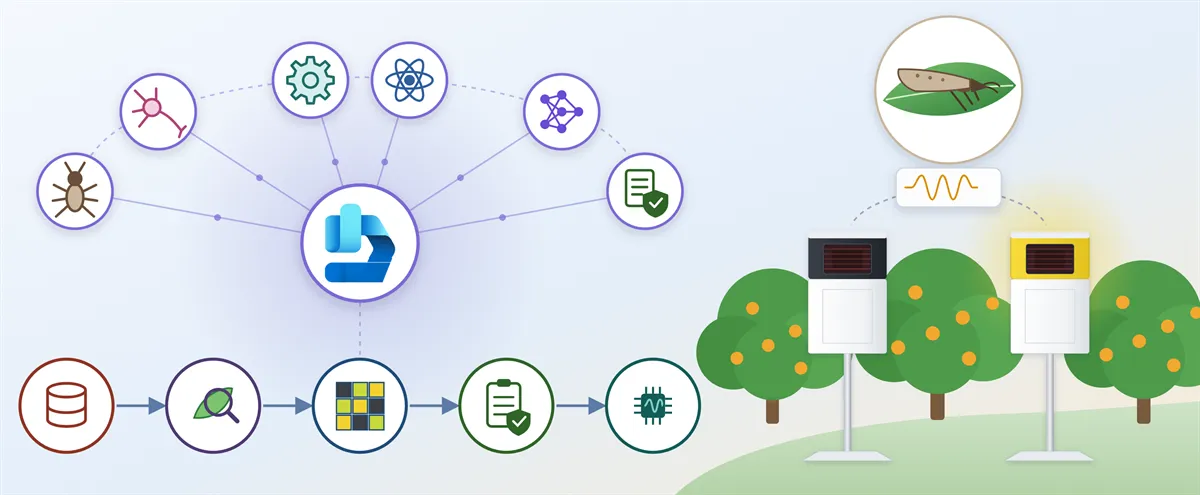
A Microsoft entomologist used agentic AI in the Microsoft Discovery app to adapt an insect monitoring platform to the Asian citrus psyllid, which spreads Citrus Greening Disease. According to the author, work that would normally take several weeks was compressed into a few days.
- A Microsoft entomologist used the Microsoft Discovery app to adapt Biological Weather Stations to the Asian citrus psyllid, which spreads Citrus Greening Disease.
- According to the author, a literature review, experimental design, permit review, and classifier development were compressed from several weeks into a few days.
- Coding agents interpreted over 120 software projects and reference documents to ground the app in the team's own systems.
- Synthetic ACP biometrics were used to build an initial edge classifier, to be tested in the lab once permits for live ACP are granted.
From human disease vectors to a crop pest
The post, published on the Microsoft Discovery Blog on Oct 22, 2026, asks whether a biological monitoring system tuned for insect-borne human and animal pathogens can be quickly adapted to major crop pathogens and pests. The author is an entomologist on the Microsoft Premonition program, which has been developing Biological Weather Stations (BWS). These devices use AI on the edge to monitor insect populations in real time and collect samples robotically, so researchers can learn how common and widespread the insects' pathogens are.
According to the post, the BWS identifies species from the biomechanics of their flight and uses robotic collection to selectively capture targeted specimens. The test case was the Asian citrus psyllid (ACP), which transmits an incurable plant pathogen to susceptible citrus trees. The result is Citrus Greening Disease (CGD), described in the post as one of the biggest threats to the global citrus industry. Effective ACP monitoring is a key component of controlling the disease and developing new interventions.
The post cites the Food and Agriculture Organization of the United Nations, which estimates that pests and plant diseases destroy up to 40% of global crop production annually. It also cites the World Health Organization, which estimates that diseases spread by mosquitoes, other biting flies, and ticks account for more than 17% of infectious diseases and cause more than 700,000 deaths each year. Traditional insect monitoring, the author writes, is highly labor-intensive, depends on scarce entomological expertise, and offers limited temporal resolution.
Five steps with the Discovery app
The author describes a workflow with five stages.
- Ground. Coding agents received read-only access to engineering artifacts, manuals, and standard operating procedures (SOPs) for the monitoring platforms. They interpreted over 120 software projects and reference documents, then generated agent skills, data taxonomies, data examples, and helper methods for the Discovery app.
- Research. The app ran a literature review on ACP ecology, co-occurring agricultural pests, natural and possibly introduced predators, and other beneficial insects. The focus was commercial citrus groves in the Southeastern U.S., where CGD is endemic.
- Experimental design. The author and the app developed designs to determine the best device configuration and deployment approaches for maximizing ACP monitoring.
- Biocontainment permitting. ACP is a regulated species. The author supplied existing permits, SOPs, and laboratory designs and worked with the agent to draft new permit requests and SOPs. The post stresses that the collaboration was essential because the lab manager would be responsible for any mistakes in these documents.
- Classifier development. Because permitting can take a long time, the app analyzed thousands of examples of insect biometrics from other species and considered biomechanical models of ACP and related species. It then helped engineer a pipeline that generates synthetic ACP biometrics.
According to the author, the synthetic data helped the team build an initial edge classifier for ACP. That classifier can be tested in the lab under proper biocontainment once permits for live ACP are granted.
What it means for researchers
The author frames the work as a shift in the role of AI, from a sophisticated search tool to something closer to a scientific collaborator. The questions the author worked through with the agent included how ACP is normally detected, what the best experimental design is, which biological or behavioral traits could affect detection, which lab experiments matter most, and which permits the field work requires.
The post presents this as one researcher's experience, not a controlled evaluation, and the time savings are the author's own account. The classifier is still an initial version built on synthetic data and has not yet been tested on live ACP. Still, the example shows how the Discovery app is being used to combine literature, tools, data, and protocols across disciplines, which the author calls "science horizontals", in order to move faster on food security problems.
Microsoft: How AI could help scientists track a pest threatening citrus trees