Mind Lab Opens Mint Recursive Post-Training to Enterprises, From $1,000
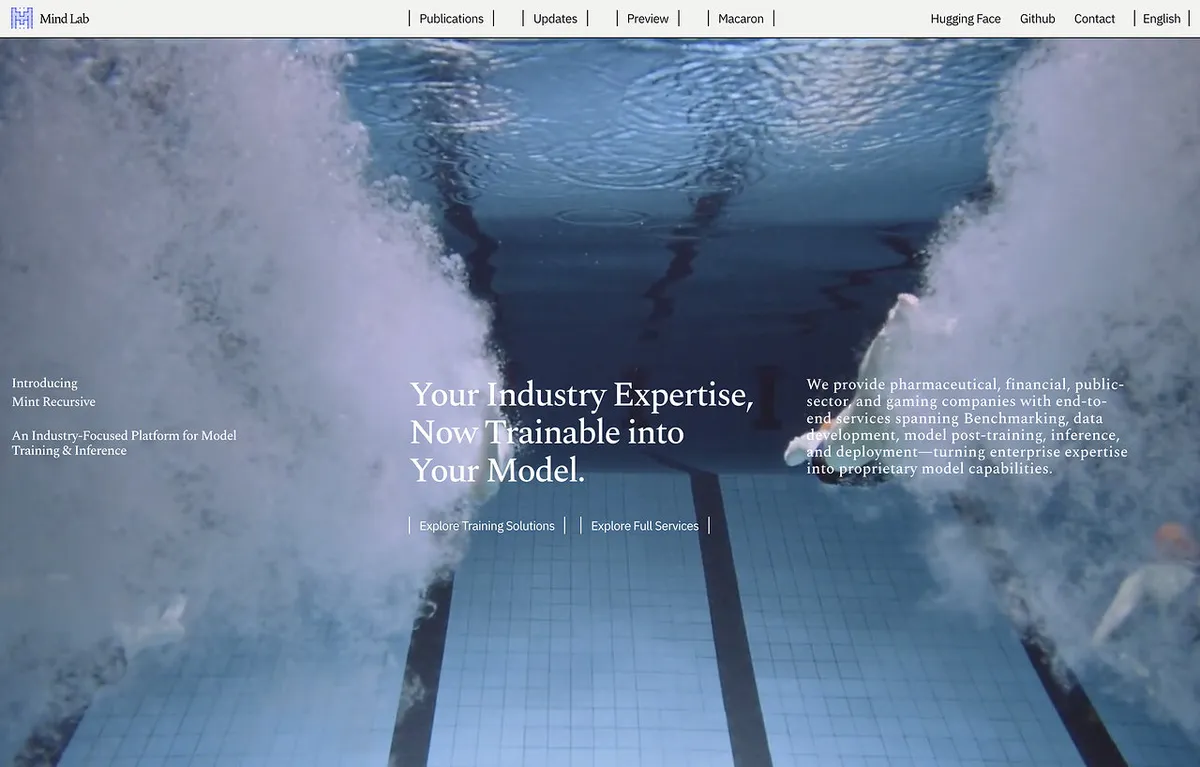
Mind Lab, an AI research lab focused on continual learning and post-training, is making its Mint Recursive platform available to enterprises that want models trained for their own industry. According to the company, specialist training starts at $1,000 and GPU costs on shipped projects have fallen by more than 90%.
- Mind Lab is making its Mint Recursive post-training platform available to enterprises building industry-specific models.
- Specialist training starts at $1,000; the company reports GPU costs on shipped projects down by more than 90%.
- Customers can pick GLM, DeepSeek, Kimi, Qwen or MiniMax base models and deploy in private, VPC or hybrid environments.
- Three working modes range from engineer-led delivery to custom loss functions and training loops.
- Macaron-V1.1, a 752B-parameter open-weights model, raised first-attempt success on 60 UI tasks from 71.67% to 96.67%, per the company.
One workflow from benchmark to deployment
Mint Recursive provides enterprise model post-training that, in Mind Lab's words, turns a company's expert experience into model capabilities the company owns. The company names pharmaceuticals, finance, the public sector and gaming as example industries.
Each engagement starts with a benchmark built together with the customer. It defines the task goal, what correct behavior looks like, the mistakes that come up most often and the acceptance line a model has to clear. Data development, LLM post-training and deployment then run in a single loop, so every iteration is measured against a standard the customer helped set.
The company's framing is that a general-purpose model is a starting point, not a finished product.
Lower costs and three ways to work
Mind Lab says cost is often what keeps teams from training their own models. The platform combines LoRA post-training, shared base models and distributed optimization, so fewer parameters are updated and less compute is spent. The company reports that GPU costs on shipped projects have fallen by more than 90%.
Customers can choose base models from the GLM, DeepSeek, Kimi, Qwen and MiniMax families and deploy in private, VPC or hybrid environments. They also decide how much of their own team to commit:
- Full service: Mind Lab's forward-deployed engineers run the benchmark, data, post-training and deployment end to end.
- Automated training: teams that define their own model, data and configuration hand scheduling, training and delivery to the platform.
- Full control: teams write their own loss functions and training loops, while the lab provides clusters, trajectory sampling, weight sync and inference.
Research behind the platform
The platform grows out of the lab's work in reinforcement learning. Mind Lab says it was among the early teams to run end-to-end LoRA reinforcement learning on trillion-parameter mixture-of-experts (MoE) models.
When it introduced Mint Recursive in September, the lab also released Macaron-V1.1, a 752B-parameter agent model post-trained from GLM-5.3, with open weights. According to the company, moving from Macaron-V1 to Macaron-V1.1 took two weeks on the platform. Across 60 UI tasks, first-attempt delivery success rose from 71.67% for GLM-5.3 to 96.67% for Macaron-V1.1.
In healthcare and life sciences, Mind Lab says it supports literature retrieval and evidence review, drug discovery and R&D intelligence, and medical chart quality control. Its shipped work in this area covers 27 quality-control indicators and more than 8,000 physician-experience traces.
What it means for enterprises
The offer is aimed at organizations that want proprietary models without a large up-front program. "An enterprise's most valuable training signal is the judgment of its own experts," said Chen Kaijie, Founder of Mind Lab, in the press release. He added: "It doesn't need to start as a big program. It can start with one real task."
Companies interested in building their own models can contact Mind Lab to define the benchmark for a single task. The source gives a starting price for specialist training and the choice between hands-on, automated and fully self-directed work, but no further pricing details. The performance and cost figures are the company's own reports.