MLCommons expands MLPerf Training with two AI workload benchmarks
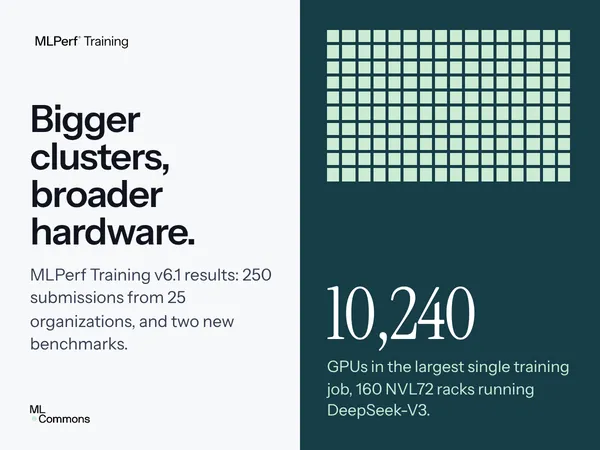
MLCommons has released results from MLPerf Training v6.1, adding benchmarks for recommendation systems and large-scale post-training while expanding participation across AI hardware providers. The latest round includes 153 systems, 250 test results and systems ranging from single-node deployments to one using 10,240 accelerators.
- MLPerf Training v6.1 adds DLRMv4-HSTU and Qwen3.5-397B.
- The round includes 153 systems and 250 test results.
- 57 systems were cloud-based, representing 37% of the total.
- The largest system used 10,240 accelerators.
- Results include NVIDIA Rubin GPUs and Google TPUv7 for the first time.
Two benchmarks target changing AI workloads
MLPerf Training v6.1 adds DLRMv4-HSTU, a recommendation benchmark, and Qwen3.5-397B, a workload for large-scale language model post-training. MLCommons describes the suite as a collection of full-system tests that put models, software and hardware through workloads covering a range of machine learning applications.
DLRMv4-HSTU updates and replaces the DLRM-dcnv2 benchmark used in earlier MLPerf versions. It uses the HSTU attention-based architecture and trains on the Yambda dataset, which MLCommons describes as one of the largest open-sourced recommendation datasets available.
Qwen3.5-397B introduces a post-training workload based on Group Relative Policy Optimization, or GRPO. According to MLCommons, the benchmark is designed to reflect the growing role of post-training in AI systems, including systems with agentic functionality. It trains a model to reason independently on software engineering tasks, including tool-calling.
“Post-training has added a new level of complexity to the architecture of AI training,” said Shriya Rishab, MLPerf Training working group co-chair. She said the community had worked on the benchmark test for two years and that the v6.1 results show it is being adopted quickly.
More systems and wider hardware representation
The v6.1 submissions include 153 systems and 250 test results. Cloud-based systems accounted for 57 submissions, or 37% of the total, compared with 29% in v6.0. Twelve systems used 1,000 or more accelerators, and the largest system used 10,240 accelerators.
The results include NVIDIA, AMD and Google accelerator hardware. This round also includes NVIDIA Rubin-generation GPUs and Google TPUv7, also called Ironwood, for the first time. MLCommons said the submissions demonstrate greater variety in hardware, system architectures and deployment scale.
“Having much more of the matrix of possible systems represented in the published results gives us a clearer view of how they stack up against each other in the most important real-world scenarios for AI training,” said Pavan Yalamanchili, MLPerf Training working group co-chair.
Yalamanchili added that organizations can use the results to identify a suitable system configuration for their needs, from a single-node system to a multi-node cluster with thousands of accelerators.
Independent benchmarking draws 24 organizations
Performance results in the v6.1 round came from 24 submitting organizations: AMD, ASUSTeK, Azure, Cisco, CoreWeave, Crusoe, Dell, Firmus, Fujitsu, Giga Computing, Google, HPE, Inventec, KRAI, Lambda, MiTAC, Nebius, NVIDIA, Oracle, Quanta Cloud Technology, Supermicro, tiny corp, TTA and the University of Florida.
Crusoe was a first-time MLPerf Training submitter in this round. David Kanter, Head of MLPerf at MLCommons, said the continued participation of existing organizations alongside new submitters shows the value of benchmark data for new workloads and systems.
MLCommons describes MLPerf Training as an open-source and peer-reviewed benchmark suite intended to support comparisons of performance and energy efficiency across the industry. Its benchmark collection is curated by experts from the AI community.
The results are available on the MLPerf Training benchmark page. The release also includes visualization tools for comparing performance across systems and ranking results among systems of similar scale. For users evaluating AI training infrastructure, the expanded workload coverage and broader set of configurations provide more data for comparing systems, although MLCommons presents the benchmark results as guidance for different deployment choices rather than a single ranking for every use case.