MLPerf Training v6.1 shows larger clusters and wider hardware choice
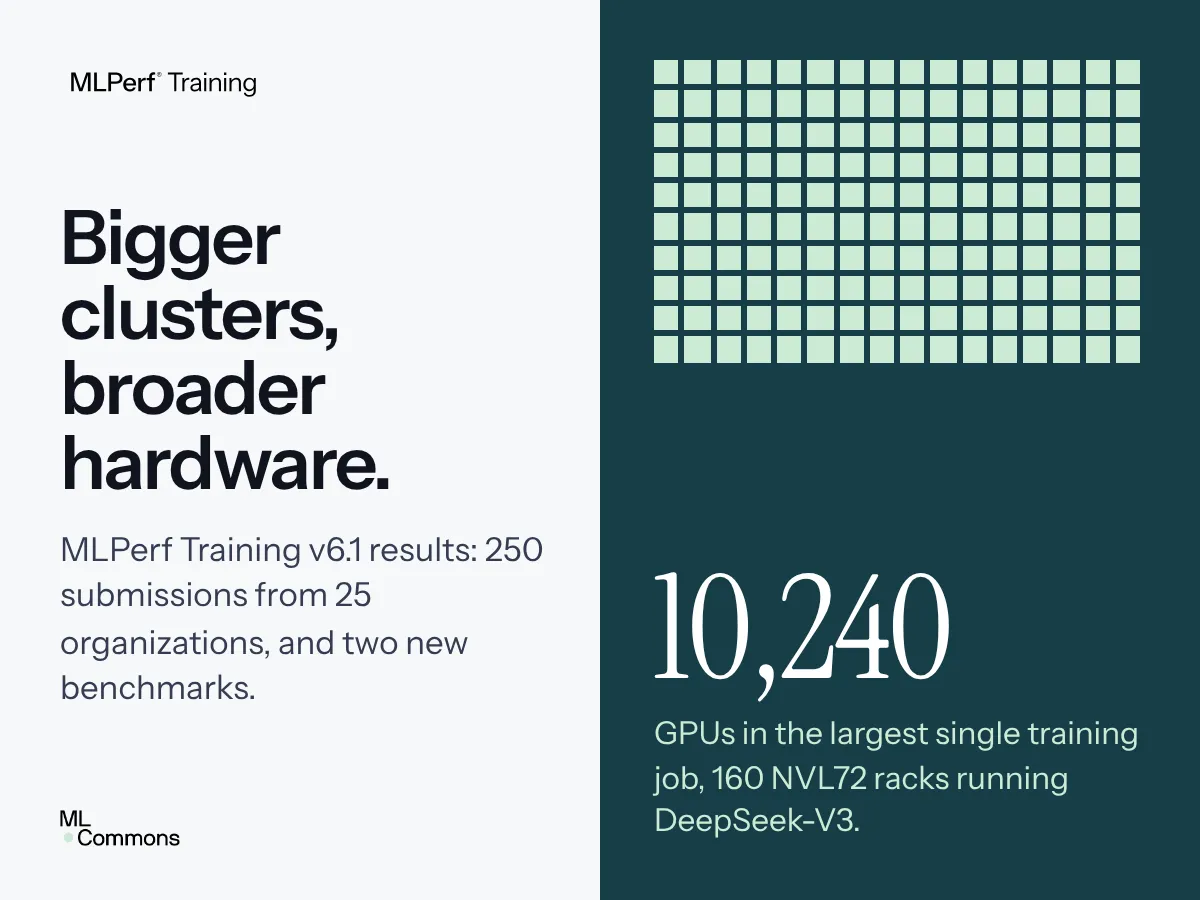
MLCommons’ MLPerf Training v6.1 benchmark round expands its workload suite while showing a sharp increase in system scale. The round includes 250 submissions from 25 submitters, with the largest jobs using 10,240 GPUs to train DeepSeek-V3.
- MLPerf Training v6.1 includes 250 submissions from 25 submitters.
- Qwen3.5-397B GRPO and DLRMv4 (HSTU) joined the benchmark suite.
- The largest jobs used 10,240 GPUs to train DeepSeek-V3.
- Multi-node systems represented 76% of systems in the round.
- Twelve accelerator products from NVIDIA, AMD and Google appeared in the results.
Two benchmarks added, two retired
MLPerf Training v6.1 adds Qwen3.5-397B GRPO, an agentic post-training workload that uses reinforcement learning to teach a 397-billion-parameter language model to repair real software projects. Seven submitters ran the benchmark, producing 29 submissions.
The second addition is DLRMv4 (HSTU), a generative recommendation model that replaces DLRM-DCNv2. Eight submitters produced 20 submissions for the new benchmark.
MLCommons retired Llama 3.1 405B after three rounds, saying large dense models are no longer representative of large-scale pretraining, which has shifted toward mixture-of-experts models. DLRM-DCNv2 was retired after seven rounds and replaced by DLRMv4 (HSTU).
Training systems are getting larger
Multi-node systems accounted for 76% of systems in the round, or 117 of 153, up from 61%, or 72 of 118, in v6.0. Nineteen of 25 submitters entered at least one multi-node system, compared with 16 of 24 in the previous round.
The median accelerator count per Closed result rose to 32 in v6.1, after remaining at 8 in every round from v4.0 through v6.0. Results using 64 or more accelerators increased from 73 in v6.0 to 111.
The largest Closed systems grew from 8,192 GPUs in v6.0 to 10,240 GPUs in v6.1. NVIDIA’s GB300 NVL72 and Azure’s GB200 NVL72 systems both trained DeepSeek-V3 at that scale. Google trained DeepSeek-V3 on 8,192 TPU7x chips in a single ICI slice.
Broader hardware and software participation
The round includes 12 accelerator products from three vendors. NVIDIA products appeared on 122 systems from 21 submitters, AMD’s MI300X, MI350X and MI355X appeared on 27 systems from nine submitters, and Google’s TPU7x appeared on four systems with up to 8,192 chips.
Google’s Ironwood and NVIDIA’s Rubin made their debut as Available systems. AMD also submitted broader workload coverage for the Instinct MI355X and MI350X. Server OEMs and ODMs submitted 38 systems, representing 33% of all submissions, across choices involving accelerators, host CPUs, cooling systems, network fabrics and rack sizes.
Cloud providers accounted for infrastructure that was often virtualized, with 28% of all submissions running on systems listed as available in the cloud. The University of Florida ran benchmarks on half of the B200 SuperPOD in its HiPerGator cluster while the other half continued serving researchers, demonstrating a use of shared academic infrastructure.
MLCommons also highlighted software improvements from Firmus and KRAI, including AI-assisted optimizations. Korea’s TTA submitted the only energy measurement in the round. TTA said, “We submitted with power because energy is becoming as meaningful a dimension of AI infrastructure as time.”
Why the results matter
MLCommons’ figures point to a training market increasingly organized around multi-node and rack-scale systems rather than standalone servers. Half of the v6.1 results used four-accelerator nodes, including 115 compute trays in GB200, GB300 and Vera Rubin NVL72 racks. The other half used eight-accelerator servers, either as single nodes or as components of larger systems.
The round also broadens what benchmark results can show. They cover new silicon, cloud infrastructure, shared academic systems, multiple cooling and CPU configurations, software optimization and energy measurement. MLCommons’ analysis says AI training performance has advanced faster than a hypothetical Moore’s Law baseline, while warning that gains can vary by workload. For users and infrastructure buyers, the results offer comparisons across accelerator families, system sizes and deployment environments, though the organization describes its performance index as derived from MLPerf results rather than an official result.