Nano Banana 2.1 Arrives in Picsart AI Playground With Multi-Turn Editing
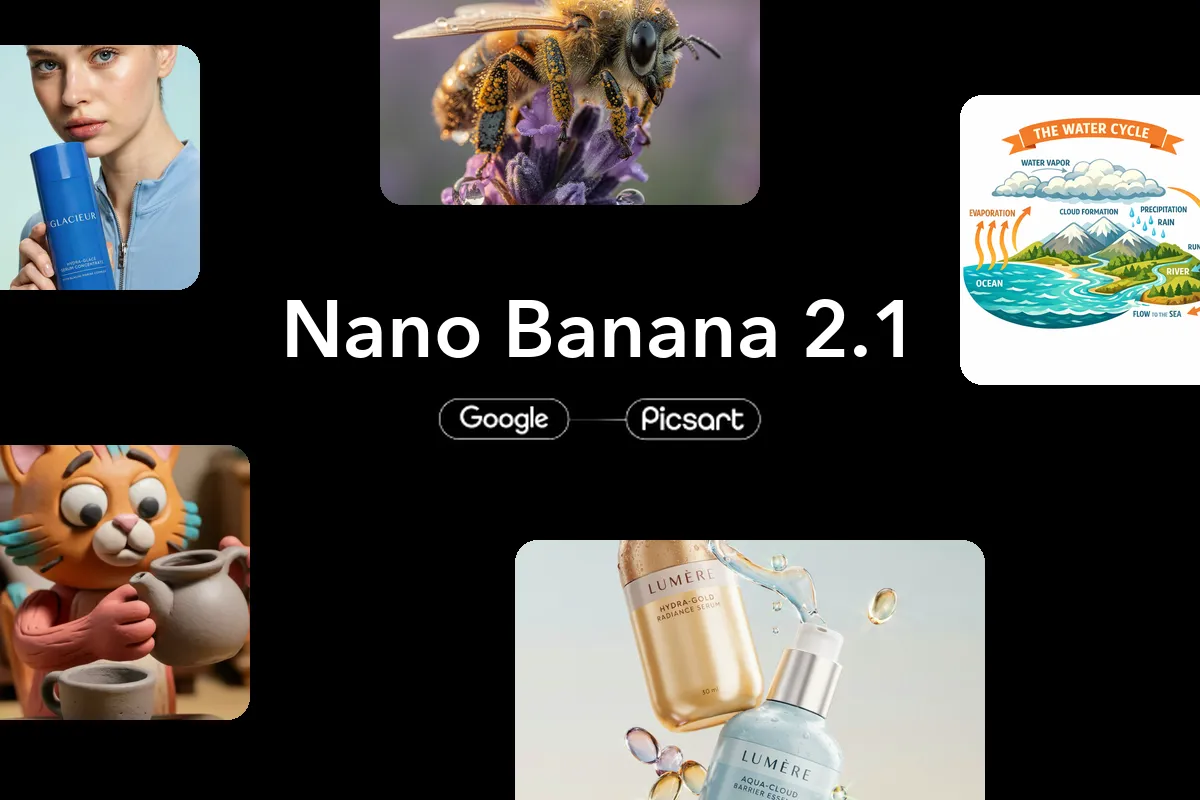
Picsart has added Google's Nano Banana 2.1 to its AI Playground. The image model, released by Google in October 2026, generates and edits pictures from text and images, and scored ahead of Nano Banana 2 and Nano Banana Pro in Google's own human evaluations.
- Google's Nano Banana 2.1 is now available in Picsart AI Playground.
- The model is built on Gemini 3.6 Flash and supports 1K, 2K and 4K output across 15 aspect ratios.
- It supports multi-turn editing, including doodle-based ink edits and multi-image scenes.
- In Google's human evaluations it scored ahead of Nano Banana 2 and Nano Banana Pro in every reported category.
- Google lists limits including blurry small text at 1K and imperfect character consistency.
What Nano Banana 2.1 is
Nano Banana 2.1 is the latest image model in Google's Nano Banana line. It belongs to the Gemini 3 series of natively multimodal reasoning models and is built on Gemini 3.6 Flash. It accepts text and images as input and can return image and text output in the same response.
Google aims the model at four kinds of work: creating and editing images with professional precision and control over multiple quick iterations, generating clear text for posters and intricate diagrams, drawing on real-world knowledge, and rendering localized text across several languages.
Output is available in 1K, 2K or 4K resolution across 15 aspect ratios, from square to wide banner shapes. These are 1:1, 4:5, 5:4, 3:4, 4:3, 3:2, 2:3, 16:9, 9:16, 21:9, 9:21, 4:1, 1:4, 8:1 and 1:8.
Editing across a whole conversation
Editing carries as much weight as generation in this release. The model supports multi-turn image editing, so a picture can be refined over a conversation instead of being rebuilt from a fresh prompt each time. Google evaluated it on both static and dynamic conversations.
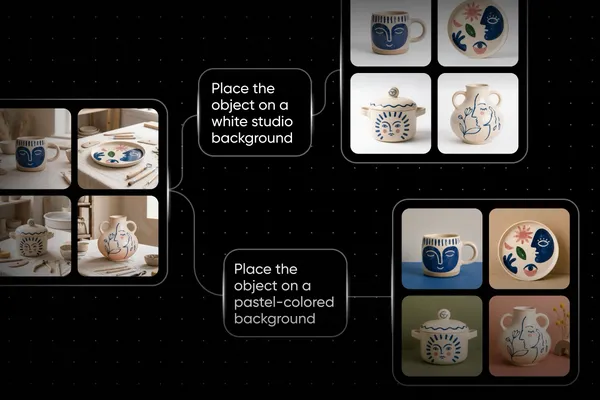
Google built and tested the model for several editing modes: general editing, stylization, character editing, and object and environment edits. It also supports ink-based editing, where users draw a doodle on the picture to direct the change. Multi-image editing covers multi-product recontextualization and multi-character scenes, such as bringing several product shots into one new scene or placing several characters in one frame.
Google notes limits here. Instruction following and ink persistence in doodle edits are still partial, so a tricky edit can take more than one pass. Character consistency between input and output is not always perfect, and Google reports rare cases where an edit keeps the pose of the original subject.
What Google's evaluations show
Google ran side-by-side human evaluations, rated as Elo, against Nano Banana 2 and Nano Banana Pro. With thinking on, Nano Banana 2.1 came out ahead of both in every reported category. Selected results:
- Overall text-to-image preference: 1050, against 990 for Nano Banana 2 and 935 for Nano Banana Pro
- Multi-character consistency: 1106, against 978 and 1011
- Mask and ink-based editing: 1049, against 965 and 927
- Infographic factuality: 0.521, against 0.179 and 0.265, almost three times the Nano Banana 2 score
Google also tested the model with thinking off. That version still scored ahead of Nano Banana 2 in every category on the list. Multi-character consistency was where the new model posted its largest gain over Nano Banana 2.
Known limitations and what it means for Picsart users
Google lists several weaknesses. Small text is often blurry at 1K, and long paragraphs and full pages of text remain hard. The model sometimes confuses left and right, and advanced world knowledge, 3D reasoning and factuality also remain limited.
For Picsart users, the model is available now in AI Playground, where it can be used to generate images from a prompt or edit images they bring in. Picsart points to posters and diagrams with real text, product scenes assembled from several shots, and character series such as comic strips or mascot campaigns as natural uses, given the multi-character and infographic results. Picsart's suggestion is to start with an existing picture, ask for one change, then another, and see how far a single conversation takes it.
Picsart: Nano Banana 2.1 is now available in Picsart