Neo4j Launches Relate, an Embedded Graph Database for AI Agents
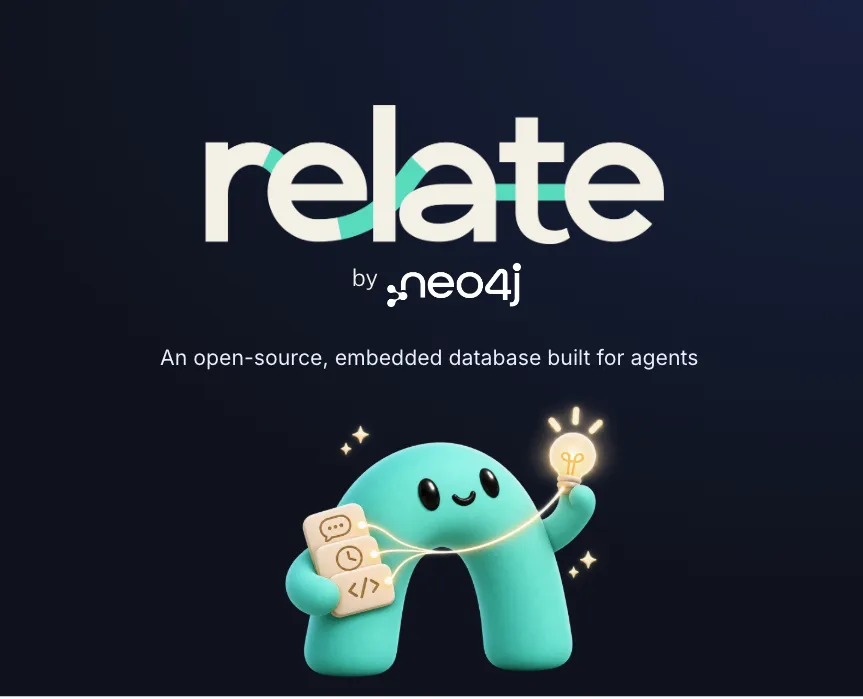
Neo4j has launched Relate, an open source embedded graph database designed for AI agents that need to store facts together with the relationships between them. The database runs inside an application, sandbox or browser without a server to deploy.
- Relate is an open source embedded graph database for AI agents.
- It runs as a library, CLI tool or WebAssembly build without a server.
- Relate supports Cypher, MCP and agent-focused output.
- A demo uses separate Relate instances to audit 24 direct dependencies.
- The database is available today through relatedb.ai.
A local graph database for agent workflows
Neo4j announced Relate at NODES 2026 on November 11, 2026. The company says the database addresses a limitation of common lightweight storage options such as Python dicts and JSON files, which can preserve facts but lose the connections between them.
Relate is designed for data such as documents, messages, tickets, notes and actions. It can run as a library in an application, a command line tool in a sandbox, or a WebAssembly build in a browser. A single command installs it, and the database starts and stops with the application.
Neo4j says Relate can be embedded in agents built with Python, JavaScript, Rust, Java, Go or Swift. Agents that do not open a shell can connect through MCP, using relate serve to expose tools for reading the schema and running queries.
Built for coding agents and connected context
Relate uses Cypher, the graph query language also used across Neo4j's graph database products. The company says agents can install Relate and add its skill without additional wiring, then turn data into a connected graph and query it.
The database includes an agent mode that returns compact TOON output and caps rows per query. It also provides actionable exit codes, explanations for errors and a built in relate agent-context command reference for the installed version.
In a demonstration, Claude Code uses Relate to audit the 24 direct dependencies of Google's Agent Development Kit. Each dependency receives a throwaway Relate instance, with packages represented as nodes and dependency links represented as relationships. The agent loads dependency trees from deps.dev, checks for publicly reported security advisories and unmaintained packages, reports its findings, and deletes the databases.
Neo4j says Relate can combine vector search with relationship traversal in one Cypher statement. That allows an agent to find text that is similar while also following links between people, tasks, decisions and supporting facts.
Open source release and path to Neo4j
Relate is a Rust implementation and is available as an open source library, according to Neo4j. The company says it has millisecond startup and submillisecond queries for ephemeral sessions, while also supporting durable storage. Data can be held in memory, stored in a directory or single file, or backed by Parquet, JSON or Markdown files.
Neo4j says Relate runs more than 30k test scenarios covering openCypher, Cypher 25 and GQL compatibility. It can also run offline on a device, keep data local to a repository or editor, and operate in a browser through WebAssembly.
For larger projects, the company says users can move shared context to Neo4j Aura. Developers can pull a subgraph from Aura into Relate, push results back, and use existing Neo4j drivers and tools over Bolt or HTTP. Relate is available today through relatedb.ai, where users can also access a playground and cookbooks. Neo4j is additionally promoting a month-long online Relate by Neo4j Hackathon.