NEURA Robotics and NXAI team up to build memory for cognitive robots
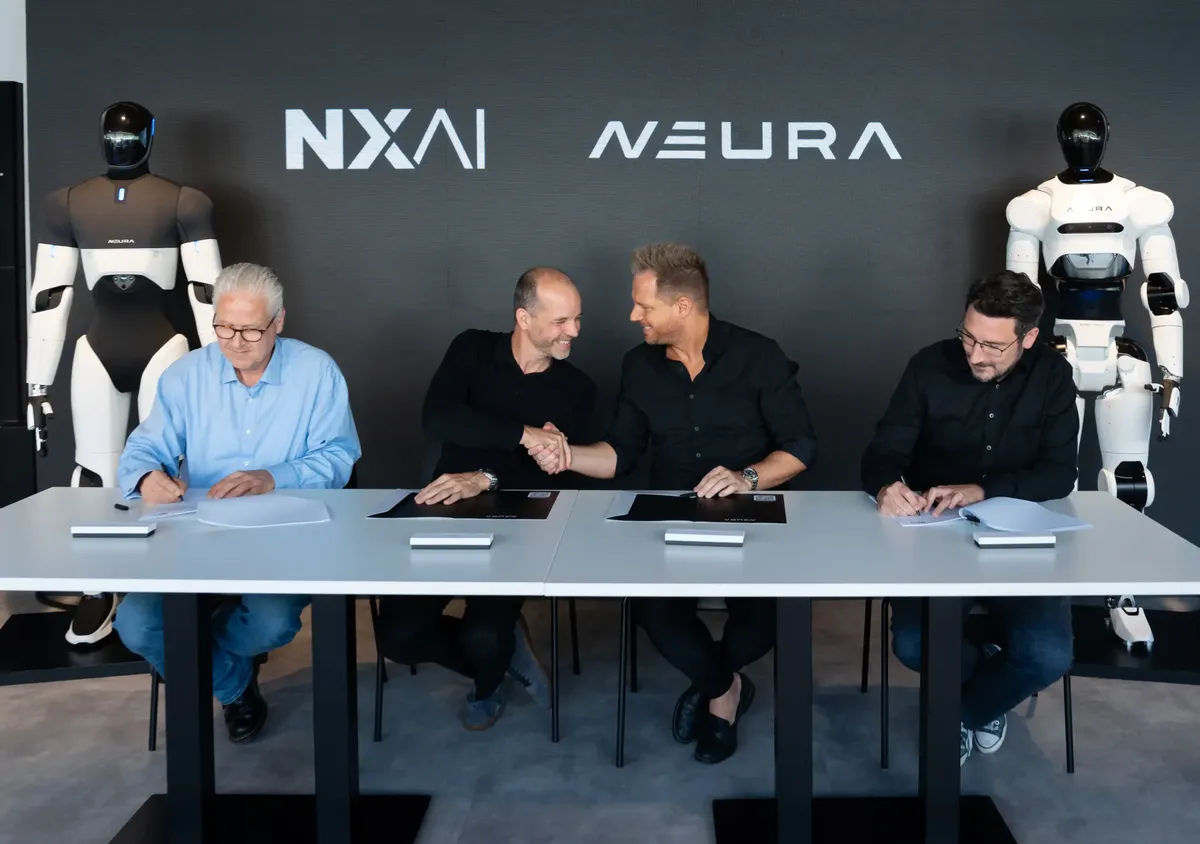
NEURA Robotics and the Austrian company NXAI are jointly developing a memory component for cognitive robots. The work combines NEURA's Physical AI stack with xLSTM, a recurrent architecture created by NXAI under Prof. Dr. Sepp Hochreiter.
- NEURA Robotics and NXAI are jointly developing a memory component for cognitive robots.
- The work combines NEURA's Physical AI stack and Neuron AI with NXAI's xLSTM architecture.
- NXAI plans to offer its xLSTM-based model on the Neuraverse platform next to Neuron AI.
- Companies could fine-tune the model, test it in NEURA Gyms and deploy it on suitable robots.
- Neuron AI continues to be developed independently, and companies keep control of their process knowledge.
What the partnership covers
According to NEURA Robotics, the collaboration has two parts. The first builds on Neuron AI, NEURA's multimodal foundation model for Physical AI, which combines 3D vision, touch, audio, robot state and language with a memory function. The partners are integrating NEURA's Physical AI stack with xLSTM, a recurrent architecture from NXAI that can hold and update state efficiently across long sequences.
The second part concerns the Neuraverse platform. NXAI plans to make its own xLSTM-based model available there, alongside Neuron AI. The announcement was issued from Metzingen on 20 October 2026.
NEURA's founder and CEO David Reger said: "A robot that genuinely helps in everyday life and industry must be able to remember." Sepp Hochreiter, founder of NXAI, said xLSTM is "fast, memory-efficient and capable of holding state across long sequences."
Why memory matters for robots
NEURA argues that a robot is not a chatbot. A chatbot handles requests one at a time, while a robot works in a continuous loop of perceiving, deciding and acting, many times per second and potentially for an entire shift.
The company describes two levels of memory this requires:
- Working memory covers the immediate situation, for example whether a component has already been inserted, whether a door is open or closed, or whether a start button has been pressed.
- Episodic memory lets a robot that has performed a process repeatedly draw on prior experience when it meets the same situation again.
The stated aim is that robots track tasks across many steps and act on accumulated experience, rather than treating every situation as if it were the first.
A second model option on a shared platform
NEURA says the planned integration will let companies fine-tune the NXAI model for their own tasks using the Neuraverse toolchain, test it in the NEURA Gyms and deploy it on suitable robots, all within the training and application environment they already use.
Neuron AI remains NEURA's own multimodal foundation model and will continue to be developed independently. The partnership adds a second model option to the platform and includes joint research. According to NEURA, companies keep control over their process knowledge and decide for themselves whether to share data and skills.
On the division of work, NEURA contributes proprietary multimodal foundation models, robotics, sensor technology, real-world training data from the NEURA Gyms and the platform for industrial deployment. NXAI brings what NEURA calls decades of AI research and a different approach to recurrent intelligence and memory. NXAI is an Austrian deep-tech company based in Linz, whose core research focuses on xLSTM models for time series and robotics.
What it means for users
For companies using the Neuraverse, the main change is more choice: a second model that can be adapted to their own tasks without leaving the same environment. The partners say they aim to make new capabilities available faster.
The longer-term ambition, according to NEURA, is for robots to do more than execute individual skills and instead build on experience over time. That fits the Neuraverse and the Robot Skill Economy, where skills gained through real-world interaction are refined and carried across machines and environments. The announcement gives no release dates or performance figures, and describes the NXAI model integration as planned.