NVIDIA shows agent-assisted workflow for building AI factory digital twins
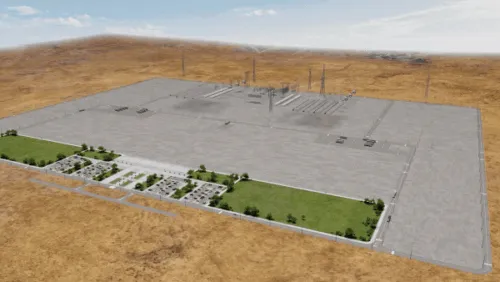
NVIDIA has published a walkthrough of an agent-assisted workflow that turns reference assets, site data and design requirements into an editable OpenUSD model of an AI factory campus. The approach builds on the NVIDIA Omniverse DSX Blueprint, part of NVIDIA DSX Sim.
- NVIDIA's Omniverse DSX Blueprint supplies reference assets, sample scripts and workflows for AI factory digital twins on OpenUSD.
- An AI agent combined DSX models, Voyager references, site plans, requirements documents and USGS data into an editable campus model.
- Changes are kept in additive USD layers, separate from source assets, and results still need dimensional and engineering checks.
- A proposed capacity study compares Vera Rubin NVL72 inference under MaxP and DSX MaxLPS within a fixed power budget.
- Dassault Systèmes, PTC, Cadence and Siemens tools connect CAD, CFD and thermal simulation to the workflow.
What the DSX Blueprint provides
According to NVIDIA, the Omniverse DSX Blueprint offers reference digital twin assets, sample scripts and workflows for developing AI factory digital twins. It is built on OpenUSD and NVIDIA Omniverse libraries, and gives developers a base for assembling facility and equipment models with SimReady assets and connecting them to engineering simulation tools.
The post argues that building such a twin means bringing site plans, equipment assets and engineering requirements into one consistent model that teams can inspect, revise and prepare for simulation. In the described workflow, developers guide the agents and connect tools, while engineers review the results to inform the next iteration.
How the campus model was built
NVIDIA says an agent needs context before it can make a useful design proposal. Given only photos or renderings, it can produce a model that looks plausible but has incorrect dimensions and proportions. The workflow therefore combines several inputs, each with a defined role:
- DSX 3D models: data hall, central utility buildings, substations, generators, cooling equipment, vehicles and vegetation.
- Architectural references: images of Voyager, the NVIDIA Santa Clara Headquarters building, used as design inspiration for roof, facade, solar canopies and landscaping.
- Site plans: PDFs describing the campus arrangement and a more detailed first phase.
- Requirements documents: an indexed collection including architectural drawings, form-factor studies, Basis of Design documents and room layouts.
- Geographic data: USGS aerial imagery and elevation data to place the campus in its terrain.
A frontier AI model runs in an agent harness, which NVIDIA describes as software that manages context, instructions and tool calls. Skills encode repeatable tasks and AI factory domain knowledge. Developers connect modeling and analysis operations through tool interfaces, including the Model Context Protocol (MCP) where supported, and define which changes the agent may propose or apply.
For the solar canopy, the agent used USD Content Agents to help generate geometry and materials, then refined the design using the Voyager references. The team combined reused assets and new geometry in additive USD layers, which keeps changes separate from the source assets. The model could be inspected in the Omniverse RTX viewport. NVIDIA stresses that the canopy remained a conceptual design, and that dimensions, structural properties and suitability for simulation still need an engineering check.
Planning for a fixed power budget
The post frames a practical question: how should an AI factory hall be configured when available power is fixed? Changing the compute configuration can affect equipment quantity, placement, electrical distribution and cooling, so those disciplines need consistent requirements and data.
NVIDIA proposes extending the campus model into a capacity planning study that links the layout with compute, electrical and cooling requirements. One illustrative starting point is a NVIDIA Vera Rubin NVL72 inference comparison. It contrasts a baseline using MaxP, the highest static GPU-level power setting, with DSX MaxLPS, which NVIDIA describes as an AI factory design and operating framework coordinating facility design, dynamic power allocation and performance-per-watt optimization. The source text is cut off before describing how this would be applied to a hall.
Ecosystem and what it means for developers
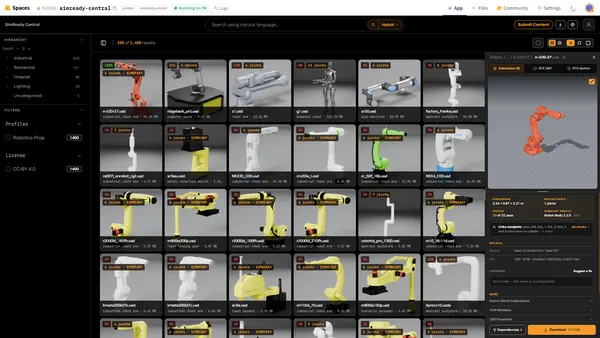
The summary in the post says SimReady Foundation specifications and the SimReady Central Library on Hugging Face help teams assess asset data readiness and reuse simulation-ready OpenUSD assets for power and cooling analysis. Application providers including Dassault Systèmes, PTC, Cadence and Siemens connect requirements management, CAD data, computational fluid dynamics and thermal simulation to the workflow.
For developers working on AI factory design, the message is that agents can speed up assembling and revising scenes, but the traceability to source drawings is what supports review. NVIDIA points to its DSX asset guidance, SimReady Foundation and AI factory pipeline samples covering CAD conversion, optimization, metadata and validation as next steps.
NVIDIA Developer: Developing an AI Factory Digital Twin with an Agent-Assisted Workflow