NVIDIA Vera Rubin Sweeps MLPerf Training and Leads Agentic Inference
NVIDIA says its Vera Rubin platform delivered leading performance across MLPerf Training, post-training and agentic inference in its benchmark debut. The platform swept every MLPerf Training v6.1 benchmark and reported more than 10x generational gains in agentic AI throughput per watt.
- Vera Rubin swept every MLPerf Training v6.1 benchmark.
- NVIDIA reported up to 2x more performance per GPU than GB300 NVL72.
- Agentic AI throughput per watt exceeded GB300 NVL72 by more than 10x in a provisional Kimi K3 result.
- Vera Rubin NVL72 reached about 97% efficiency when scaling from 256 to 1,024 GPUs.
- The Vera Rubin Kimi K3 result is pending MLCommons Association verification.
Vera Rubin takes every MLPerf Training v6.1 benchmark
MLPerf Training measures how quickly a system can train different AI models to a target level of accuracy. NVIDIA says it was the only platform with results on every benchmark in this round, covering large language models, image generation, recommender systems and reinforcement learning post-training.
In its debut, Vera Rubin NVL72 delivered up to 2x more performance per GPU than NVIDIA GB300 NVL72, according to NVIDIA. The company said the results reflect early generation-over-generation gains and added that performance will continue to improve through optimization of its CUDA-powered software stack.
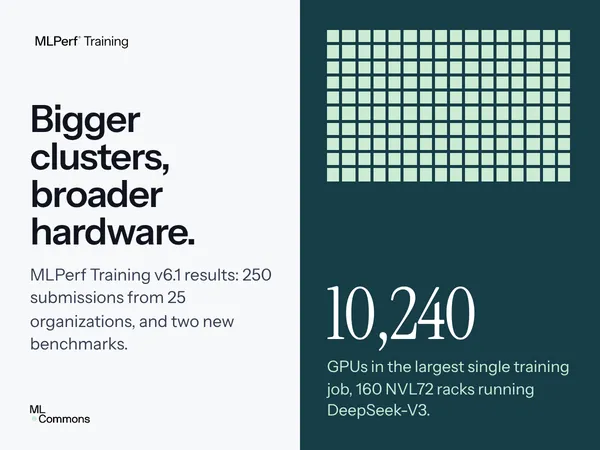
NVIDIA also reported results at scale on the DeepSeek-V3 benchmark. Vera Rubin NVL72 scaled from 256 to 1,024 GPUs with about 97% efficiency. Quadrupling the GPU count reduced training time from 16 minutes to about four, according to the company.
More than 10x throughput per watt for agentic AI
MLPerf Endpoints tests systems on agentic coding and enterprise workflows, while checking whether agents complete their tasks correctly. These workloads can require an agent to reason, call tools and verify its work several times, with each step generating tokens.
In its first MLPerf Endpoints submission, NVIDIA said Vera Rubin led across all of its agentic benchmarks. In a provisional Kimi K3 result, Vera Rubin NVL72 delivered more than 10x the throughput per watt of NVIDIA GB300 NVL72 at the same response speed, based on throughput per kilowatt at a shared minimum average interactivity of 50 tokens per second per user.
The Vera Rubin result is pending verification by the MLCommons Association and remains subject to change pending peer review. The cited Kimi K3 comparison was published on November 9, 2026.
Why the results matter for AI infrastructure
NVIDIA says its networking systems help large GPU clusters operate efficiently. NVLink connects GPUs within each system, while Quantum-X800 InfiniBand and Spectrum-X Ethernet connect systems across the data center. The company says this combination, together with optimized software, helps developers keep thousands of GPUs working together and reduce training times.
The Training submissions included work from 20 organizations, including Azure, CoreWeave, Google Cloud, Microsoft Azure, Oracle, Supermicro and the University of Florida. NVIDIA says the participation demonstrates how its programmable platform, open source libraries and frameworks support optimization across a broad partner ecosystem.
For users and AI developers, the reported gains could mean faster model training and more efficient agent serving, if the benchmark results translate to production workloads. NVIDIA linked faster training to agents reaching users sooner, drug discovery models keeping pace with new laboratory data and fraud detection models adapting faster to new threats. The company also said Vera Rubin supports workloads ranging from pretraining and post-training to agentic inference and high-performance computing.