Open-weight AI models trail closed ones by 6-7 months on cyber, Epoch AI finds
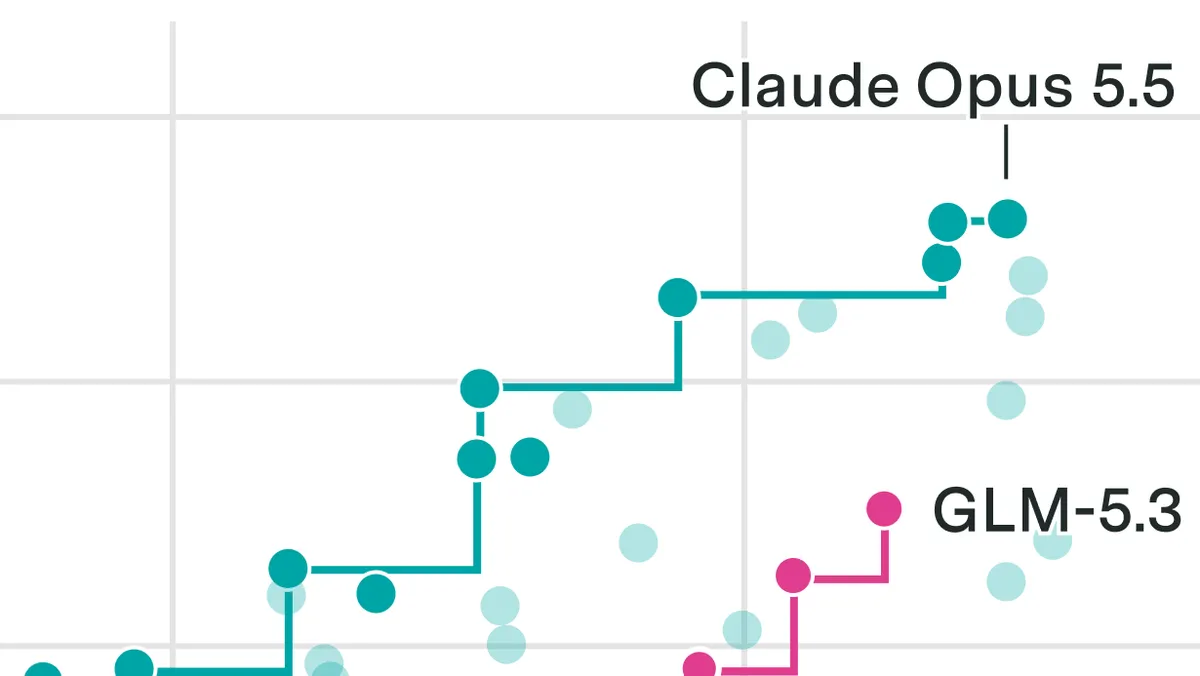
Open-weight AI models are roughly 6 to 7 months behind the closed frontier on cybersecurity tasks, according to Epoch AI. Z.ai's GLM-5.3 is the top open-weight model on the Cyber ECI with a score of 160, above OpenAI's GPT-5.4 but below Claude Mythos Preview and GPT-5.5.
- Z.ai's GLM-5.3 is the top open-weight model on Epoch AI's Cyber ECI with a score of 160.
- It beats GPT-5.4 but trails Claude Mythos Preview and GPT-5.5, both from April 2026.
- Epoch AI puts the open cyber frontier about 6 to 7 months behind the closed one.
- Claude Opus 5.5 and GPT-6 Astra lead the closed frontier at 171.
- GLM-5.3's score rests on only three CAISI benchmark results.
GLM-5.3 leads the open-weight field
Epoch AI publishes the Cyber ECI, a cybersecurity-focused version of its Epoch Capabilities Index (ECI). On this measure, Z.ai's GLM-5.3, released on 2026-08-14 under a restricted-use open-weights license, is the highest-scoring open-weight model. Its central estimate is 160.10, with a 90% interval of 155.83 to 166.97.
That is higher than OpenAI's GPT-5.4, which came out in March 2026 and scores 157.04. It is lower than Claude Mythos Preview (April) at 164.82 and GPT-5.5 at 162.22, both from April 2026. Epoch AI concludes that the open cyber frontier sits roughly where the closed frontier stood 6 to 7 months ago.
Other open-weight models in the dataset score lower. Kimi K3 from Moonshot reaches 157.60, GLM-5.2 reaches 154.12, GLM-5.1 reaches 152.91 and DeepSeek-V4-Pro reaches 150.35.
The closed frontier keeps moving
Closed-weight models have also continued to advance. According to Epoch AI, the frontier is currently led by Anthropic's Claude Opus 5.5 and OpenAI's GPT-6 Astra, both with a Cyber ECI of 171. Their central estimates are 171.14 and 171.03 respectively.
To estimate the lag, Epoch AI looked at the closed-weight models whose scores most closely bracket GLM-5.3. GPT-5.4, released on March 5, 2026, scores below it, and Mythos Preview, released on April 7, 2026, scores above it. As of the data cutoff, those releases were 7 and 6 months earlier, respectively.
Epoch AI compares models by central estimates. It says it expects methodology changes soon that will allow better estimates of uncertainty in differences between models.
How the index is built
The Cyber ECI is a domain-specific version of the ECI based on cybersecurity benchmarks. Epoch AI keeps the benchmark parameters from a joint fit of the ECI on general and cyber benchmarks, then estimates each model's score from its cyber results alone. Scores are on the same scale as the general ECI.
The data is as of October 8, 2026. The October update expanded the index from 56 to 76 models and from 20 to 35 cybersecurity benchmarks, for a total of 324 model-benchmark results. Sources include the UK AI Security Institute (AISI), CAISI, the AI cyber-evaluations company Irregular, reports by model developers, and other public sources. The analysis covers the 57 models with at least two cyber benchmark results.
Limitations and what it means
Epoch AI lists several caveats:
- Few results per model. GLM-5.3's score rests on three CAISI benchmark results, and Opus 5.5's on four benchmarks reported by Anthropic. Opus 5.5 and Astra share no benchmarks, and their confidence intervals overlap almost entirely.
- Inferred identities. CAISI did not name the US models it evaluated, so Epoch AI attributed those results to the models it judges most likely to have been leading at the time, such as GPT-6 Astra and Claude Mythos Preview.
- Refits change scores. The October refit lowered several top scores, with Claude Mythos 5 falling by 3.9 points and GPT-5.6 Sol by 4.7. Values from earlier Epoch AI publications are not directly comparable to the new ones.
For readers tracking cyber capabilities, the finding is that freely downloadable models are close to, but not at, the leading closed systems. The gap is measured in months, not years, though the thin benchmark coverage for GLM-5.3 means the estimate carries real uncertainty.
Epoch AI: Open-weight AI models are 6-7 months behind on cyber