Penn Engineers Develop Artificial Muscles for Precise Robotic Movement
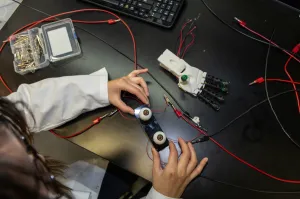
Penn Engineers have developed artificial muscles that can sense their own movement, hold intermediate positions and coordinate with other muscles. The CoilLCE fibers were demonstrated in robotic fingers that play piano keys and artificial eyes that shift their gaze.
- CoilLCE fibers combine liquid crystal elastomers, graphene and a copper coil.
- The embedded coil both heats the muscle and senses its movement.
- Robotic fingers played piano keys and artificial eyes shifted their gaze.
- Opposing actuators can reduce the number of control inputs needed.
- The team plans to integrate more muscles for complex movements.
A muscle that acts as both actuator and sensor
Led by Shu Yang, Joseph Bordogna Professor in Materials Science and Engineering, and Cynthia Sung, Associate Professor in Mechanical Engineering and Applied Mechanics, the Penn team combined liquid crystal elastomers, graphene and an embedded copper coil to create the fibers.
Liquid crystal elastomers change shape when heated. In the resulting CoilLCE material, electrical signals produce controlled, muscle-like movement. Graphene helps make the fibers softer yet tougher, allowing them to stretch while withstanding the forces created when artificial muscles work against one another.
The copper coil has two functions. It heats the material to trigger contraction, and it measures changes in electrical resistance as the muscle moves. The researchers use that resistance as a feedback signal, adjusting heating power in real time to keep it near a target value. This means the artificial muscle does not need a separate sensor for feedback.
“Because the coil served as both a heater and a sensor, we did not need a separate sensor for feedback,” said Xuelin Wu, a master’s student in Mechanical Engineering and Applied Mechanics, according to Penn Engineering.
Inspired by fingers and eyes
The researchers looked to the small muscles in human hands and around the eyes, rather than larger muscles designed to generate more force. These biological systems support delicate tasks, including shifting and maintaining the gaze, and require fine control and coordination.
In demonstrations, an artificial finger pressed one piano key, paused and moved to the next. An artificial eye also shifted its gaze through a series of controlled movements. The system was able to hold intermediate contraction levels for extended periods, addressing a difficulty with liquid crystal elastomers, which can continue contracting when heated or move toward their original shape as they cool.
The team also used four pairs of opposing actuators in the artificial eyes. Like biological muscles, one muscle contracts while another stretches. This arrangement can provide controlled movement while reducing the number of control inputs needed.
A step toward more complex soft robots
The research, published in Advanced Functional Materials, addresses a challenge in soft robotics: combining flexibility, lightness, strength and precise control in a single system. According to Sung, “This is the first time that feedback control has been demonstrated on an LCE actuator,” and the capability is necessary for future robotic applications involving these artificial muscles.
The approach could eventually support systems such as robotic humanoid faces, where dozens of small, coordinated muscles would need to fit into a confined space to produce natural expressions. The team is interested in using artificial intelligence and computer vision to coordinate more complex systems, but says its next challenge is integrating more muscles so they can perform increasingly complex movements.
“We’ve shown that these materials can be controlled to produce precise movements and work together in coordinated ways,” said Ziyun Zhang, the study’s co-lead author, according to Penn Engineering. Funding came from the Army Research Office through the MURI program, the National Science Foundation, the NSF Graduate Research Fellowship Program and the National GEM Consortium through the GEM Fellowship.
Penn Engineering: Artificial Muscles Give Robots Precise Control