RAI Institute Brings Five Robot Learning Papers to CoRL 2026 in Austin

The RAI Institute has had several papers and workshops accepted at the Conference on Robot Learning (CoRL) 2026, which runs from November 9-11 in Austin, Texas. The work covers humanoid loco-manipulation, robot mapping, sim-to-real policy learning and zero-shot long-horizon planning.
- RAI Institute has several papers and workshops accepted at CoRL 2026 in Austin, Texas, November 9-11.
- ExpertGen reports up to 85% success on long-horizon tasks and 91.1% on industrial assembly benchmarks.
- RoMo-GS runs 15, 150×faster than offline deblurring 3DGS methods, with about 20% fewer Gaussians than the online baseline.
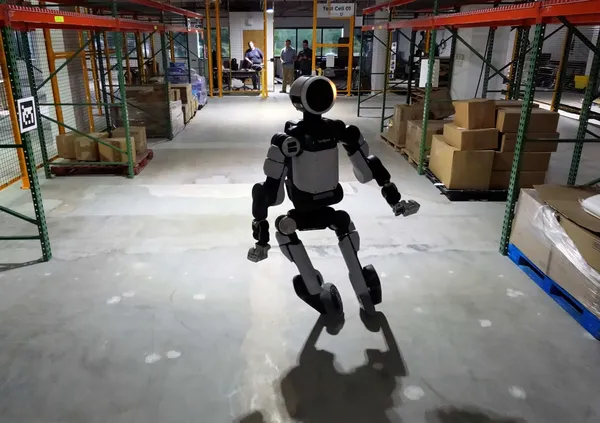
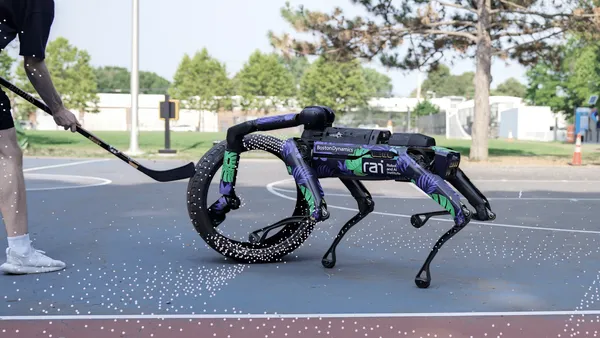
- HLO-AMP and the SMPC paper were deployed on a Unitree G1 humanoid, and the latter also on an arm-equipped Spot.
- NovaPlan achieves zero-shot long-horizon manipulation without task-specific training or demonstrations.
A milestone year for CoRL
CoRL brings together research on robotics and machine learning. According to the RAI Institute, the conference debuted in 2017 and celebrates its 10th year in 2026. The institute says research teams submitted work on handheld data collection, loco-manipulation, robot mapping and perception, sim-to-real policy transfer and zero-shot long-horizon planning.
Loco-manipulation on humanoids and quadrupeds
Two papers address robots that walk and manipulate objects at the same time.
HLO-AMP targets hierarchical pipelines for humanoids, which usually pair a task-agnostic whole-body controller with a downstream task policy. The authors argue that such controllers are often trained without the manipulated object in the scene and approximate object dynamics through randomized end-effector force disturbances. Their approach trains the low-level controller as an object-aware motion prior, using motion imitation on retargeted motion-capture references with the object physically present. A reference-free high-level policy is then trained on top. The framework was demonstrated on a Unitree G1 for bimanual box pick-and-place, where, according to the paper, the same deployed policy generalizes across object masses and dimensions, initial and goal poses, and recovers from intentional drops mid-carry.
The second paper, on learning from Sample-based Model Predictive Control (SMPC) demonstrations, uses SMPC in simulation as an automated expert to generate large offline datasets. This allows an off-policy RL agent to learn from purely sparse task rewards, which the authors say reduces the time needed to learn new skills and removes manual tuning. The learned policies can surpass the original optimal control teacher, and the team reports deployment on an arm-equipped Spot quadruped and a G1 humanoid.
Mapping and sim-to-real expert learning
RoMo-GS is an online 3D Gaussian Splatting system for robot mapping. The authors say rapid robot maneuvers cause motion blur that corrupts geometry and causes camera pose drift, while the number of Gaussians grows without bound. Instead of averaging discrete sub-frames, RoMo-GS analytically integrates each projected Gaussian over the exposure interval, giving O(1) complexity per Gaussian, and bounds growth with a Hessian-based pruning score. According to the paper, it matches or exceeds offline deblurring 3DGS methods in rendering quality while running 15, 150×faster, and operates online with about 20% fewer Gaussians than the online 3DGS baseline.
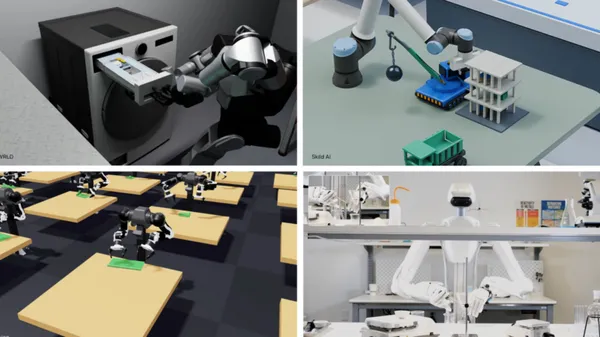
ExpertGen automates expert policy learning in simulation without human demonstrations. It starts from a diffusion policy trained on synthetic data, then uses reinforcement learning to steer it by optimizing the diffusion model's initial noise while the denoising process stays frozen. The authors report success rates of up to 85% on long-horizon manipulation tasks and a 91.1% overall success rate on industrial assembly benchmarks, outperforming all baselines. The state-based experts were distilled into visuomotor policies via DAgger and deployed on real hardware.
Zero-shot planning and a data-collection workshop
NovaPlan is a hierarchical framework for zero-shot long-horizon manipulation. A vision-language model planner decomposes tasks and filters out dynamically inconsistent futures by checking multiple candidate video rollouts. A hybrid geometric representation switches between object-centric flow and human hand flow, and the system monitors execution to synthesize corrective behaviors such as fingertip poking. The authors say it substantially outperforms prior zero-shot systems, achieving complex assembly and dexterous error recovery without task-specific training or demonstrations.
On the workshop side, the institute presents Eucalyptus, an extension of UMI for sustained, force-aware data collection without needing a robot. It combines a redesigned mechanical frame with a sensing suite of RGB vision, gripper width, interaction forces and 6-DoF pose. The redesign eliminates measurable backlash, expands the maximum gripper width and improves ergonomics for a wide range of hand sizes.
What it means
Taken together, the papers point to a common theme: reducing reliance on manual reward design and costly real-world demonstrations by shifting more learning into simulation, while keeping transfer to real hardware. Attendees in Austin can see the work firsthand from November 9-11.
RAI Institute: CoRL 2026 Publication and Workshop Round Up