RAI Institute Brings Six Robotics Papers and Custom Platforms to IROS 2026

The RAI Institute has had several papers accepted at IROS 2026, the IEEE/RSJ International Conference on Intelligent Robots and Systems, which runs from September 27th to October 1st in Pittsburgh, PA. The work covers visuomotor policies, LiDAR learning, quadruped table tennis, deformable object simulation and rapid robot learning in simulation.
- The RAI Institute has several papers at IROS 2026, held September 27th to October 1st in Pittsburgh, PA.
- Vernata improves on Sonata baselines, with mIoU of 54.7 on TartanGround and 57.1 on Waymo.
- ZeroBot reports an 87% success rate with an average training time of 119 seconds.
- A Spot quadruped with an arm can return spinning table tennis balls and rally with humans.
- RAI shows the UMV, Roadrunner and Koala grippers at booth #1102.
What RAI is showing in Pittsburgh
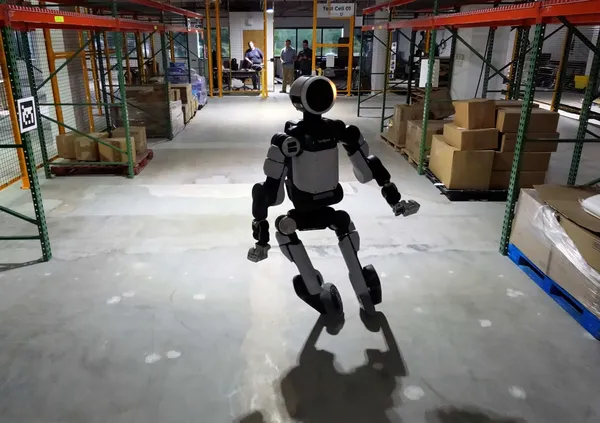
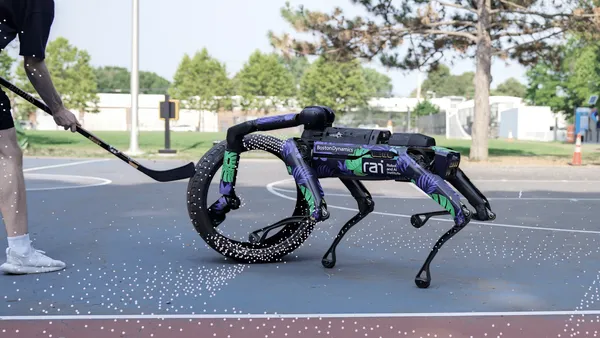
According to the RAI Institute, IROS is one of the premier global robotics conferences, with technical sessions, workshops and demos. The institute will have a booth in the exhibition hall (#1102). Visitors can see custom built research platforms including the Ultra Mobility Vehicle (UMV), Roadrunner, and the Koala grippers for robotic data collection.
The accepted papers range from closed-loop visuomotor policies and self-supervised learning on outdoor LiDAR point clouds to whole-body model predictive control for quadruped table tennis.
Skills, LiDAR and table tennis
PACTS. The paper on Predicate-Action Skills targets a weakness of Learning from Demonstration: existing approaches often fail to generalize to new compositions of known skills without retraining. PACTS are closed-loop visuomotor policies that model skills as a joint generative process over action and predicate belief trajectories. The authors say this improves both action generation and predicate classification, and that online predicate predictions let learned skills be composed zero-shot through planning.
Vernata. Building on the Sonata architecture, Vernata is a multi-modal, multi-teacher distillation framework for self-supervised learning on outdoor LiDAR point clouds. It adds sparse view augmentation, a memory bank mechanism for resource-constrained training, and cross-modal distillation using dense 2D image features. The authors report mIoU scores of 54.7 on TartanGround (+5.9 points, +12.1%) and 57.1 on Waymo (+7.3 points, +14.7%) over Sonata baselines. Without color or normals, it reaches 49.4 and 50.2 on the respective datasets.
Spin-aware table tennis. The team presents a continuous-time model predictive controller for a quadrupedal robot with an arm. It is paired with a hybrid model-based and learned spin estimator and an aiming planner. The system runs on a Spot quadruped, can return balls with varying spin types, and is able to rally with human players, according to the paper.
Deformables and learning in simulation
EMPM. Embodied MPM is a deformable object modeling framework built on a differentiable Material Point Method simulator. From multi-view RGB-D videos it reconstructs geometry and appearance, then optimizes MPM parameters online using sensory feedback. The authors say it outperforms spring-mass baseline models.
ZeroBot. This real2sim framework learns a manipulation task from scratch with zero human demonstrations, zero policy pre-training and zero known object models. From a single view of an object and a goal pose, it uses image-to-3D generative models to get a mesh for large-scale parallel reinforcement learning. On real-world tasks including grasping, pushing, articulated object interaction and multi-stage manipulation, ZeroBot reaches an 87% success rate with an average training time of 119 seconds.
Simify. A training-free, test-time framework, Simify reconstructs simulation-ready assets from a single RGB-D image using 3D generative models and vision-language models. Given a reward function, such as building the tallest tower, it launches thousands of parallel rollouts and runs an evolutionary search over object arrangements, typically converging within seconds. The authors report that it outperforms prior work on foundation models for spatial reasoning, and that complete and accurate geometry matters for sim-to-real transfer.
What it means
Taken together, the papers show a focus on combining generative models with physics simulation and on reducing the need for labeled data or human demonstrations. The results come from the authors' own evaluations, and the source does not give comparisons beyond those stated. Attendees can see the hardware platforms at booth #1102 and read the papers through the links on the RAI Institute blog.
RAI Institute: IROS 2026 Publication Round-Up