Roboflow adds Google's Gemini 4 Argon for labeling and vision workflows
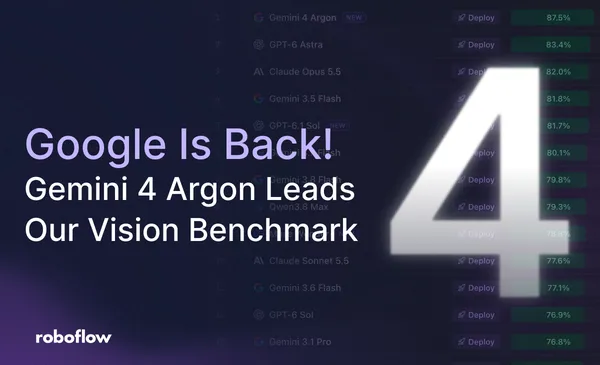
Roboflow has added Gemini 4 Argon, Google's newest multimodal model, to its computer vision platform. According to Roboflow, the model currently ranks first on Roboflow Playground for object detection, counting and text extraction.
- Roboflow added Google's Gemini 4 Argon, which it says ranks first on Roboflow Playground for object detection, counting and text extraction.
- Argon is available in Auto Label, Label Assist and Roboflow Agent, and is the default object detection labeling model on paid plans.
- The Google Gemini block in Workflows supports Argon for detection, OCR, structured output, classification, VQA, captioning and open prompts.
- Workflows with Argon run in the Roboflow cloud via the Serverless API now; self-hosted inference support is planned.
- Gemini token use is billed to Roboflow credits by default, or users can bring their own Google AI API key.
What Gemini 4 Argon does in Roboflow
Roboflow is a platform for building computer vision applications, covering image labeling, model training and deployment in the cloud or on a user's own hardware. Gemini 4 Argon takes an image and plain-language instructions, and returns text, structured data, or bounding boxes around requested objects.
Roboflow says that in its own evaluations the model is especially strong at three tasks: finding objects, counting them, and reading text in real-world images from manufacturing, logistics and aerial imagery. The company frames the addition as part of a wider aim to be a "vision harness" that lets customers adopt better models from any provider without vendor lock-in.
Auto Label: Argon labels, a smaller model runs in production
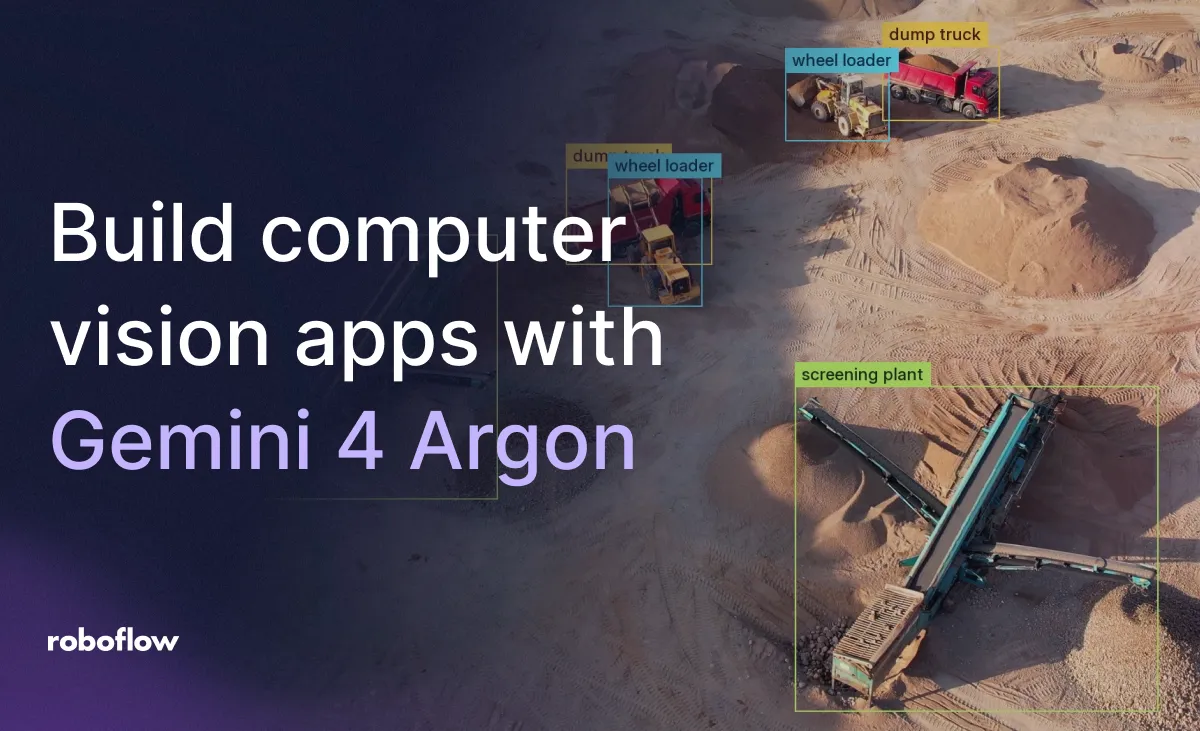
Auto Label draws labels on a whole batch of images. Users list the objects they want, add a short description of each, and Gemini 4 Argon finds every match and draws a bounding box. Users then review the results instead of drawing boxes by hand.
Roboflow stresses that a model of Argon's size is too slow and costly to run on every frame of a live video. The suggested approach is to use Argon to create training data, then train a specialized model such as RF-DETR, which runs in real time on edge devices like NVIDIA Jetson.
Roboflow's example is a quarry operator who pulls a few hundred drone frames, lists classes such as haul truck, dump truck, wheel loader, excavator and screening plant, and runs Auto Label. After reviewing the labels, the operator trains an RF-DETR model to track every vehicle frame by frame.
Argon is available in Auto Label on object detection projects, in Label Assist in the annotation editor, and through Roboflow Agent. Auto Label jobs can also be started from the Roboflow API, the Roboflow MCP server and the Python SDK by setting the model type to gemini-4-argon-boxes. On paid plans, it is now the default model for object detection labeling.
Using Argon inside Workflows
Workflows let users connect models and logic as steps and run the result in the cloud or on their own hardware. Gemini 4 Argon is now a model option in the Google Gemini block. Roboflow notes that a large multimodal model takes longer and costs more per image than a specialized detector, so it recommends using it selectively. One pattern is to run a detector like RF-DETR on every frame, then pass Argon only the frames or crops that need reading or reasoning.
In the company's example, a detector finds each capacitor on an assembled motherboard and a Dynamic Crop step cuts each one out. Argon reads the capacitance and voltage rating and returns them as JSON fields. A final step compares them with the bill of materials, flags boards for rework when a rating is wrong, and sends them to a technician when a marking is unreadable.
The block supports these task types with Argon:
- Object Detection: bounding boxes for the classes you list.
- Text Recognition (OCR): reading text in an image.
- Structured Output Generation: JSON with fields you define.
- Single-Label and Multi-Label Classification: assigning one or more provided classes.
- Visual Question Answering: answering a question about the image.
- Captioning: short or detailed descriptions.
- Open Prompt: following a written prompt and returning text.
Detection and classification results use the same format as other Roboflow models, so they connect to blocks such as visualizations, counting and filters. Users can also set a thinking level per step, low for quick answers and high for tasks needing more reasoning.
Availability and billing
Workflows with Gemini 4 Argon run in the Roboflow cloud starting today through the Serverless API. Support for self-hosted inference servers will follow in an upcoming release of Roboflow Inference. By default, the block uses Roboflow's managed key and bills Gemini token use to the user's Roboflow credits. Users can instead supply a Google AI API key and pay Google directly.
For teams building vision systems, the practical takeaway from Roboflow's description is a split of roles: Argon handles labeling and the steps that require reading or reasoning, while a fast specialized model covers continuous video. Roboflow points readers to Roboflow Playground for comparisons with other models.
Roboflow: Use Gemini 4 Argon to build computer vision applications