Shield expands Greece’s V-BAT fleet with additional NSPA order
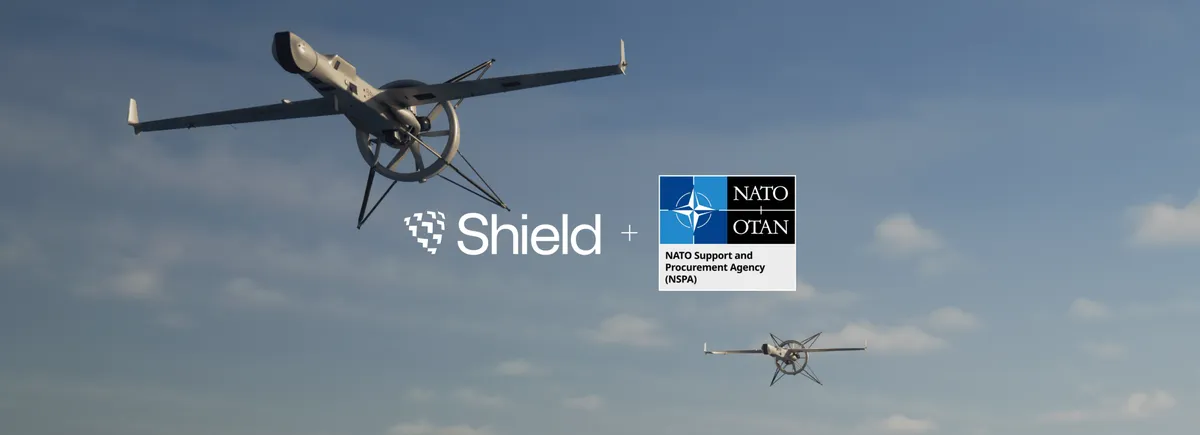
The NATO Support and Procurement Agency has ordered additional Shield V-BAT vertical takeoff and landing UAVs for the Hellenic Armed Forces. The contract expands Greece’s existing V-BAT fleet and includes spares, training, ground support equipment and long-term in-service support.
- NSPA ordered additional Shield V-BAT UAVs for Greece’s Army and Navy.
- The contract includes spares, training, ground support equipment and long-term support.
- The order expands a common V-BAT fleet for land and maritime ISR.
- V-BAT is designed to operate from ships, islands and other sites without runways.
- Shield has expanded its industrial and technology partnerships in Greece.
A common fleet for land and maritime ISR
The additional aircraft will support intelligence, surveillance and reconnaissance operations for Greece’s Army and Navy, building on a capability already in Hellenic service. Shield said the order will create a common V-BAT fleet across the Armed Forces.
According to Shield, operating a shared fleet is intended to improve interoperability, standardize training and maintenance, and give both services access to an aircraft that does not depend on runways. The company describes V-BAT as designed for maritime and expeditionary operations, including missions from islands, coastlines, ships and austere sites.
“An order for additional V-BATs represents a major expansion of Greece’s persistent ISR capacity and a strong vote of confidence in an aircraft already operating in Hellenic service,” said James Lythgoe, Shield’s regional director for Eastern and Southeast Europe.
NSPA contract covers the aircraft’s service life
The order was awarded under the NATO Support and Procurement Agency’s UAS Support Partnership legal framework. The framework gives participating nations a way to procure and support the full uncrewed aerial systems spectrum, from acquisition through continued service.
Shield said the arrangement can consolidate national requirements, reduce contracting timelines and create common support solutions. Participating nations retain ownership and control of their capabilities while gaining access to shared logistics and economies of scale.
NSPA’s AGS and UAS Programme provides life-cycle support covering acquisition, spares, maintenance, training, upgrades and technical assistance. Lythgoe said the agency offers “a streamlined way to acquire the aircraft and keep them ready throughout their service lives.”
V-BAT’s role in Greece’s Aegean operations
Shield describes V-BAT as a NATO Tactical VTOL UAS with a single ducted-fan design, more than 12 hours of endurance and a heavy-fuel engine. Its enclosed-rotor configuration is designed to enable unassisted launch and recovery from ship decks, islands, remote coastlines and other locations without runways or dedicated launch equipment.
The company says the aircraft has been designed, tested and deployed for contested electronic warfare environments. Shield also says V-BAT has demonstrated resilience in GPS- and communications-denied conditions and is intended to provide ISR and targeting with lower cost and logistical burden than larger NATO systems.
The contract is the latest step in Shield’s expanding partnership with Greece. The company has opened a regional office in Athens, signed a memorandum of understanding with GEK TERNA to pursue X-BAT opportunities, partnered with ALTUS LSA to arm V-BAT with the Greek-built KMB Hunter interceptor, and worked with EFA GROUP on sovereign autonomous pilots powered by Hivemind.