ThoughtSpot Launches Spotter Analysts for Task-Specific AI Analytics
ThoughtSpot has made Spotter Analysts generally available in ThoughtSpot 26.10, letting organizations customize its Spotter AI for a single job, from the data it reads to the people who can use it. According to the company, the feature can be shared with internal teams or embedded in a customer-facing product.
- Spotter Analysts are generally available in ThoughtSpot 26.10, according to ThoughtSpot.
- Each Analyst can use up to five data models, only allowed MCP connectors, and up to 5,000 characters of instructions.
- Analysts can be shared with teams or embedded in an app with SpotterEmbed, and managed through public APIs.
- Row- and column-level security remains the control for data access, since instructions cannot replace it.
- Included with Spotter at no extra cost; per-Analyst monitoring is coming in a follow-up release.
What a Spotter Analyst is
ThoughtSpot describes Spotter as the generalist on an analytics team, able to pick up any dataset and work out an answer. A Spotter Analyst is the specialist: Spotter customized for one body of work, with the models, connectors and instructions that work needs. According to ThoughtSpot, everything Spotter can do, an Analyst can do, pointed at the job chosen.
The company gives a Revenue Analyst as an example. It works from the revenue and pipeline models, can check a revenue ops Slack channel, and answers in the format a forecast call expects. Sales managers open it and start asking questions, without picking a model or writing a prompt.
ThoughtSpot says the feature responds to customer requests. Customers wanted to decide how an AI analyst behaves, including what it should never attempt, to customize it end to end, and to control who uses it. The company says the strongest demand came from teams embedding ThoughtSpot in their own products.
How an Analyst is built and configured
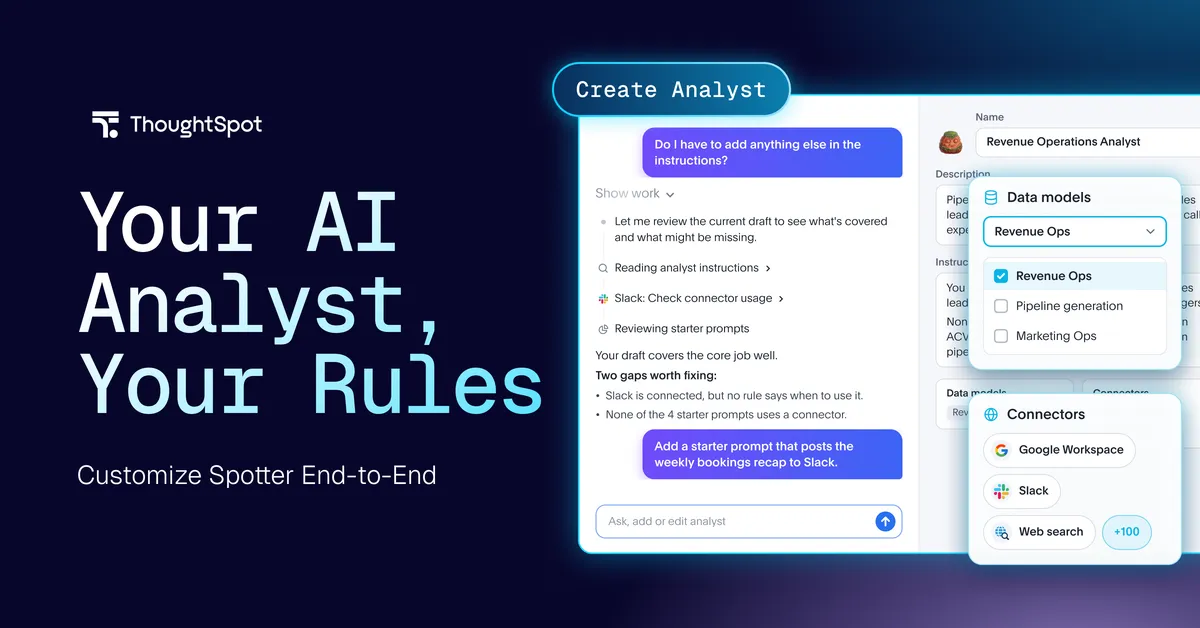
Setup starts in Analyst Builder, where a user describes the job in plain language, for example an analyst that helps sales managers prepare for pipeline reviews. Spotter asks clarifying questions, finds fitting data models and connectors, and drafts instructions into an editable form beside the chat. It only offers models and connectors the user can already access.
Four decisions stay with the builder:
- What it works from: up to five data models.
- What it can reach: only the MCP connectors the builder allows.
- How it works: up to 5,000 characters of instructions on routing, tools, what to ask first and answer shape.
- Who uses it: the people, groups or customers it is shared with or embedded for.
Builders can then test the Analyst with their team's real questions and edit until answers hold. An Analyst can be copied to start a variant and deleted when a project ends.
ThoughtSpot also offers guidance on where business rules belong. Definitions true for anyone who queries the data, such as when the fiscal year starts or how bookings and ARR are calculated, should live in the semantic data model. Rules specific to a job, such as leading with the number and the period it covers, belong in the Analyst. The company warns that otherwise the same definition can end up in several Analysts and drift apart.
Guardrails, sharing and embedding
Guardrails are set in configuration. An Analyst sees only the data models chosen for it and says a question is out of scope if it falls outside them, and it can point the user to a better Analyst. It calls only allowed connectors. Its instructions override org-wide defaults for that Analyst alone, so tuning one function, such as finance, does not break another, such as supply chain.
People an Analyst is shared with can use it and copy it. Editing stays with the creator, admins and holders of the Can manage Spotter privilege. ThoughtSpot states a limit plainly: instructions are natural language read by a model, so they shape behavior but cannot replace access control. Records that must never reach a user should be protected with row- and column-level security, which the company says stays where it is.
Analysts can be shared with users or groups from a directory, and they then appear in those users' library. Sharing also grants view access to the Analyst's data models. For ThoughtSpot Embedded customers, one Analyst can be pinned into an app with SpotterEmbed, and public APIs allow Analysts to be created and managed in code.
Trust, cost and what comes next
ThoughtSpot argues that a narrow scope is the basis of trust: an Analyst answers from fewer, chosen models and follows rules a domain expert wrote down, so answer shapes are consistent. An Analyst can reason across up to five models in one answer and use a connected tool, so a pipeline question can return a number and the latest forecast note from Slack. Every answer shows its work, according to the company, which also cites 82.8% execution accuracy on the public BIRD text-to-SQL benchmark.
Per-Analyst monitoring is planned for a follow-up release. Until then, ThoughtSpot says the testing step is the quality check.
According to the company's FAQ, Spotter Analysts cost nothing extra and are included with Spotter in ThoughtSpot Analytics and ThoughtSpot Embedded. They do not replace Spotter, and users can switch between it and any Analyst shared with them.
ThoughtSpot advises building an Analyst when a question keeps coming back and answering it well depends on how a team works. For open-ended exploration across many models or one-off questions, Spotter remains the better fit. The company suggests starting narrow, with one function and one job that people currently queue behind an expert for.
ThoughtSpot: Build an AI Analyst Your Team, or Your Customers, Can Trust