Waymo Study: Sober Drivers Still Face 3.1 to 3.9 Times Higher Risk at Night
Even if every drunk driver were removed from US roads, sober drivers would still face a nighttime fatal crash risk 3.1 to 3.9 times higher than in daytime, according to new research from Waymo. The company presents two studies that it says show traffic deaths come from compounding factors, not driver behavior alone.
- Waymo says removing alcohol-involved drivers cuts the average urban fatal crash involvement rate by 23%, from 1.42 to 1.10 per 100 million miles.
- Even for fully sober drivers, nighttime fatal crash risk is 3.1 to 3.9 times higher than daytime risk.
- In 37,654 fatal cases from 2023 FARS data, only 8.2% involved strictly human behavior factors alone.
- Waymo estimates autonomous systems could address up to 83% of system failures contributing to passenger-vehicle-involved fatal crashes in the US.
Building a sober driver baseline
Waymo says alcohol impairment contributes directly to over 30% of all traffic deaths in the U.S. The company states it supports efforts to eliminate drunk driving alongside partners such as Mothers Against Drunk Driving (MADD). Its first study, accepted for publication in the Journal of Safety Research, asks how well humans perform when they are completely sober.
National traffic databases do not track vehicle miles traveled (VMT) by a driver's blood alcohol concentration (BAC). Waymo's researchers therefore built an "exposure reconstruction" model. It cross-references toxicological data from the Fatality Analysis Reporting System (FARS) with real-world telematics to estimate miles driven by sober (zero BAC) and impaired drivers across the 50 most populous U.S. urban areas. The company used the figures to set unimpaired driving baselines for each city.
According to Waymo, removing alcohol-involved drivers cuts the average urban fatal crash involvement rate by 23%, from 1.42 to 1.10 incidents per 100 million miles. The effect differs by place: in Houston the fatal crash rate drops by 31%, while in Minneapolis the reduction is 13%. Waymo argues this shows why local human benchmarks matter more than national averages. It also notes that in some places over 2% of nighttime drivers, or 1 out of every 50, are drunk.
Night remains dangerous without alcohol
One hypothesis is that elevated nighttime crash rates stem solely from impaired driving. Waymo's study indicates otherwise: for 100% sober drivers, nighttime fatal crash risk is still 3.1 to 3.9 times higher than daytime risk. The company says this is partly because sober drivers must still react to impaired ones.
It points to other known nighttime factors: reduced visibility, inadequate lighting, driver fatigue, structural speeding layouts, and interaction with other unpredictable road users. In Waymo's view, these create conditions that sobriety alone cannot correct.
MADD CEO Stacey D. Stewart said the work "can fill a major gap in road safety research" and described autonomous technology as a vital tool alongside anti-drunk driving technology built into human-driven vehicles.
Compounding risks in fatal crashes
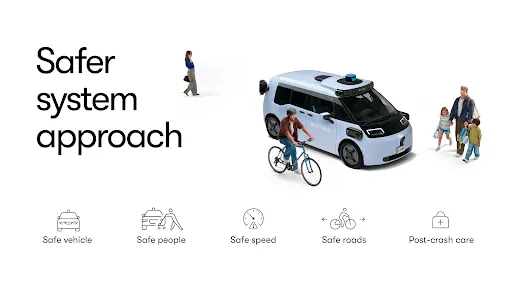
The second study, published by the International Research Council on the Biomechanics of Injury (IRCOBI), uses the U.S. Department of Transportation's Safe System Approach. This framework holds that people will make mistakes while driving, but those mistakes should not cost lives. It relies on layers of protection: Safer People, Safer Vehicles, Safer Speeds, and Safer Roads.
The paper evaluated 37,654 real-world fatal cases from the 2023 FARS database. Impairment, speeding, and seat belt or helmet misuse or nonuse featured heavily. Over 77% of fatal cases involved at least one of the three, and 9.2% involved all three. Only 8.2% of fatal cases involved strictly human behavior factors alone. Most were a convergence of factors, for example an unlit road layout, a large vehicle size mismatch and unexpected high speeds.
What Waymo draws from the findings
Waymo says an idealized human who never drinks, speeds, gets distracted or tires does not exist, so it benchmarks its performance against real-world human driving under actual conditions. The sober baseline adds a further lens: a higher bar against which to judge autonomous vehicles.
The company says it designs the Waymo Driver to respect all elements of the Safe System, with constant 360 vigilance, adherence to posted speed limits, defensive driving, and zero impairment or distraction. Its analysis estimates that autonomous systems could address up to 83% of the system failures contributing to passenger-vehicle-involved fatal crashes across the United States. These are Waymo's own estimates.
Chief Safety Officer Mauricio Pena said fatal crashes typically result from compounding factors "like low visibility, high speeds, and poor road design" that even sober drivers cannot always overcome.
For the wider safety debate, the research suggests that comparing self-driving systems with local, sober human benchmarks may become a stricter test than comparing them with average drivers.