ZTE unveils 800V power and liquid cooling systems for AI data centers
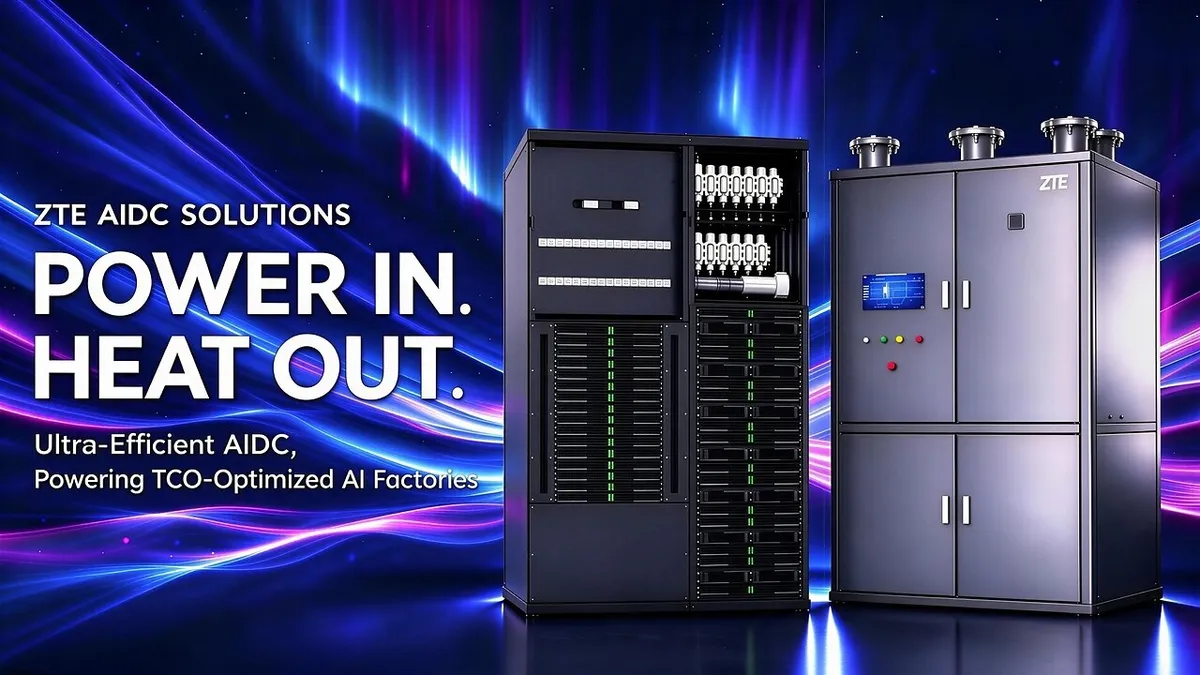
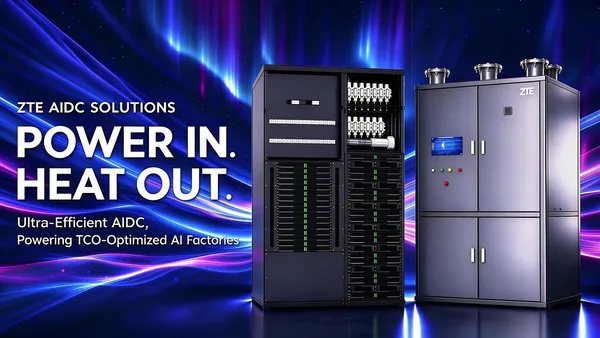
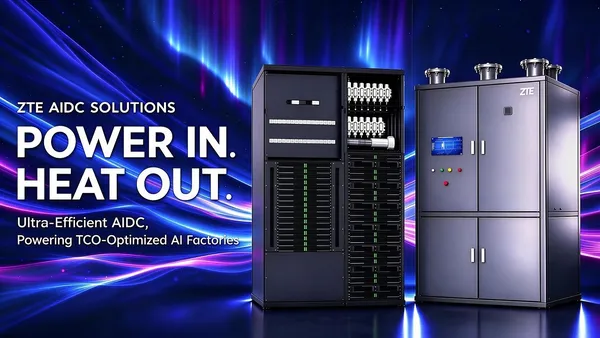
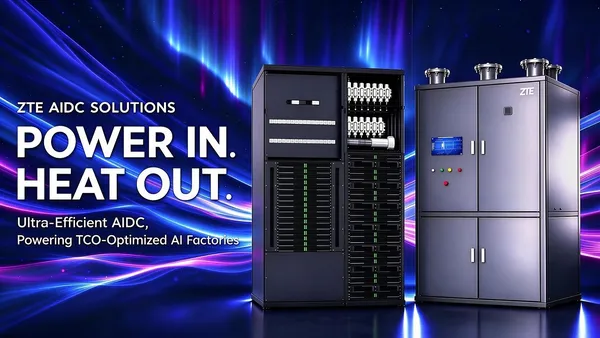
ZTE has presented an infrastructure approach for high-density AI data centers that combines an 800V high-voltage DC power system with a megawatt-scale liquid cooling CDU. The company says the design is intended to reduce energy losses, support dense computing deployments and improve end-to-end efficiency.
- ZTE presented an 800V high-voltage DC power system for high-density AI infrastructure.
- The system supports ±400V and 800V standards and modular capacity expansion.
- ZTE's liquid cooling CDU provides 1.5 MW per unit and can expand to 2.4 MW.
- The company reports a PUE of 1.15 at the Nanjing Binjiang Data Center.
- Karakoram-01 uses liquid cooling and modular power infrastructure for AI computing.
AI data centers are pushing power and cooling limits
According to ZTE, the energy requirements of AI data centers are changing rapidly as GPU clusters are deployed at higher densities. Traditional data centers typically use 10-20 kW per rack, while AI data center loads can exceed 100 kW. High-end intelligent computing scenarios can reach 600 kW or even 1 MW per rack.
The company says conventional power architectures lose significant energy through multiple conversion stages between the transformer and the server. Cooling is another constraint. ZTE puts the technical limit of air cooling at about 20-30 kW per rack, beyond which cooling capacity falls sharply. As a result, the company describes liquid cooling as a conventional solution for maintaining high-value computing systems at full load.
This is shifting competition in AI data centers from computing scale toward computing efficiency, with the power supply limit and the end-to-end conversion of energy into tokens becoming increasingly important factors, ZTE says.
800V DC system targets power conversion losses
ZTE's first response is an 800V high-voltage DC system designed to provide high-density, high-efficiency and reliable power for computing infrastructure. The system includes a DC/DC battery management system, centralized management across the power chain, and visibility and control across the system.
Its monitoring functions include fault recording, temperature measurement at key points and selective protection simulation. Predictive maintenance covers module faults, system faults and battery life, according to ZTE.
The modular design supports two voltage standards, ±400V and 800V, allowing the system to switch between them. Capacity can be expanded as demand grows, which ZTE says can reduce initial investment pressure. The company positions the system for large centralized computing bases and distributed edge computing upgrades, serving operators, internet companies and professional computing-power investors.
Liquid cooling reaches 1.5 MW per unit
ZTE has also introduced a cold-plate liquid cooling CDU designed to manage cooling costs across the equipment lifecycle and maintain cooling safety in technical rooms under different weather conditions. Its cooling capacity is 1.5 MW per unit and can be expanded to 2.4 MW, with flexible configurations of two or five CDU cabinets.
The CDU uses sensors for flow, pressure and temperature. ZTE says it can provide temperature control of ±0.5°C and pressure control of ±0.05 bar. Health indicators and status visualisation support maintenance, while redundant N+X hot backup and dual power supplies are designed to support uninterrupted 7×24-hour operation.
ZTE says the combination of its 800V DC system and 1500 kW liquid cooling CDU can keep power usage effectiveness, or PUE, stable within 1.15. At the Nanjing Binjiang Data Center, an integrated liquid cooling solution reached a power density of up to 60 kW and a PUE of 1.15 after an upgrade and transformation, according to the company.
ZTE also says it and its partners recently launched Karakoram-01, described as Pakistan's first and largest AI-ready data center campus. The site uses cold-plate liquid cooling, prefabricated power modules and intelligent bus ducts to support flexible expansion and continued evolution of AI computing infrastructure.