ZTE targets AI data center efficiency with 800V power and liquid cooling
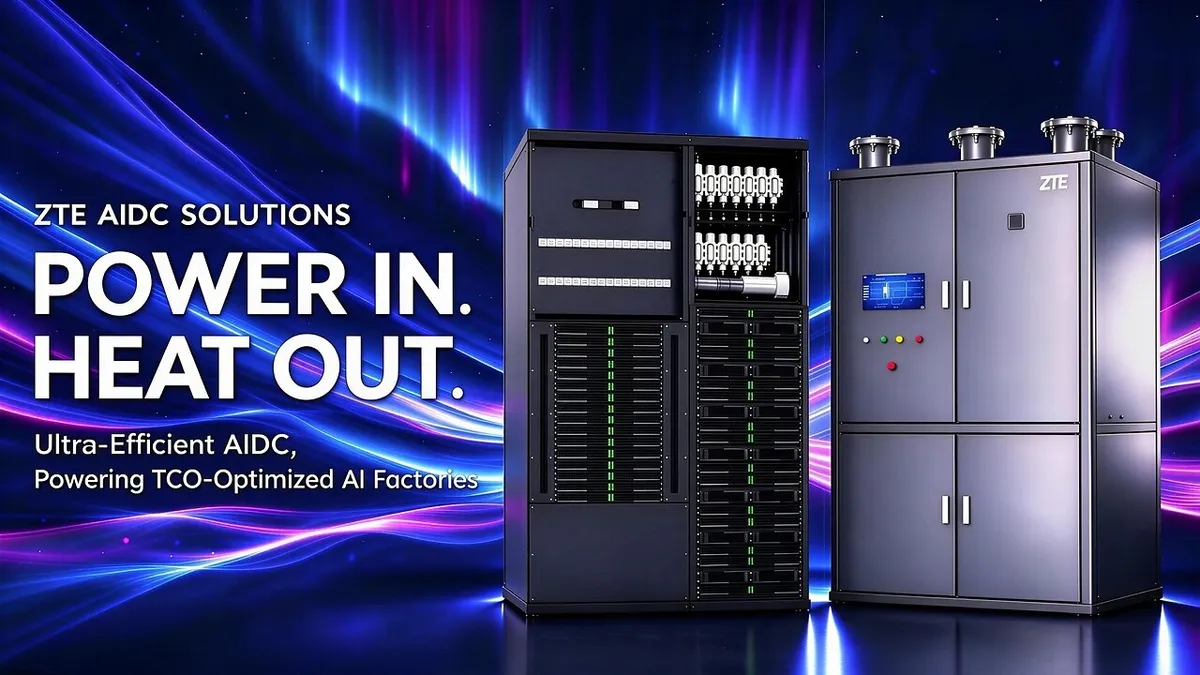
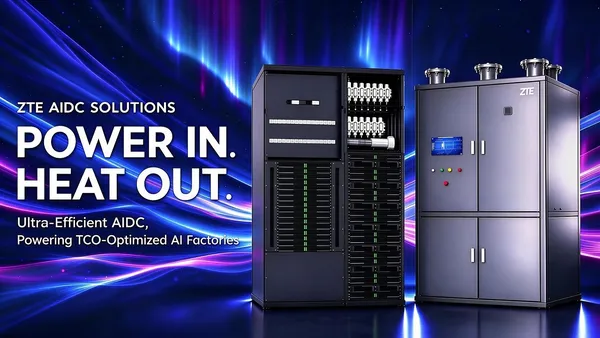
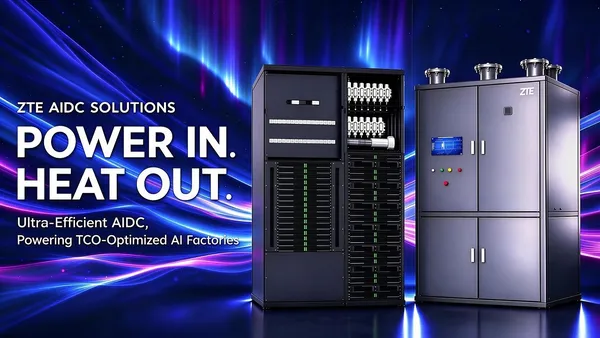
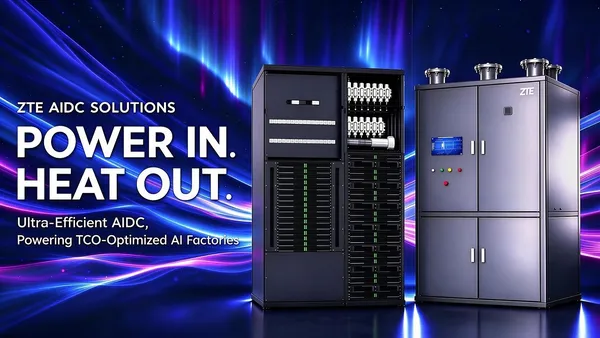
ZTE has outlined an infrastructure strategy for AI data centers that combines 800V high-voltage direct current power with megawatt-scale liquid cooling. The company says the approach is designed to address rising rack power, heat density and energy losses as AI computing expands.
- ZTE is promoting an 800V high-voltage DC system for high-density AI computing.
- Its liquid cooling CDU provides 1.5 MW per unit and can expand to 2.4 MW.
- ZTE says the combined power and cooling approach can keep PUE within 1.15.
- The company is integrating computing, power, cooling and energy storage management.
AI data centers push power and cooling limits
According to ZTE, conventional data center racks typically consume 10-20 kW, while high-density GPU clusters in the AI data center era can exceed 100 kW per rack. Advanced intelligent computing scenarios can reach 600 kW or even 1 MW.
The company says traditional power architectures lose energy across several conversion stages between the transformer and the server. Air cooling is also approaching its technical limit, which ZTE places at around 20-30 kW per rack. Above that level, the company says, liquid cooling becomes a standard solution for maintaining high-performance computing under full load.
ZTE argues that these conditions are shifting competition in AI data centers from raw computing power toward computing efficiency. In its view, the long-term expansion of AI computing depends on both the available energy supply and the efficiency of converting energy into tokens.
800V direct current system targets power losses
ZTE's first response is an 800V high-voltage direct current system. The company describes it as a redesign of the traditional power architecture, using an efficiency-focused topology, intelligent DC/DC battery management and a modular design intended for high-density computing infrastructure.
The system supports both voltage standards, ±400V and 800V, allowing operators to switch between them and move between existing and new deployment scenarios. ZTE says capacity can be expanded as required, helping reduce pressure from the initial investment. The company presents the system as suitable for centralized large-scale computing bases and distributed edge computing upgrades, including deployments by operators, internet companies and professional computing investors.
Management features include fault recording, temperature measurement at key locations and selective protection simulation. ZTE says predictive maintenance covers module faults, system faults and battery lifespan, while the system provides visibility and control across the infrastructure.
Liquid cooling scales to 2.4 MW
To address the thermal side of high-density computing, ZTE has introduced a cold-plate liquid cooling CDU. Each unit has a cooling capacity of 1.5 MW, expandable to 2.4 MW, with configurations using between two and five CDU cabinets.
The CDU uses sensors for flow, pressure and temperature. ZTE says the 1500 kW liquid cooling system can provide temperature control of ±0.5 °C and pressure control of ±0.05 bar. It also includes health indicators, status displays, N+X redundant emergency power and dual power supplies, which the company says support uninterrupted operation around the clock.
ZTE says the combination of 800V high-voltage DC power and 1500 kW liquid cooling creates efficient power delivery and heat removal for AI data centers, keeping PUE stable within 1.15. At Nanjing Binjiang Data Center, an integrated liquid cooling deployment with power density of up to 60 kW reportedly achieved a PUE of 1.15 using high-efficiency HVDC power distribution, busbars, 32°C air supply and group-control optimization.
From separate systems to coordinated infrastructure
ZTE says AI data centers require power, cooling, computing and maintenance to be planned as one system rather than as separate projects. Its proposed architecture coordinates computing capacity, electricity transmission and distribution, and heat removal through dynamic resource matching and coordinated control.
The company describes an intelligent computing center based on the integration of source, grid, load and storage. Its architecture combines 800V high-voltage DC power and full liquid cooling with management and control systems including BESS, iDCIM and iEMS. ZTE says this approach is intended to lower energy consumption, improve efficiency and support greener, lower-carbon development.
The company also says it recently worked with partners to launch Karakoram-01, described as Pakistan's first and largest data center campus built specifically for AI. The site uses cold-plate liquid cooling, prefabricated power modules and smart busbars to support elastic cooling, flexible power expansion and continued evolution of AI computing infrastructure.