CMU Researchers Build Low-Cost Robotic Fingertip That Can Feel Pills and Chips
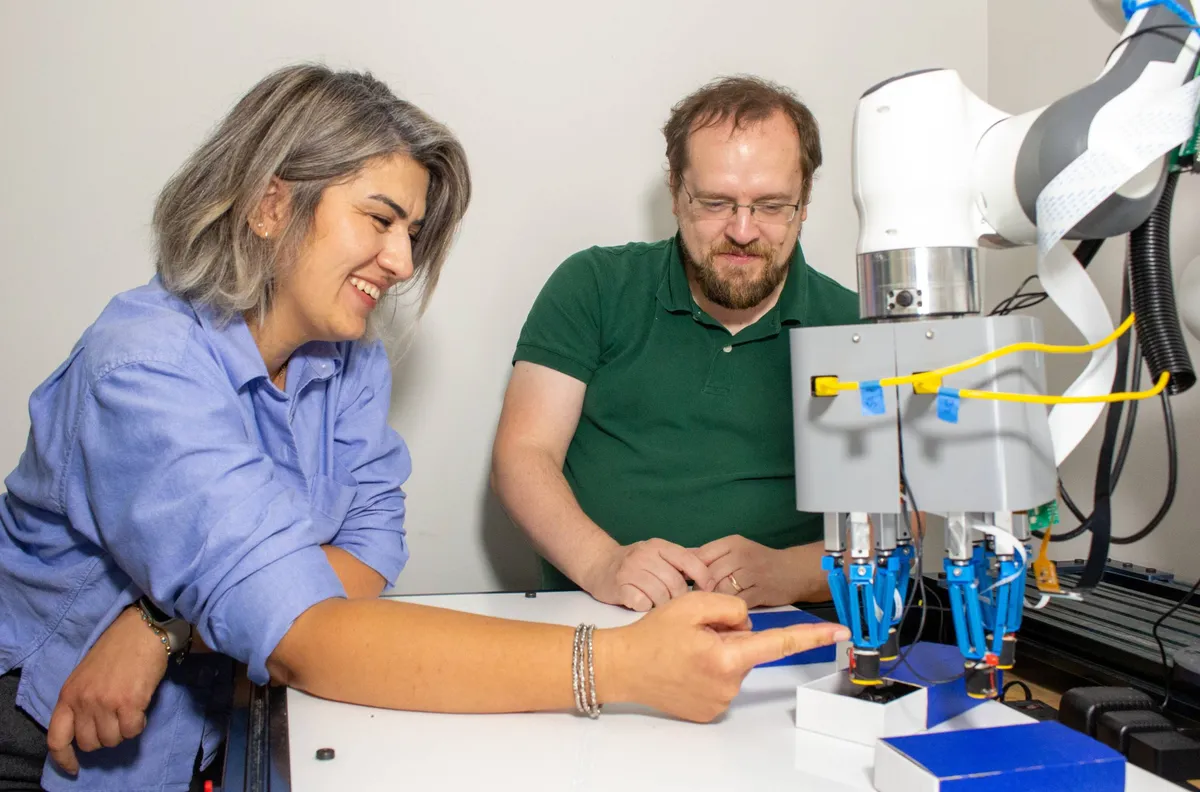
Researchers at Carnegie Mellon University have designed a robotic fingertip that senses both squeezing pressure and microvibrations, letting a robot hand handle small, fragile items such as pills and potato chips. According to the university, each fingertip costs less than $100, compared with $800 for a similar device built from off-the-shelf products.
- CMU researchers built a robotic fingertip that measures squeezing pressure with a strain gauge and captures microvibrations with a microphone behind a plastic fingernail.
- Each fingertip costs less than $100, versus $800 for a similar device made from off-the-shelf products, according to the university.
- The fingertips attach to the team's DeltaHands flexible robotic hand, which can have one to six finger-like devices.
- Tests included counting paper cups, identifying materials by vibration, and grasping tofu cubes and potato chips.
- The team plans to extend sensing from the fingertips to the whole hand.
A fingertip modeled on the human one
The team at the Carnegie Mellon University Kenneth C. Griffin School of Computer Science built the fingertips to combine several senses in one small device. They are inspired by human fingers and include familiar elements, among them a fingernail.
Two sensors do the main work. A strain gauge measures the squeezing pressure the finger applies, so the hand knows exactly how hard it is pinching. A contact microphone sits behind a tiny plastic fingernail and captures high-frequency vibrations as the finger slides over an object or bumps into a surface. The setup is wrapped in a soft silicone skin for grip.
According to the researchers, this lets the robot hear subtle textures, detect slipping and note hidden edges it may catch on.
Built on the DeltaHands project
The fingertips attach directly to DeltaHands, the team's earlier device, which received funding from the National Science Foundation. DeltaHands is a low-cost, highly customizable flexible robotic hand intended for tasks that are typically difficult for a robot, such as turning the pages of a book or grabbing an oddly shaped item. It can have anywhere from one to six finger-like devices, and because many components are 3D printed, it can be modified for specific tasks.
"Dexterity is a frontier area of robotics, and we're making rapid progress," said Oliver Kroemer, an associate professor in the Robotics Institute. "However, fine manipulation is still very much an open challenge, and that's why we wanted to focus on it."
Zhuowei Xu, an alumnus of the College of Engineering who worked on the project during his master's degree in mechanical engineering, said the combination of force and vibration sensing lets the robot interact with objects in different ways depending on the task. Examples he gave include adjusting its grasp when an object starts to slip, locating fine features that are hard to see, and identifying properties of objects hidden from vision.
Tests with cups, fabrics and tofu
The researchers tested the fingertips on three kinds of tasks: counting and unstacking paper cups, detecting the material of items such as coarse fabric or wax paper through micro-vibrations, and grasping fragile items such as tofu cubes and potato chips.
The cup task was designed to test manipulation when vision is blocked. The fingernail, which protects the microphone, slid along the edge of the cups and counted them. In the material task, the microphone picked up differences in microvibrations, and the system learned from those differences to recognize what kind of material it was touching.
What it could mean for home robots
The university says the technology could help a robotic home assistant pick up a specific number of pills, a task that is hard because the objects are tiny and easy to break.
Zeynep Temel, an associate professor in the Robotics Institute, described the kind of help she would want. She said she would like a helper robot "that can hand me the right materials, one that knows the difference between a box of nails and a box of rubber bands or if the rice jar is empty or not."
The work was presented at the 2026 Intelligent Robots and Systems Conference in Pittsburgh. The team plans to keep developing the hand and to explore expanding sensing from the fingertips to the whole device. Zilin Si and Kevin Zhang, both Robotics Institute Ph.D. alumni, were also part of the team.
CMU School of Computer Science: CMU Researchers Give Robots a Delicate Touch