CMU Opens Robotics Labs to Hundreds of IROS 2026 Conference Attendees
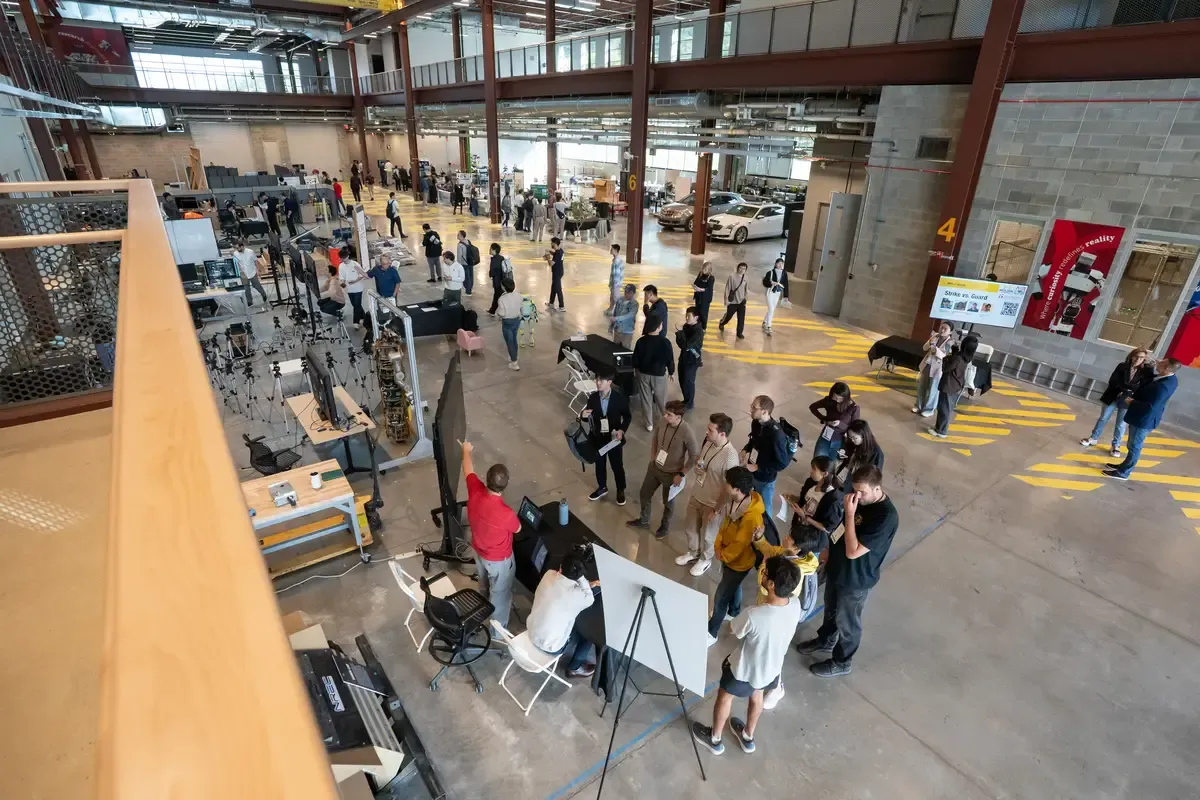
Hundreds of academics and industry leaders in robotics toured Carnegie Mellon University's robotics and engineering facilities on Oct. 1 as part of the International Conference on Intelligent Robots and Systems (IROS) 2026. Visitors saw research inside the Robotics Innovation Center, Mill 19 and the National Robotics Engineering Center (NREC).
- Hundreds of robotics academics and industry leaders toured CMU facilities on Oct. 1 during IROS 2026.
- Tours covered the Robotics Innovation Center, Mill 19 and the National Robotics Engineering Center.
- Exhibits included soft and bio-inspired robots, snake robots, autonomous drones and the student-built 26x car.
- IROS was last held in Pittsburgh in 1995; IROS 2027 will be in Florence, Italy.
Tours fill up fast
According to CMU, space on the tours was limited and spots filled up quickly. George Darakos, chief partnerships officer in the Kenneth C. Griffin School of Computer Science, said the university wanted to showcase robotics work across Carnegie Mellon and Pittsburgh, and to invite the global robotics community into its facilities.
Displays gave visitors close access to teams rooted in CMU, including the Future Interfaces Group, the Biorobotics Lab and the CMU spin-out FuturHand Robotics. One exhibit was the Amazon Fauna Sprout, a compact robot that navigates space using technology from the lab of Associate Research Professor Kris Kitani.
Kitani, who is in the Robotics Institute and co-directs the Extended Reality Technology Center, said the event showed the interdisciplinary nature of robotics. "As a lot of these AI and robot technologies become more and more practical, more and more used, it's really important to bring in diverse technologies to make one whole system," he said.
Bio-inspired robots and smart devices
Bio-inspired machines drew much of the attention. Carmel Majidi, the Clarence H. Adamson Professor of Mechanical Engineering and head of the Soft Machines Lab, showed starfish- and fossil-inspired robots and artificial hands for sensitive tactile scenarios. He also held up a motorless starfish-inspired robot.
Majidi said his group has spent years developing new material architectures for robotic systems. "We're now at the point where we need to find breakthrough applications of these technologies," he said, adding that the team feels ready to start deploying these systems in the real world.
Howie Choset, the Kaνčić-Moura Professor of Computer Science in the Robotics Institute and general chair of the IROS organizing committee, showed his Biorobotics Lab's creations. They included snake robots for underwater navigation and a terrestrial snake robot of the kind he used in rescue operations after earthquakes in Venezuela. A demonstration of an aquatic snake robot took place in the Robotics Innovation Center's water tank.
Alexandra Ion, an assistant professor in the Human-Computer Interaction Institute, presented work from her Interactive Structures Lab, which covers proactive robotic objects and unpowered wearable exoskeletons. She describes her approach as unobtrusive intelligence. Robots that understand human preferences, infer user intent and assist dynamically, she said, promise to add tremendous value to our lives.
The Robotics Institute's AirLab showed autonomous drones performing complex spatial navigation tasks in real time, including navigating around one another.
Student-built autonomous car
Undergraduates also took part. Carnegie Mellon Racing presented 26x, which CMU describes as the first student-built autonomous car that allows both driverless and human-driven control. According to CMU, each year's car represents the work of thousands of students from all seven of its schools and colleges.
Arya Lohia, a third-year engineering student and lead for the team's Autonomous Division, said undergraduates spend 30 hours a week on classes and can spend 40 hours a week on projects like this. Speaking to visitors, he said, was "a massive, massive opportunity."
Pittsburgh's place in robotics
IROS is among the premier robotics conferences, and researchers from around the world came to present and learn about the latest in the field. The conference was last held in Pittsburgh in 1995. CMU says the 2026 edition reinforces the city's status as a leader in dynamic physical systems.
Jeff Legault, associate director at NREC, which hosted a significant portion of the tours, said such conferences further cement Pittsburgh as "a global hub for robotics with a vibrant and growing ecosystem of start-ups, research centers and talent."
IROS 2027 will take place in Florence, Italy, and CMU says it will keep a strong presence there. The university also pointed to a recently announced $3 billion gift from Citadel founder and CEO Ken Griffin, intended to elevate CMU in Pittsburgh and launch Carnegie Mellon University Miami.
CMU School of Computer Science: CMU Robotics Expertise and Facilities Attract IROS 2026 Conference Attendees