EPFL to launch Bachelor’s degree in Artificial Intelligence in 2027
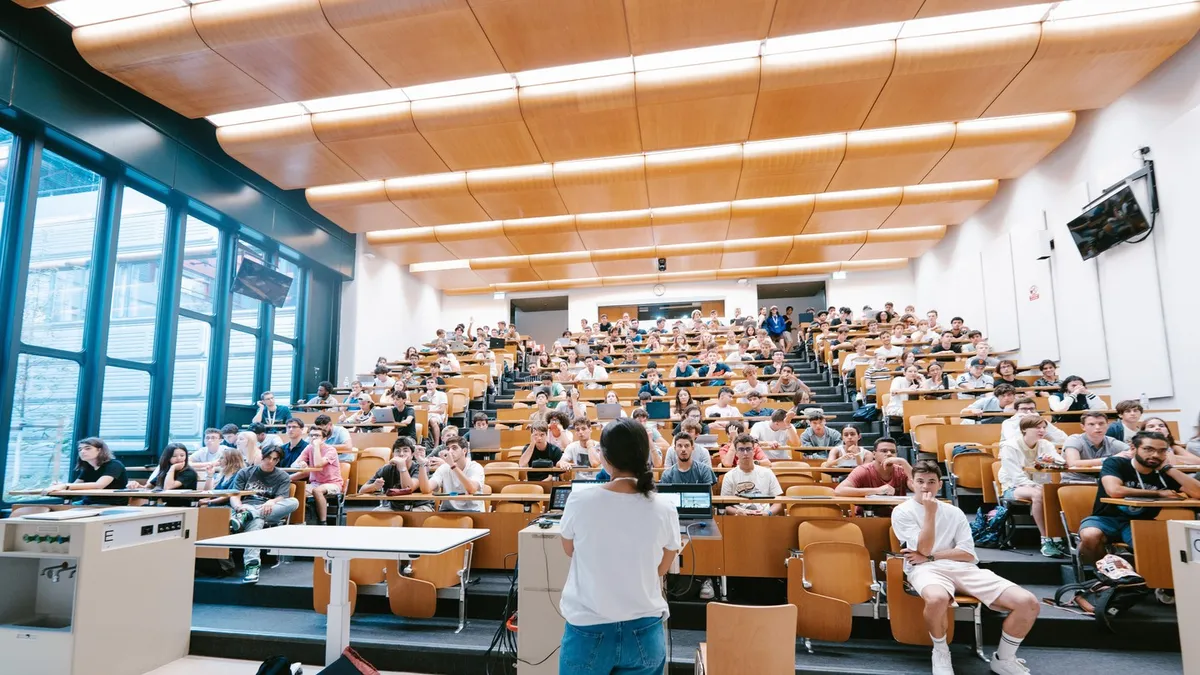
EPFL will introduce a Bachelor degree in Artificial Intelligence in the 2027, 2028 academic year, giving students a foundation in mathematics and computing alongside practical projects and training in AI ethics. The program will welcome its first students in that academic year.
- EPFL will launch the Bachelor in Artificial Intelligence in the 2027, 2028 academic year.
- The program will share its first year with Computer Science before adopting a distinct curriculum.
- Students will study mathematics, computing, AI theory, life sciences and robotics.
- A mandatory AI Ethics and Policy course will cover fairness and accountability.
- First-year programming will be taught in French, while later courses will be taught in English.
A shared first year, followed by specialist study
The School of Computer and Communication Sciences, known as IC, is developing the new degree around the mathematical and computational foundations of artificial intelligence. Students will study the models, algorithms and computing systems needed to understand AI, develop intelligent systems and assess their effects on society.
The Artificial Intelligence and Computer Science bachelor’s programs will share a common first year. That year will provide a foundation in mathematics and computing before the programs move to distinct curricula from the second year onward. Both degrees will combine theoretical study with substantial hands-on projects.
“Our goal is to educate students who can do more than apply existing AI technologies. We want them to understand the scientific principles behind these technologies and acquire the knowledge needed to develop new ones,” said Haitham Al Hassanieh, professor at IC and director of the new program. He added that the curriculum would require rigorous education in mathematics and computing, with EPFL working closely with its Institute of Mathematics.
AI across disciplines
The curriculum is designed to reflect AI’s connections with other areas of science and engineering. EPFL’s IC School is developing orientations that will allow students to devote a substantial part of their elective coursework to areas including AI theory, life sciences and robotics.
These options are intended to give students in-depth exposure to the disciplines connected to AI, rather than treating artificial intelligence as a standalone technical tool. “For instance, studying AI in the context of robotics should mean learning about mechanics and control systems, not just applying machine learning to robots,” said Katerina Argyraki, Vice-Dean of Education at EPFL’s School of Computer and Communication Sciences.
Artificial intelligence is increasingly used across scientific and engineering fields, including the discovery of new medical treatments and the modeling of the Earth’s climate. EPFL said the program responds to the need for scientists and engineers who understand both how to use AI and the principles behind it.
Ethics and language arrangements
A mandatory course in AI Ethics and Policy will address fairness, accountability and the broader societal consequences of AI technologies. EPFL said this focus reflects the growing role of AI systems in decisions involving healthcare, employment and public services.
Nicolas Grandjean, Vice President for Education at EPFL, said the institution has a role in preparing talent and expertise needed by Switzerland. EPFL is also developing minors in AI and exploring a cross-disciplinary course on its use, including in sustainability, the energy transition and healthcare innovation.
During the first year, programming courses will be taught in French. Students will be able to choose French or English for mathematics and physics courses, while all courses in the second and third years will be taught in English. The program’s emphasis on durable knowledge is intended to help students understand and shape AI technologies as they change.
EPFL News: EPFL introduces a new Bachelor in Artificial Intelligence