Krea Nodes goes multiplayer: teams can build AI workflows live
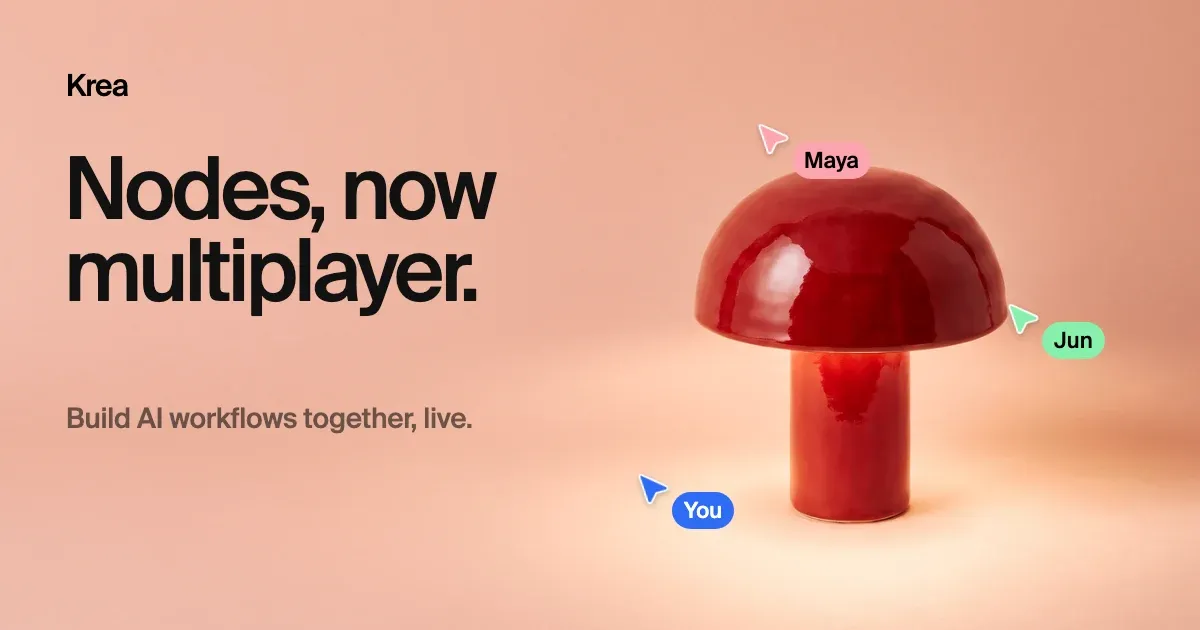
Krea has made its node-based workflow editor multiplayer, so several people can edit and run the same Nodes project at once. According to the company, changes appear on every screen as they happen, but live co-editing is only available on Krea Enterprise.
- Krea Nodes now supports real-time collaboration with live co-editing, cursors and shared runs.
- Undo and redo only affect a user's own changes.
- View sharing is on every plan; edit sharing and live presence require Krea Enterprise.
- The person who starts a run is billed for it in their active workspace.
- Krea's Agent and MCP clients edit shared projects through the same operations as people.
What Multiplayer Nodes does
A Krea Nodes project is a graph of image, video and text nodes linked by edges, where each node's output feeds the next. Until now, the Krea Team says, sharing a workflow meant sending a link, waiting for feedback and then making the changes yourself. With the update, several collaborators can work on the same canvas together.
- Live co-editing: moving nodes, connecting edges, changing prompts, swapping models and adding sticky notes sync to everyone in the project.
- Live presence: each collaborator gets a color, and others can see their cursor, selected nodes and selection box.
- Shared runs: when someone runs a node or chain, everyone sees it go from queued to running to done, and outputs appear on every screen.
- Personal undo: undo and redo only affect your own changes, so pressing ⌘Z does not erase a teammate's work.
Krea illustrates this with a campaign for a glossy red ceramic mushroom lamp, where one person adds a product shot and moodboard while others build scene variations such as a bedroom at blue hour, a desert at golden hour and a swimming pool.
Sharing, permissions and conflicts
The Share dialog offers three levels of general access, plus individual invites. Private limits access to invited people. Workspace opens the project to everyone in the active workspace, with the owner choosing whether members can view or edit. A public link lets anyone with the link view the project. Individual invites can be set to Can view or Can edit, and edit access applies only within the project's own workspace. If a person has both a personal grant and workspace access, the higher level applies.
Viewers see the nodes, their connections and the inputs, but not generated outputs or run history, and they cannot run anything. They can duplicate the project to make their own copy, which Krea suggests makes a public link useful for reusable workflow templates.
When two people change different things, both changes go through. If they edit the same field, the last edit wins. Krea says live cursors make this rare. Nodes also keeps version snapshots, at most one every five minutes and for five days, which can be previewed and restored.
Runs, credits and the Agent
Anyone with edit access can run nodes. Each run is visible to all project members, and finished outputs are saved to the node's history for all editors. Whoever starts a run pays for it, billed in their active workspace. When someone starts a chain, their tab submits each next step, and the chain keeps running if they switch tabs.
Krea's Agent and MCP clients edit Nodes projects through the same operations as people do. When the Agent adds a step or rewires a graph, its changes sync to everyone on the canvas like a teammate's would.
Who can use it
View sharing, covering workspace view, person view and public links, is available on every plan. Edit sharing and live presence, meaning co-editing, live cursors and shared runs between collaborators, are available on Krea Enterprise. Edit grants work while the active workspace is on Enterprise. If a workspace leaves Enterprise, its edit grants act as view grants and return if it rejoins.
Krea names several use cases: agencies sharing a view link for client review before building the final pass live, studio teams splitting a large pipeline and building in parallel, workshops where students duplicate a public workflow, and publishing templates as public links. For teams that want real-time editing, the feature sits behind an Enterprise plan, while free sharing of read-only workflows is open to all.